What Is A Resume Headline: Best Examples & Tips
Discover what is a resume headline, why it's crucial for ATS, and how to write a perfect one. Get expert examples for your 2026 job search!
TL;DR: A resume headline is a short, punchy phrase at the top of your resume that tells a recruiter exactly who you are and what you do, like a title for your career. Keep it to 7 to 10 words, place it directly below your name, and tailor it to the exact role because recruiters search ATS databases by job title and skills, and a targeted headline can lift callbacks 3.5 times when matched well to the posting.
You’re probably staring at your resume right now thinking one of two things: either “Do I really need one more section?” or “Why does my resume feel fine but still not get replies?” Fair question.
For a lot of STARs, that top part of the resume is where things go sideways. Bootcamp grads undersell their projects. Veterans lead with a military title that civilian recruiters don’t search for. Tradespeople bury licenses and certifications halfway down the page like they’re trying to keep a secret. Meanwhile, the recruiter is skimming fast, the ATS is scanning even faster, and your best stuff is hiding in paragraph three.
A strong headline fixes that. It’s the little line doing a very big job.
Table of Contents
- Your Resume Gets 7 Seconds Make Them Count
- What a Resume Headline Is and What It Is Not
- The Formula for a High-Impact Resume Headline
- Headline Examples for Skills-First Careers
- Common Headline Mistakes That Get You Ghosted
- Your Headline Is Your First Impression Make It a Great One
Your Resume Gets 7 Seconds Make Them Count
A recruiter opens your resume. They glance at your name, your top line, maybe your most recent role, then they move on. That’s the actual-world moment your resume has to survive.
A lot of candidates treat the top of the page like dead space. Name. Contact info. Maybe a bland summary that says “hardworking professional seeking opportunity.” That kind of line doesn’t help a recruiter sort you, and it definitely doesn’t help a candidate without a traditional degree stand out fast.
The resume headline is the part that acts like your billboard. Not your autobiography. Not your life story. Just the clearest possible signal of what role you fit and why someone should keep reading.
Think about three candidates applying for the same job:
- Candidate one writes “Motivated professional seeking growth”
- Candidate two writes “IT Support Specialist”
- Candidate three writes “IT Support Specialist | Google IT Cert | Ticketing & Troubleshooting”
Only one of those gives instant direction.
A good headline saves the reader from having to guess what kind of candidate you are.
That matters even more for people coming from nontraditional paths. If your credibility comes from a bootcamp, military training, an apprenticeship, licenses, or project work, you can’t assume the recruiter will connect the dots for you. You have to connect them at the top.
That’s why I push candidates to think of their headline as the shortest sales pitch on the page. It tells the reader, “Here’s the lane I’m in.” Then the rest of the resume proves it.
If you want more practical job search advice built for skills-first candidates, the HiredBySkill blog is a solid place to keep learning without the usual degree-heavy nonsense.
What a Resume Headline Is and What It Is Not
The simple definition
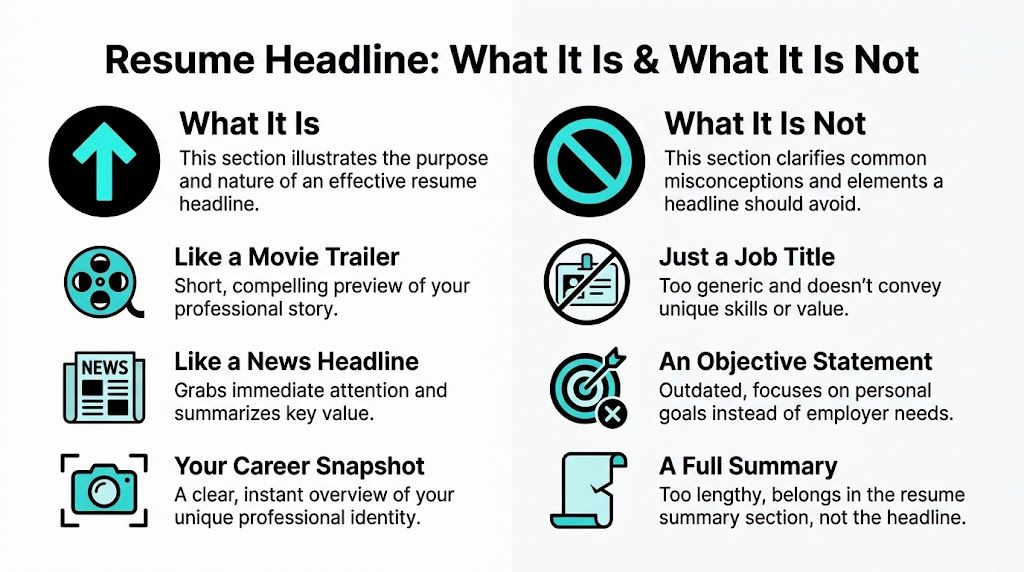
A resume headline is a concise, one-line statement placed directly below your name. It usually runs 7 to 10 words and answers one question fast: “Is this person the right job title with the right skills?” That placement matters because ATS systems weigh content near the top of the document more heavily, and recruiters often search databases by exact title and skills. According to ResumeOptimizerPro’s resume headline guide, 55% of recruiters search by exact job title, 76% search by skills, and a targeted headline can boost callback rates 3.5 times.
That’s the plain-English answer to what is a resume headline. It’s a label with teeth.
It works like a movie trailer. A trailer doesn’t explain every scene. It gives you the hook. Your headline should do the same thing. Fast role match. Fast credibility. Fast reason to continue.
Headline vs summary vs objective
Often, people get tangled up. These terms sound similar, but they do different jobs.
| Resume element | What it does | What it should sound like |
|---|---|---|
| Headline | Declares your professional identity | “Cybersecurity Analyst | CompTIA Security+ | Threat Monitoring” |
| Summary | Gives context and tells the bigger story | A short paragraph about your background, skills, and fit |
| Objective | States what you want | “Seeking a challenging role...” |
The headline is the billboard. The summary is the guided tour. The objective is usually old-fashioned and focused on you instead of the employer.
If your resume opens with “Seeking an opportunity to grow my skills,” you’ve used valuable space to say almost nothing. Recruiters already know you want a job. You applied.
A headline should declare, not ask. It should identify, not explain.
Here’s the easiest way to tell if you’ve written a headline or something else:
- If it sounds like a request, it’s probably an objective.
- If it sounds like a paragraph chopped in half, it’s probably a summary.
- If it immediately tells someone your target role plus a top qualifier, that’s a headline.
Practical rule: if your line can fit on one clean line and instantly tell a stranger what role you fit, you’re on the right track.
For candidates using AI tools to tighten language without turning their resume into mush, these AI resume tips from HiredBySkill can help you edit the line without losing your actual voice.
The Formula for a High-Impact Resume Headline
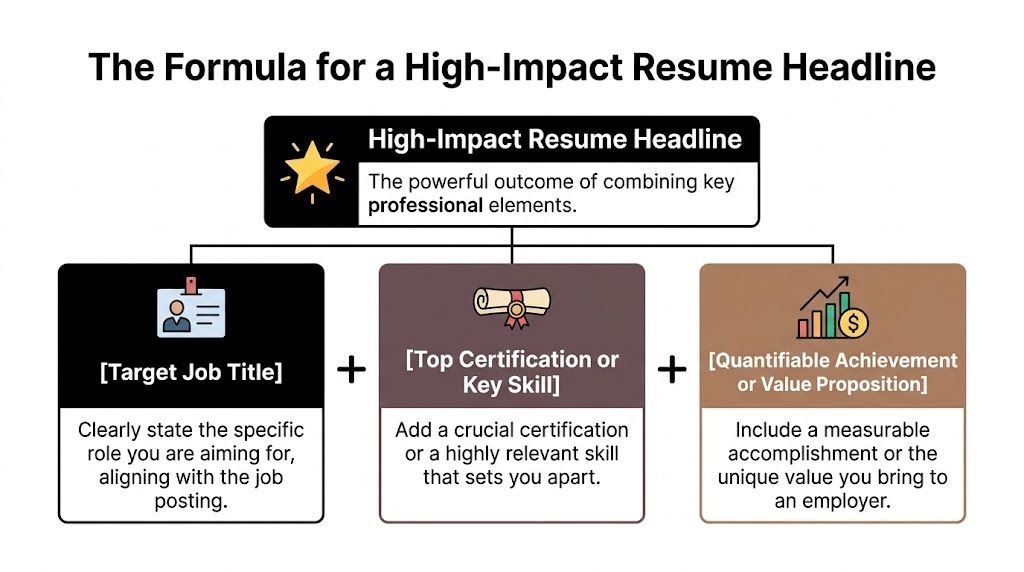
There’s a simple formula that works far better than trying to sound impressive:
[Target Job Title] + [Top Certification or Key Skill] + [Quantifiable Achievement or Value Proposition]
That formula is especially useful for STARs because it lets you lead with what employers can verify right now. Not the degree you don’t have. Not a vague personality trait. Proof.
A visual helps here.
Start with the exact target job title
This part matters more than people think. Don’t get creative with the title. Mirror the one in the posting when it honestly matches your background.
If the posting says Help Desk Technician, don’t write Tech Problem Solver. If the posting says Junior Data Analyst, don’t write Data Enthusiast.
ATS systems love literal matches. Human recruiters do too, because exact titles reduce friction. Your headline should make them think, “Yes, this is one of the people I need to review.”
For career changers, this can feel weird. You might think, “But I haven’t officially held that title yet.” That’s okay if the title reflects the role you’re targeting and the rest of your resume supports it. A bootcamp grad can absolutely use Frontend Developer if the projects, tools, and skills back it up.
Add the proof that makes you believable
Here, STARs win.
If you don’t have a degree-heavy background, your proof usually comes from one of these:
- A certification like CompTIA Security+, AWS, OSHA, EPA, or Google IT Support
- A key technical skill like Python, SQL, React, HVAC diagnostics, CAD, or EMR systems
- A specific achievement from a project, deployment, apprenticeship, military assignment, or customer-facing role
Resume headlines with quantifiable achievements get 30 to 40% higher engagement, and eye-tracking research referenced by The Interview Guys’ resume headline examples found that metrics increase read-through by 61% because numbers signal value fast. The same source notes skills-based candidates see 2.5x better odds in skills-first hiring markets when their value is easy to scan.
That doesn’t mean you should jam random numbers into the line. It means if you have a real, relevant metric, use it.
Examples:
- Frontend Developer | React | Built Portfolio Projects
- Logistics Coordinator | Military Operations | Supply Chain Support
- HVAC Technician | EPA Certified | Energy Efficiency Projects
Some people won’t have a clean metric yet. That’s fine. Use a cert or skill instead of forcing fake precision.
A useful gut check: if the proof sounds like something a hiring manager could verify in an interview, it belongs. If it sounds like fluff, cut it.
Here’s a short walkthrough if you want another explanation in video form.
Keep it tight and test it
A headline loses punch when it becomes a sentence. You’re writing a sign, not a cover letter.
Try these rules:
- Keep it to one line. If it wraps, trim it.
- Use separators sparingly. The vertical bar works well because it breaks information cleanly.
- Cut filler words. “Motivated,” “dynamic,” and “results-driven” usually add fog, not meaning.
- Tailor the title for each application. This is the part worth changing every time.
Your headline should be readable in one breath.
If you want help drafting a first version, these tips for using ChatGPT in your job search are useful for brainstorming variations. Just make sure you edit the result back into your own language.
Headline Examples for Skills-First Careers
Generic examples aren’t enough here. A veteran moving into cybersecurity has different needs than an HVAC tech going after supervisory work. A bootcamp grad has different proof than a warehouse lead.
The trick is always the same. Use the target title first. Then add the strongest signal you have.
Tech bootcamp graduates
The biggest mistake bootcamp grads make is leading with “Recent graduate” instead of the role they want. That instantly shrinks how the recruiter sees them.
Bad:
- Recent Bootcamp Graduate
- Junior Tech Professional
- Motivated Software Candidate
Better:
- Frontend Developer | React | JavaScript Projects
- Junior Data Analyst | SQL | Dashboard Projects
- QA Analyst | Test Cases | Bug Tracking
Great:
- Frontend Developer | React | Built User-Focused Web Apps
- Data Analyst | SQL & Excel | Reporting Project Experience
- Cybersecurity Analyst | CompTIA Security+ | SOC Training
If you have a recognized certification, use it high. For STARs, credentials can do the heavy lifting a degree would otherwise do.
Military veterans moving into civilian roles
Veterans often undersell themselves by using military-only terms that civilian employers won’t search. The goal is translation, not erasing your background.
Bad:
- Former NCO Seeking Civilian Role
- Military Professional
- Veteran With Leadership Experience
Better:
- Project Coordinator | Military Logistics | Team Leadership
- Cybersecurity Analyst | Military Intel | Security Operations
- Operations Supervisor | Veteran | Process Improvement
Great:
- Cybersecurity Analyst | CompTIA Security+ | 5 Years Military Intel
- Project Manager | Veteran Leader | Logistics Operations
- Supply Chain Coordinator | Military Logistics | Cross-Functional Support
One verified example is especially strong here. According to Jobscan’s resume headline guide, a headline like “Cybersecurity Analyst | CompTIA Security+ | 5 Years Military Intel” passes ATS screens 85% faster than generic profiles and leads to a 2.1x callback uplift for degree-optional roles. That finding is especially relevant for veterans and other STARs because it shows how much better certification-led positioning works than generic self-description.
Skilled trades professionals
Trades resumes often have the opposite problem. The candidate has excellent real-world value, but the top line only says something broad like “Experienced Technician.”
That wastes strong proof like licenses, safety credentials, equipment specialization, or efficiency work.
Bad:
- Experienced HVAC Professional
- Skilled Electrician
- Maintenance Worker
Better:
- HVAC Technician | EPA Certified | System Diagnostics
- Electrician | Licensed | Commercial Installations
- Maintenance Technician | Preventive Maintenance | Repairs
Great:
- HVAC Technician | EPA Certified | Energy Efficiency Projects
- Licensed Electrician | Commercial Systems | Troubleshooting Expert
- Maintenance Technician | Equipment Repair | Facility Operations
A trade resume headline should feel solid and practical. Less “branding statement,” more “this is the work I do.”
Here’s a swipeable template table you can use.
| Career Path | Headline Template | Example |
|---|---|---|
| Bootcamp graduate | Target role + core tool + project proof | Frontend Developer | React | Portfolio Web Apps |
| Veteran | Civilian target role + cert or military function + transferable value | Project Manager | Veteran Leader | Logistics Operations |
| Cybersecurity career changer | Target role + security cert + relevant background | Cybersecurity Analyst | CompTIA Security+ | Military Intel |
| Trades professional | Licensed role + certification or specialization + work focus | HVAC Technician | EPA Certified | System Diagnostics |
| Healthcare support | Target role + credential + core patient or admin skill | Medical Assistant | Certified | EHR and Patient Intake |
| Logistics worker | Target role + operations skill + process value | Logistics Coordinator | Inventory Control | Shipping Operations |
If you’re exploring degree-optional paths across industries, the no-degree jobs board at HiredBySkill is useful for spotting the exact job titles employers use. That makes headline tailoring much easier.
Common Headline Mistakes That Get You Ghosted
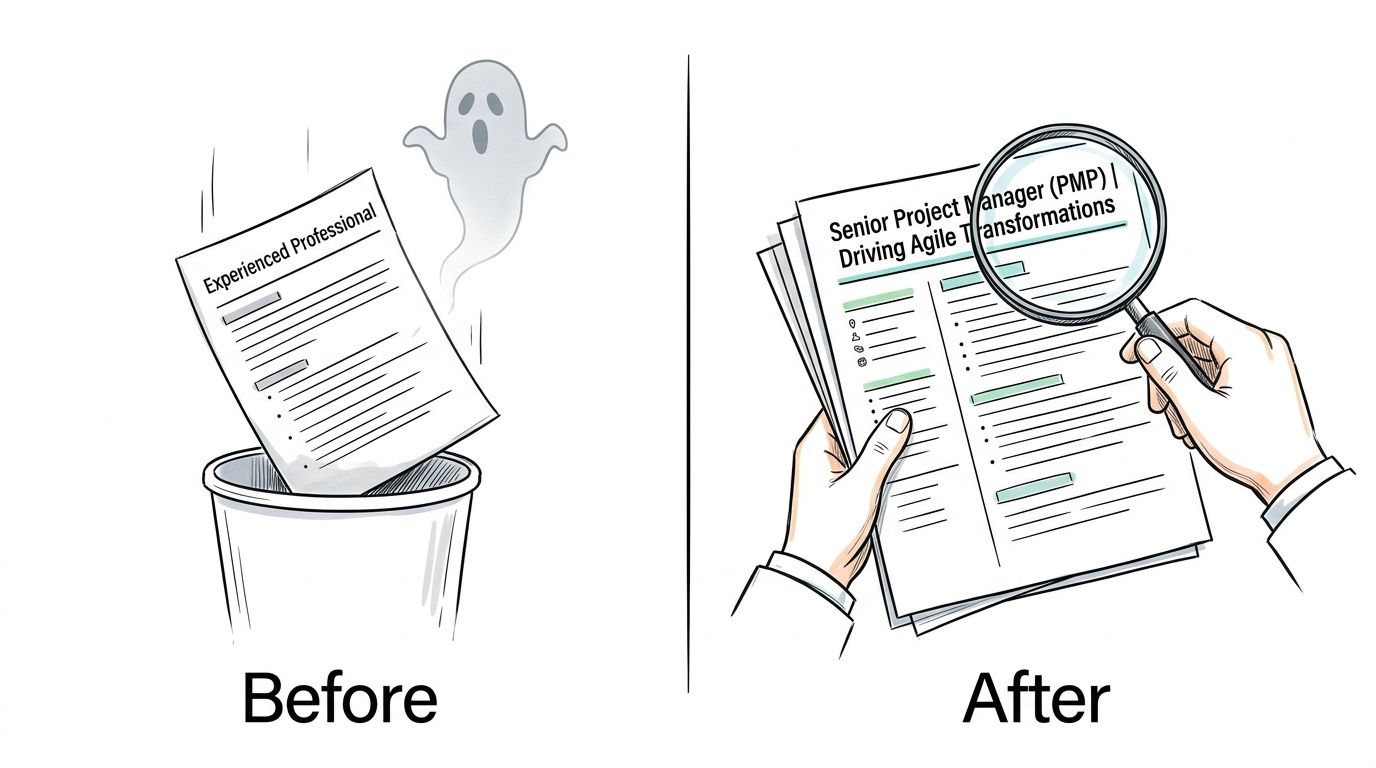
Weak headlines usually fail for one of three reasons. They’re vague, overloaded, or written like a request instead of a value signal.
Too vague to mean anything
These are the classics:
- Results-oriented team player
- Hardworking professional
- Motivated self-starter
None of those tell the reader what job you do.
Before: Results-Oriented Team Player
After: Help Desk Technician | Google IT Cert | Troubleshooting Support
The fix is simple. Replace personality claims with role-specific proof.
Too stuffed to scan
Some candidates hear “use keywords” and turn the headline into a keyword burrito.
Before: Data Analyst SQL Python Tableau Excel Power BI Reporting Data Cleaning
After: Data Analyst | SQL & Tableau | Reporting Projects
The second version is cleaner and easier for both humans and software to process.
If your headline feels like you emptied your entire skills section into one line, it’s doing too much.
Too passive to sell you
Anything that starts with “seeking,” “looking for,” or “hoping to obtain” weakens the line.
Before: Seeking a challenging role as a cybersecurity professional
After: Cybersecurity Analyst | CompTIA Security+ | Threat Monitoring
A headline isn’t a wish. It’s a professional label.
Here are a few quick repairs that work well:
Just a title
- Before: Electrician
- After: Licensed Electrician | Commercial Installations
Too fluffy
- Before: Dynamic leader with strong communication skills
- After: Operations Supervisor | Team Leadership | Process Improvement
Too long
- Before: Recent self-taught developer with strong passion for creating creative software solutions
- After: Junior Software Developer | Python | App Projects
If you want to test different headline versions inside a resume format that stays clean, the HiredBySkill resume builder makes quick edits easier than fighting with Word margins for an hour.
Your Headline Is Your First Impression Make It a Great One
A resume headline looks small, but it punches above its weight. It tells the recruiter what lane you belong in before they read a single bullet point. For STARs, that matters even more because you often need your skills, certifications, and transferable experience to speak first.
The best headlines are specific. They use the exact target title. They include one strong qualifier. They sound confident without sounding stuffed or fake.
If you remember nothing else, remember this:
- Lead with the role you want
- Add proof that fits the job
- Keep it short enough to scan instantly
- Tailor it every time
That’s the whole game. Not magic. Just smart packaging.
A lot of resumes don’t fail because the candidate lacks value. They fail because the value shows up too late. Fix the top line, and the rest of the resume gets a fair shot.
If you’re ready to put this into action, build or update your resume on HiredBySkill. It’s built for skills-first candidates, degree-optional roles, and the kind of job search where certifications, projects, military experience, and hands-on ability should carry real weight.