Affiliations on a Resume: The Skills-First Guide
Learn how to use affiliations on a resume to showcase your skills. This guide covers choosing, formatting, and examples for bootcamp grads, vets, and trades.
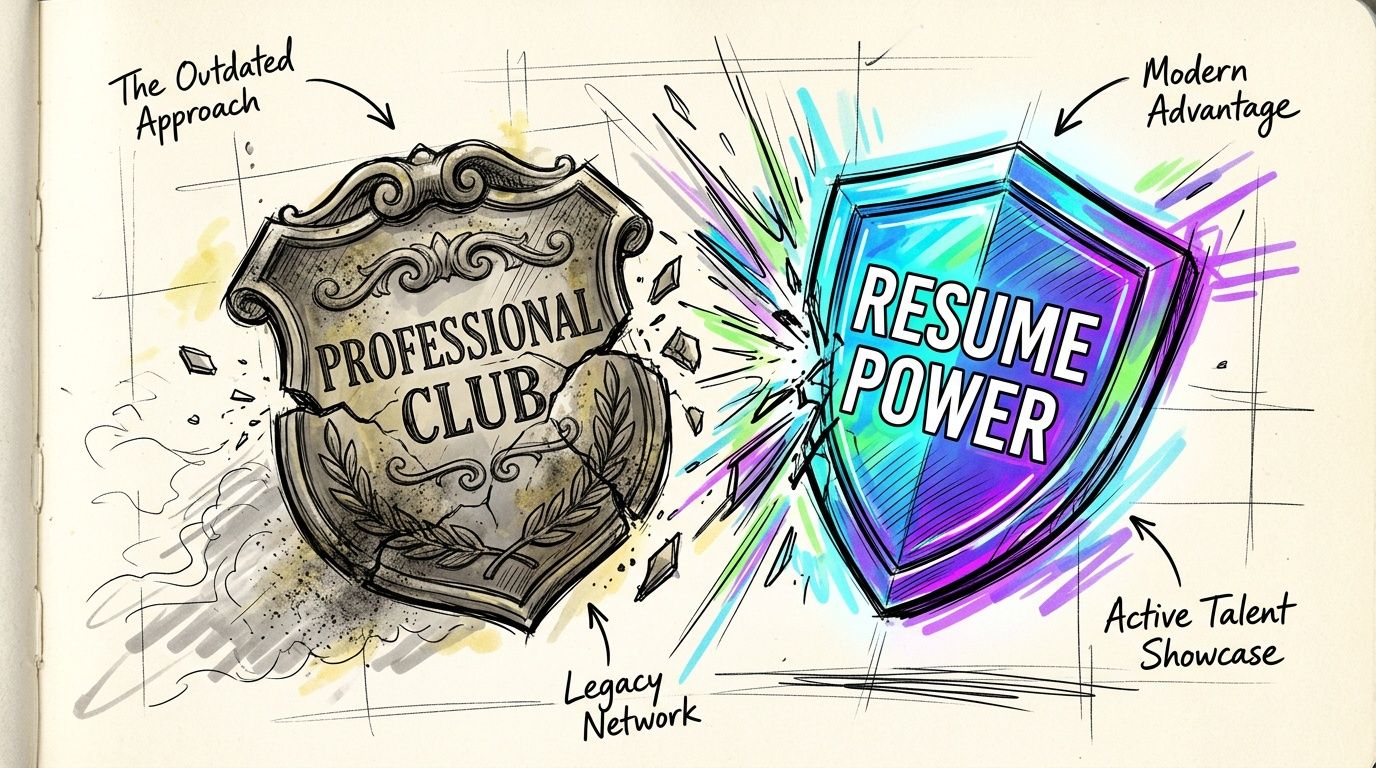
Most advice about affiliations on a resume is stuck in another era. It acts like the only things that count are alumni associations, formal trade bodies, and the kind of memberships people frame on an office wall.
That’s outdated. If you’re a STAR, skilled through alternative routes, your best affiliations might be a bootcamp community, a military network, an apprenticeship group, an open-source project, or an industry meetup where you contribute. Those signals matter because they prove you’re in the work, not just around it.
The smart move is to treat affiliations as evidence. They can show skill, relevance, network access, and follow-through in one line. If you’ve built a career without a degree, that’s exactly what your resume needs. And if you’re still figuring out your best-fit path, a quick career quiz for skills-first roles can help you aim these signals at the right jobs.
Table of Contents
- Why Resume Affiliations Are Your New Secret Weapon
- Decoding What Actually Counts as an Affiliation in 2026
- How to Choose the Right Affiliations to List
- Formatting Affiliations to Beat the Bots and Wow Recruiters
- Real-World Affiliation Examples for STARs
- Common Affiliation Mistakes to Avoid on Your Resume
Why Resume Affiliations Are Your New Secret Weapon
Affiliations on a resume are often treated like filler. That’s a mistake.
For STARs, affiliations can do a job that degrees often do for other candidates. They signal credibility fast. They show you’re plugged into your field. They tell a recruiter you didn’t just learn a skill once and disappear. You stayed involved.
That matters more than a lot of resume guides admit. Research highlighted by Harvard Business School Working Knowledge on resume presentation and callbacks found that 25% of Black candidates received callbacks when resumes highlighted professional qualifications, compared with 10% when ethnic details were included. For Asian candidates, 21% received callbacks with focused professional presentations versus 11.5% without them.
Those numbers should change how you think about this section.
Affiliations are proof, not decoration
A good affiliation tells an employer at least one useful thing:
- You’re active in the field. Not just interested in it.
- You’ve got outside validation. A bootcamp cohort, veteran tech group, union, or open-source project creates social proof.
- You know the language of the job. The right affiliation lines up with the role and makes your resume feel targeted.
- You’re easier to trust. That’s a big deal when your path doesn’t follow the standard degree route.
Affiliations work best when they answer the employer’s quiet question: “Why should I take this candidate seriously?”
Old-school affiliations are not the only game
If you work in law, healthcare, or education, formal associations still matter. In those fields, they’re often expected. But in skills-first hiring, the field has widened. A GitHub maintainer role, a veteran cybersecurity group, a coding fellowship, or a trade apprenticeship can carry more practical weight than a generic membership line.
My opinion. If your affiliation shows what you can do, who you work with, or how you keep learning, it belongs on the resume. If it just proves you paid dues once, it probably doesn’t.
Decoding What Actually Counts as an Affiliation in 2026
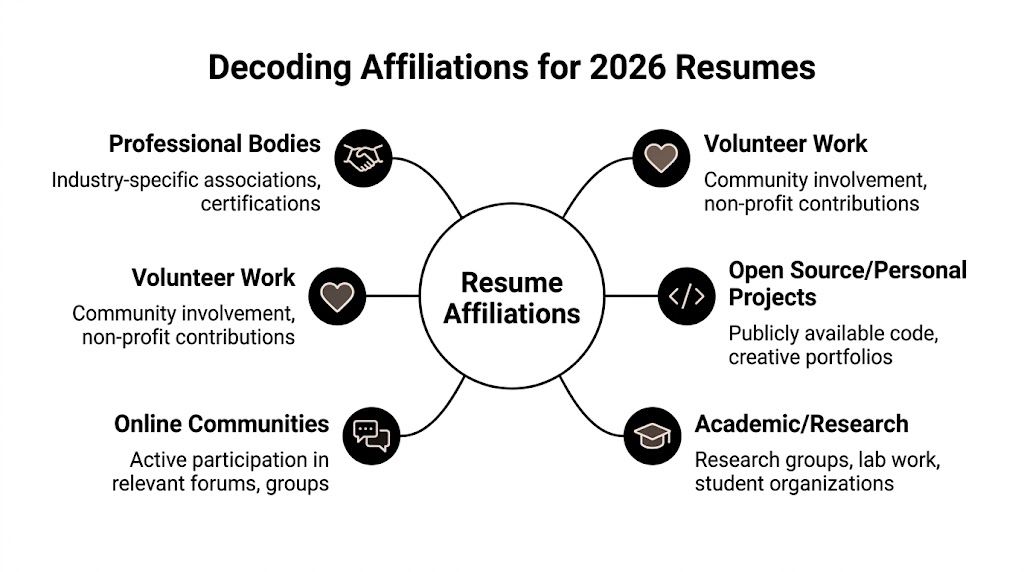
A lot more counts than people think. You do not need a fancy acronym after your name for something to qualify.
The rule is simple. If the connection shows professional community, skill development, industry involvement, or trusted participation, it can count as an affiliation on a resume.
Also, don’t ignore the network effect. MyPerfectResume’s networking research reports that 54% of U.S. workers landed their current jobs through a connection, while only 1 in 10 job seekers network regularly. That’s why affiliations matter beyond the resume line itself. They hint that you’re connected to people, conversations, and opportunities.
Five categories that absolutely count
| Category | What it includes | Why it works |
|---|---|---|
| Professional bodies | Trade groups, associations, certifying organizations | Shows formal relevance and industry standards |
| Bootcamps and training communities | Alumni groups, fellow networks, graduate communities | Proves active learning and peer credibility |
| Open-source and project communities | GitHub orgs, Apache contributors, public build communities | Shows visible skill in action |
| Military and veteran networks | Vets in Tech, VetSec, service-related associations | Signals discipline, transition support, and transferable skills |
| Volunteer and community leadership | Organizing, board service, nonprofit roles tied to job skills | Adds leadership and initiative when relevant |
What this looks like in real life
Some examples are obvious. Some aren’t.
A licensed HVAC tech listing a union or apprenticeship group. That’s an affiliation.
A self-taught developer who contributes to an open-source project and helps moderate a Discord community for cloud security. That can also be an affiliation, if it’s framed professionally.
A veteran in transition who’s active in a career network for cybersecurity. Definitely an affiliation.
Practical rule: If you’d be comfortable discussing it in an interview as part of your professional identity, it can probably live on your resume.
What does not count automatically
Not every group belongs there. A random social club, generic hobby forum, or unrelated volunteer role usually weakens the section unless it clearly supports the job target.
Use this filter:
- Relevant to the role
- Recent enough to feel current
- Concrete enough to explain
- Professional enough to support your brand
If a recruiter has to guess why it’s there, cut it.
How to Choose the Right Affiliations to List
You don’t win by listing everything. You win by listing the right few.
The easiest framework is Relevance, Activity, Recency. In that order. Relevance always comes first. A smaller, directly related affiliation beats a more impressive-sounding one that has nothing to do with the job.
Start with the job description
Pull up the posting and scan for repeated terms. If the role mentions cybersecurity, logistics, patient support, Scrum, data privacy, field service, or apprenticeship training, those are clues. Your affiliations should echo the work itself, not your personal backstory.
Candidates often make a mistake. They add organizations they like instead of organizations that strengthen fit.
Use this quick sorting test
Ask these three questions about every possible affiliation:
- Does it directly support the job I want?
- Was I active, visible, or responsible in some way?
- Is it recent enough to feel current?
If the answer is no to the first question, it usually shouldn’t make the cut.
If the answer is yes to the first but no to the second, it might still work, but it needs to be compact.
If it’s old and unrelated, it’s gone.
Keep the list tight
The sweet spot for affiliations on a resume is usually a short, focused set. You want enough to signal depth, but not so many that the section turns into clutter. A good benchmark is a handful of strong entries. If you’re targeting several roles, tailor the mix each time.
Here’s the blunt version:
- Pick the job first. Don’t build a generic affiliation section and spray it everywhere.
- Favor active roles. Committee work, contributor status, chapter support, mentorship, and volunteer leadership beat passive membership.
- Choose proof over prestige. A smaller group where you did real work is often better than a famous organization where you did nothing.
- Check fit against pay goals. If you’re moving upmarket, use a no-degree salary guide for skills-first careers to target roles worth tailoring for.
A clean resume is a strategic document, not a scrapbook.
Formatting Affiliations to Beat the Bots and Wow Recruiters
Most candidates frequently lose easy points. They either hide affiliations in a weird corner, or they dump a vague list with no role, no dates, and no clue why it matters.
Clean formatting fixes that.
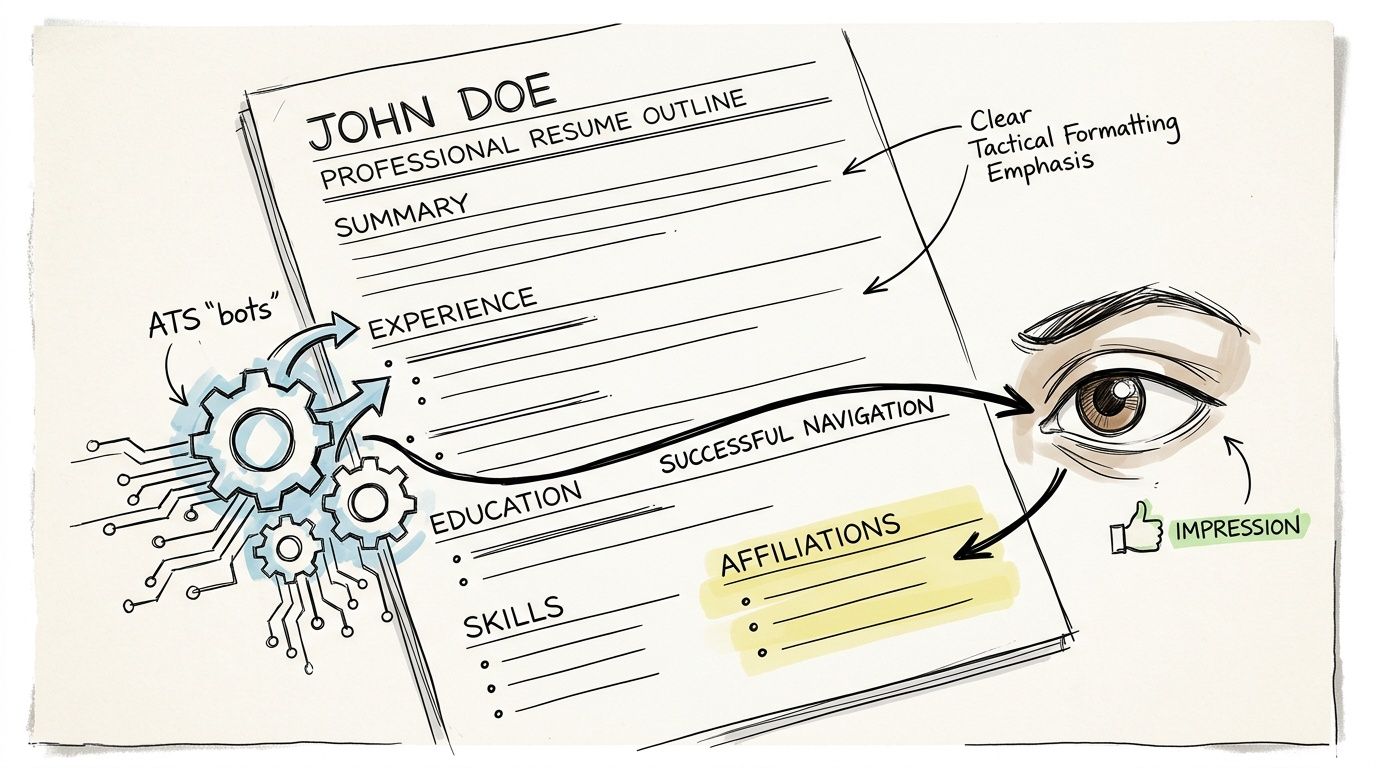
For skills-first candidates, formatting isn’t cosmetic. It affects discoverability and credibility. According to Resumly’s guidance on professional affiliations and recruiter benchmarks, resumes with 3+ relevant affiliations can see 15-25% higher callback rates in tech and trades. The same source says military veterans who list affiliations such as the Armed Forces Communications Electronics Association can double interview odds in cybersecurity roles.
Where to put affiliations
You’ve got two strong options.
Use a dedicated section
This works best if you have multiple relevant entries.
Put it after work experience and before education if your practical skill story is stronger than your academic story. That’s often the right move for STARs.
Header options
- Certifications & Affiliations
- Professional Affiliations
- Industry Involvement
Weave one into your summary
This works if you only have one standout item.
Example:
Cybersecurity analyst with hands-on SOC training, incident response skills, and active involvement in VetSec.
That one line can add trust quickly.
The format that works
Use this structure:
Role, Organization (Dates)
- Key achievement or contribution using job-relevant language
Examples:
Member, Vets in Tech (2023 to Present)
- Attend employer panels and peer mentoring sessions focused on cloud support and cybersecurity transitions
Contributor, Apache Software Foundation (2024 to Present)
- Submitted pull requests and collaborated with maintainers on open-source tooling used in data workflows
Apprentice, National Association of Home Builders (2022 to Present)
- Completed hands-on training in site safety, framing, and blueprint interpretation
Add keywords without sounding fake
ATS tools look for relevance. Humans look for clarity. You need both.
That means using the same language employers use when it’s true. If the job says “data privacy,” don’t describe your affiliation only as “security community involvement.” If the role says “logistics operations,” don’t hide your trade group under generic wording.
A few smart moves:
- Mirror the posting language when it fits
- Include acronyms and full names if both matter
- Add dates so the entry looks real and current
- Name your role instead of just the organization
If you want a fast draft, a resume builder for skills-first candidates can help you format this section without turning it into a mess.
A quick visual walkthrough helps too:
Two formatting mistakes that quietly hurt you
First, don’t create mystery entries. “AMA, member” means little if the recruiter doesn’t know the context or relevance.
Second, don’t pad. If you’ve got only one or two strong items, bundle them with certifications under one section. That looks deliberate. A thin standalone section can look like you’re stretching.
Real-World Affiliation Examples for STARs
Generic examples are useless if they all assume you went to college, joined a polished association, and followed a neat career path.
Most STARs didn’t. That’s why non-traditional affiliations matter so much here. A Career.io summary of 2025 LinkedIn findings on informal networks and resume match rates says 68% of hiring managers in tech and trades prioritize skills demonstrated through informal networks over degrees, and listing non-traditional affiliations can boost resume match rates by 22% on skills-first job platforms.
For bootcamp grads and self-taught developers
You do not need to fake a formal association. Use the communities where your work is visible.
Contributor, Open Source Project on GitHub (2024 to Present)
- Submitted bug fixes, reviewed issues, and collaborated with maintainers on front-end improvements
Member, Bootcamp Alumni Network (2023 to Present)
- Participate in peer code reviews, mock interviews, and employer meetups for junior developer roles
This works because it shows output plus community. That combination hits harder than “aspiring software engineer” in a summary.
For military veterans moving into civilian roles
Veterans often undersell the affiliations that make their transition story make sense. Don’t.
Member, Vets in Tech (2023 to Present)
- Attend technical workshops and mentorship sessions focused on cloud support and systems administration
Participant, VetSec Community (2024 to Present)
- Collaborate with peers on cybersecurity labs and career transition resources
These entries tell employers you’re translating military experience into civilian language and staying active in the field.
The strongest veteran resumes don’t just say “served with honor.” They show current involvement in the target industry.
For tradespeople and apprentices
Trades resumes often skip affiliations even when they’re some of the strongest proof available.
Apprentice, United Brotherhood of Carpenters (2022 to Present)
- Completed structured training in safety, installation, and jobsite coordination
Member, National Association of Home Builders (2024 to Present)
- Engage with industry education and workforce development events tied to residential construction
That signals standards, training, and professionalism. It also helps hiring managers see you as someone moving up, not just clocking in.
For community builders and volunteers
This category works only when the role connects to the target job.
Lead Organizer, Local Tech Meetup (2023 to Present)
- Coordinate speaker sessions and volunteer logistics for community learning events
Volunteer Coordinator, City Food Distribution Network (2022 to Present)
- Manage scheduling and day-of operations for high-volume community support events
If you’re applying for ops, support, customer success, project coordination, or team lead roles, these can pull real weight. If you’re applying for a highly technical role, make sure they don’t crowd out stronger technical proof.
And if you’re using AI to tighten the wording, keep it honest. A guide to AI resume tips for skills-first job seekers can help you sharpen entries without making them sound fake.
Common Affiliation Mistakes to Avoid on Your Resume
Most affiliation sections fail for one reason. Candidates stop being strategic.
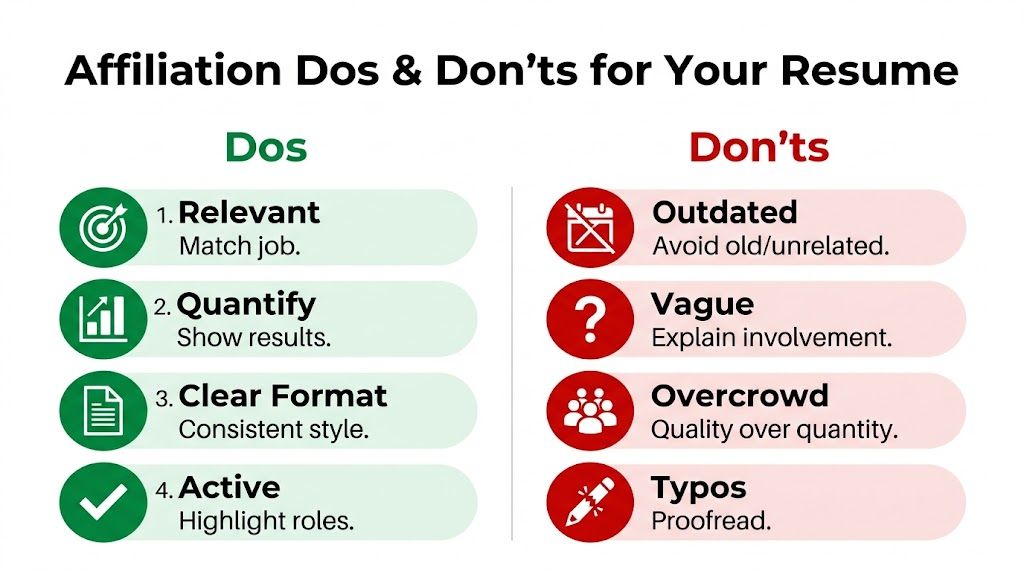
The biggest trap is irrelevance. VisualCV’s resume affiliation benchmarks report that 62% of recruiters are confused by irrelevant affiliations, and listing more than 5 entries can lead to an 18% lower ATS pass rate. Their benchmark is 3 to 5 highly relevant, quantified affiliations.
Don’t do this. Do this instead
Don’t list unrelated groups
Add affiliations that match the role. A civic club on a tech resume usually creates noise.Don’t use vague labels
“Member, industry group” is weak. Name the organization, your role, and your dates.Don’t overload the section
Keep the strongest entries and cut the rest. More is not better here.Don’t hide active involvement
If you organized, contributed, mentored, built, or led, say that.Don’t include risky or distracting affiliations
If a group could trigger confusion, controversy, or bias without helping your candidacy, leave it off.
Your affiliation section should make the recruiter’s job easier. If it raises extra questions, it’s not doing its job.
One more thing. Proofread it. Typos in organization names make you look careless fast. If you’re polishing the whole application with AI, use it carefully. This guide on how to use ChatGPT for job search tasks is useful if you want help tightening language without turning your resume into obvious robot mush.
If you’re serious about landing a better role without a degree, HiredBySkill is worth checking out. It’s built for STARs, surfaces degree-optional jobs across tech, trades, logistics, healthcare support, and more, and gives you practical tools to sharpen your resume around real skills instead of pedigree.
Latest jobs
- New Home Consultant — Fletcher Building
- Accountant - Supervisor Level — Bowman & Company LLP
- Service Technician — DAIOHS U S A INC
- Full Charge Bookkeeper — Bowman & Company LLP
- Substitute Administrative Assistant- St. Peter the Apostle Catholic School — St Peter the Apostle Catholic School
- Media Specialist- St Peter the Apostle Catholic School — St Peter the Apostle Catholic School
- Depot Supervisor — DAIOHS U S A INC
- Court Maintenance Worker — Royal Oaks Country Club Houston