Chronological vs Functional Resume Guide 2026
Choosing a chronological vs functional resume? See pros, cons, & ATS risks for career changers & vets. Find your winning format for 2026.
You’re probably staring at a resume right now thinking, “I know I can do this job. Why does my background look weird on paper?”
That’s the problem for a lot of STARs. You learned through military service, a bootcamp, an apprenticeship, freelance work, certifications, shift leadership, or plain old doing the work. But your timeline may not look neat. Maybe you changed industries. Maybe you’ve got a gap. Maybe your best proof lives in projects, not titles.
Good. That doesn’t mean you’re behind. It means you need a smarter format.
The whole chronological vs functional resume debate gets framed like a personality test. It’s not. It’s a strategy decision. One format makes recruiters comfortable. One format often makes them suspicious. And one format usually gives skills-first candidates the best shot.
Before you keep tweaking bullets for the tenth time, take a quick detour through the career quiz for skills-first job seekers. Sometimes the fastest way to fix a resume is getting clearer on the role you’re targeting.
Table of Contents
- Resume Remorse? Let's Pick Your Perfect Format
- The Chronological Resume Your Reliable Classic
- The Functional Resume The Creative Curveball
- ATS Robots vs Human Recruiters The Ultimate Showdown
- Meet the Hybrid Resume The 2026 MVP for STARs
- Which Resume Format Should You Actually Use?
- If you’re a bootcamp grad
- If you’re a military veteran moving into civilian work
- If you have a long employment gap
- If you’re a tradesperson moving into a higher-paying role
- If your career path is clean and your recent titles match the job
- If you’re tempted to use functional because you’re embarrassed
- Quick decision guide
- Build Your Winning Skills-First Resume Today
- Your Burning Resume Questions Answered
Resume Remorse? Let's Pick Your Perfect Format
A resume format is just the shape of your story.
If your story is clean and linear, one format works great. If your story is impressive but nontraditional, the wrong format can bury your strengths.
Here’s the short version.
| Format | What it emphasizes | Best for | Biggest risk | My take |
|---|---|---|---|---|
| Chronological | Work history in reverse order | Stable career path, same field, clear progression | Shows gaps and pivots clearly | Safe and trusted |
| Functional | Skills grouped by category | Rare cases with major pivots or complicated gaps | Recruiters may think you’re hiding something | Usually too risky |
| Hybrid | Skills first, then timeline | STARs, career changers, bootcamp grads, veterans, tradespeople | Can get messy if overdesigned | Best option for most readers here |
Three resume personalities
Think of these formats like three job-search characters.
Chronological is the reliable one. It walks in, shakes hands, and says, “Here’s where I worked, when I worked there, and how I grew.”
Functional is the flashy one. It says, “Don’t look at the timeline. Look at my skills.” Sometimes that works. Often it makes people wonder what’s being hidden.
Hybrid is the smart one. It leads with what matters most, then backs it up with a timeline recruiters and ATS can follow.
You do not need a perfect background. You need a format that makes your value easy to spot.
My blunt advice
If you’re a no-degree candidate with real skills, don’t choose a format based on what feels flattering. Choose the one that gets read, understood, and trusted.
That’s the whole game.
The Chronological Resume Your Reliable Classic
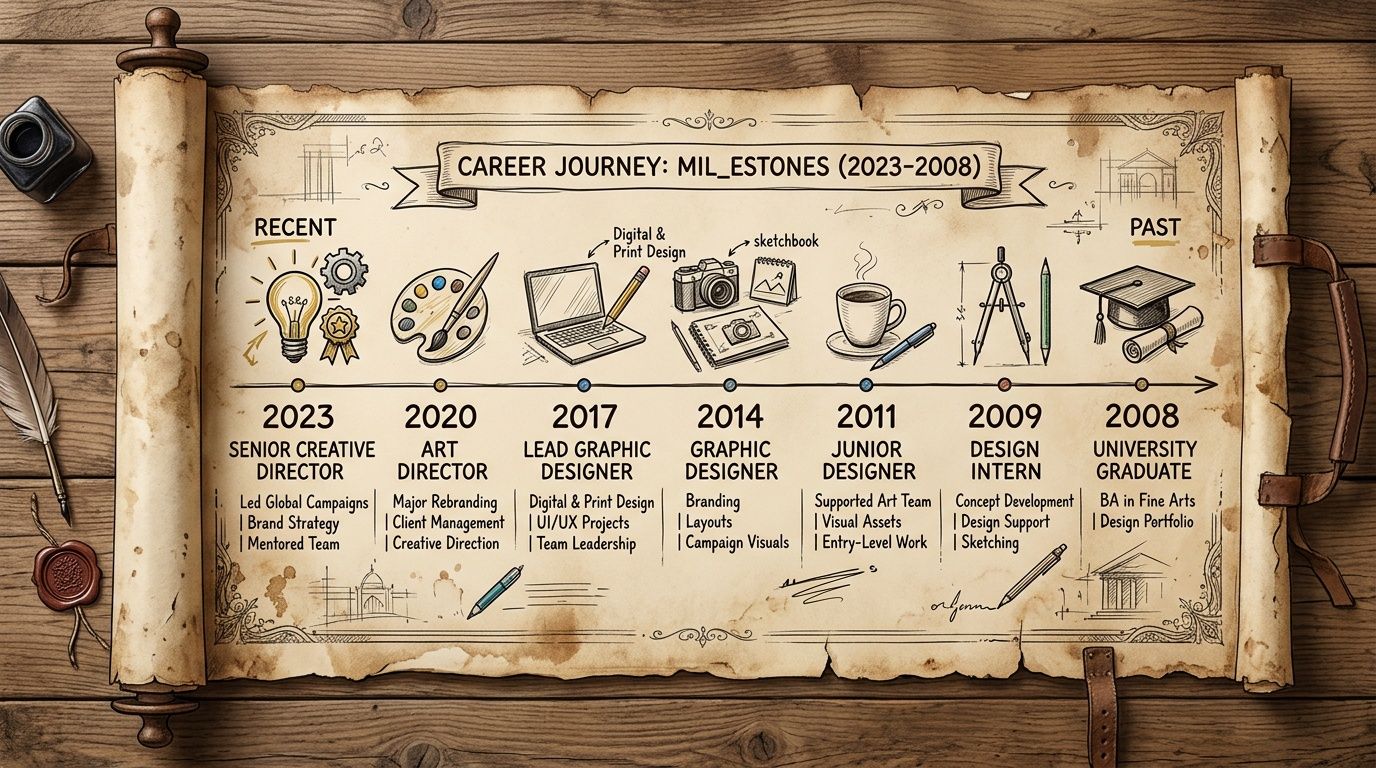
The chronological resume is the default for a reason. It tells your career story backward, starting with your most recent role and moving into older experience.
Recruiters know it. ATS software knows it. Most hiring teams expect it.
Why recruiters like it
It answers the basic questions fast.
- What did you do most recently
- How long did you do it
- Did you move up
- Does your background match this role
That speed matters. A 2022 global survey found that 78% of professional resumes use a chronological format, and a 2021 study showed candidates using chronological resumes received interview callbacks at a 32% rate.
That’s not a tiny preference. That’s a hiring-market habit.
Who should absolutely use it
Chronological is your best move if this sounds like you:
- You’re staying in the same lane. Warehouse lead to logistics supervisor. Help desk to IT support specialist. Apprentice electrician to journeyman role.
- Your recent experience is your strongest selling point. Your last one or two jobs already prove you can do the next one.
- Your timeline shows momentum. Better titles, more responsibility, stronger projects.
What it looks like
A good chronological resume usually follows this order:
- Contact info
- Short summary
- Work experience in reverse chronological order
- Skills
- Certifications or education
Where it falls short for STARs
At this point, people get tripped up.
Chronological works beautifully when your path makes obvious sense on paper. But if you’re switching from military logistics into civilian operations, from restaurant management into customer success, or from a coding bootcamp into junior software work, your strongest skills may not appear in your latest title.
That doesn’t make chronological bad. It just means it may not be enough on its own.
Practical rule: If your job titles already sell you, use chronological. If your skills sell you better than your titles, you probably need hybrid.
The Functional Resume The Creative Curveball
The functional resume groups your experience by skill area instead of job history.
So instead of seeing “Service Technician, 2022 to 2024,” a recruiter sees sections like Troubleshooting, Team Leadership, or Customer Service with bullet points underneath.
That sounds clever. Sometimes it even feels safer. Especially if your work history is messy.
Why people choose it
I get the appeal.
A functional resume can help you:
- Push transferable skills up top
- Downplay unrelated old jobs
- Soften the visual impact of employment gaps
- Make a career pivot feel more connected
If you’re moving from teaching to corporate training, or from military service into cybersecurity, that skill-first setup can look attractive.
Why I’m cautious about it
Here’s the hard truth. Recruiters often don’t read a functional resume and think “smart.” They think “what’s missing?”
That’s the issue. Even when your reasons are honest, the format can still trigger doubt.
When it may be okay
I’m not going to say functional resumes are never useful. That would be lazy advice.
A pure functional resume can make sense if:
- You have a major career reset and your older titles would distract from your target role
- You’re re-entering after a serious gap and your recent proof comes from projects, training, or volunteer work
- You’re sending a resume directly to a human who already knows your situation
Still, even in those cases, I usually prefer a hybrid.
My opinion
Functional resumes solve one problem by creating two more.
They can hide a gap. They can also hide credibility.
They can spotlight skills. They can also strip away context.
That tradeoff usually isn’t worth it.
ATS Robots vs Human Recruiters The Ultimate Showdown
The chronological vs functional resume question stops being theoretical at this stage.
You have two gatekeepers. First, the ATS. Then the human being doing a quick scan. Your format has to survive both.
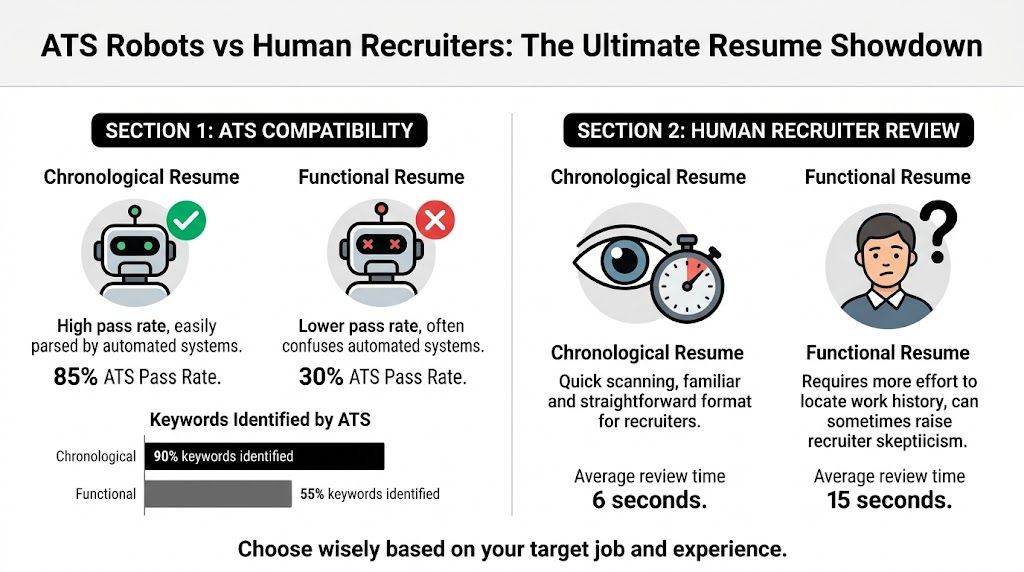
To make that easier to see, here’s the visual breakdown.
Round one: ATS parsing
ATS systems like Workday and Taleo want structure. They’re looking for recognizable sections, job titles, employers, and dates in a predictable order.
That gap matters because a badly parsed resume can scramble your experience before a recruiter ever sees it.
Functional resumes often break the expected pattern. Skill clusters look nice to a human writer. To software, they can look incomplete or confusing.
Round two: the first scan
A hiring manager doesn’t sit down with tea and spend ten minutes admiring your formatting.
The same ATS comparison found human reviewers spend an average of 7.4 seconds on an initial resume review. In that tiny window, chronological layouts help people spot recency and progression fast, while functional layouts create more cognitive load in the scan.
That’s recruiter language for “this takes work.”
Here’s the embedded breakdown if you want another quick walk-through:
If you’re tuning your document for ATS and quick human review, the guidance in these AI resume tips for ATS-friendly applications can help clean up formatting mistakes that sabotage good candidates.
Round three: trust
This part doesn’t get talked about enough.
Recruiters use format as a signal. Not because they’re being unfair, but because they’re moving fast. A chronological resume says, “I’m showing you my timeline plainly.” A functional resume says, “Start with my claims and work backward to figure out the story.”
One builds trust faster.
One creates homework.
If a recruiter has to decode your resume, you’ve already made the process harder than it should be.
Winner of the showdown
Chronological wins on parsing. It wins on scan speed. It usually wins on trust.
That’s why I don’t recommend pure functional resumes for many job seekers.
But that still doesn’t settle the problem for STARs, because plenty of candidates need something more skills-forward than plain chronological. That’s where the hybrid format earns its spot.
Meet the Hybrid Resume The 2026 MVP for STARs
This is the format I’d put in the hands of most bootcamp grads, veterans, self-taught tech candidates, tradespeople moving up, and career changers with real proof of skill.
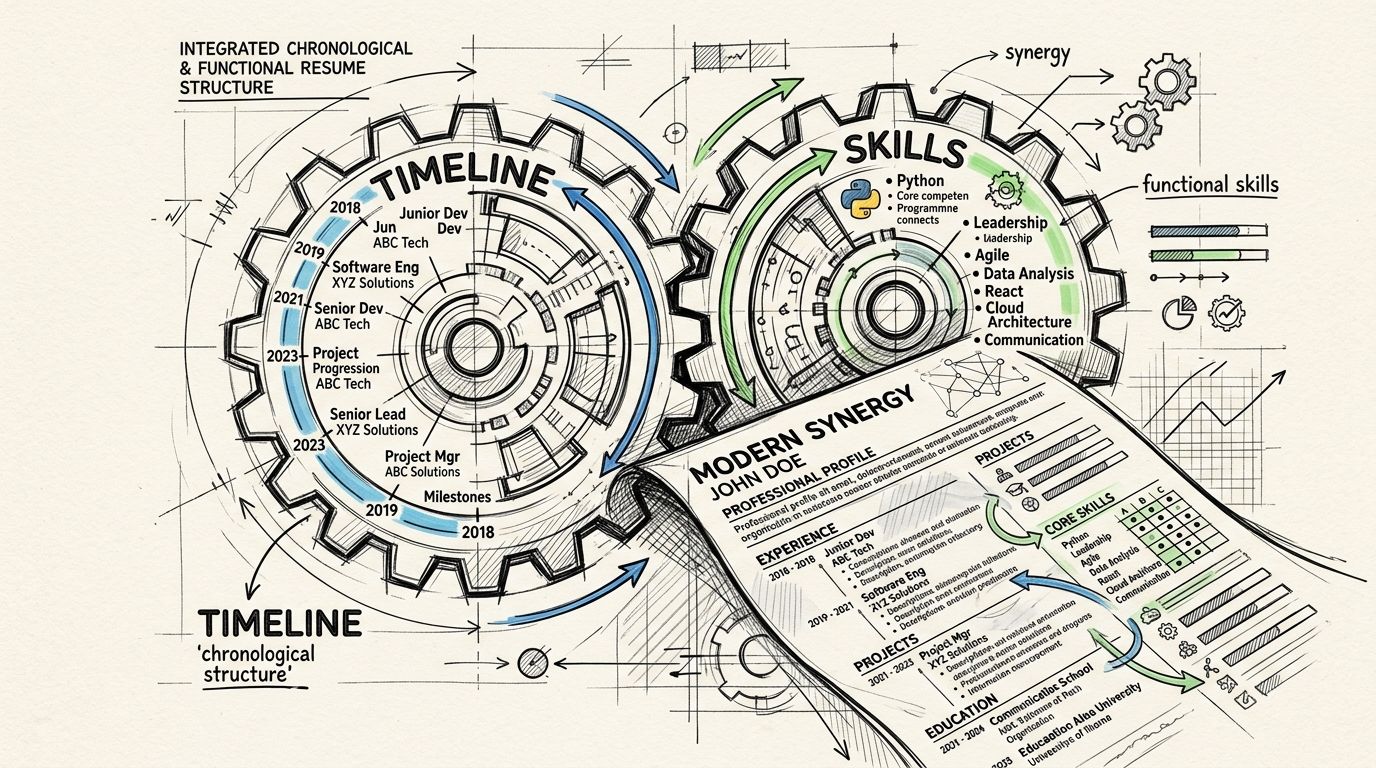
The hybrid resume gives you two things at once. It puts your strongest skills near the top, then keeps a clean reverse-chronological work history underneath.
That’s the sweet spot.
What a hybrid resume includes
A strong hybrid resume usually has:
- A sharp headline or summary
- A skills summary or core competencies section
- Certifications, tools, or platforms
- Reverse-chronological work history
- Projects, licenses, or training if relevant
This works because you don’t force yourself into a fake choice between “skills” and “experience.”
You show both.
Why it fits STARs so well
A lot of no-degree talent has one weird resume problem. Their capabilities are better than their titles.
A military operations specialist may be applying for supply chain roles. A bootcamp grad may have stronger projects than job history. A plumber moving into facilities management may have leadership skills that never appeared in a formal office title.
Hybrid lets you lead with what the employer cares about, then prove it with real timeline context.
Why I think hybrid wins now
According to a future-dated projection cited by Indeed’s career advice page, hybrids dominated 62% of successful applicant-tracked resumes, and they outperformed other formats by 35% for tech bootcamp grads after post-2025 ATS updates began penalizing pure functional resumes.
The year matters here. Those are projections and trend claims tied to 2025 and beyond, not timeless facts. Still, they line up with what I’d recommend anyway: keep the timeline, add a targeted skills layer, and stop trying to hide your path.
You can browse more job-search guidance in these career guides for skills-first candidates.
The hybrid resume doesn’t pretend your background is linear. It translates it into something employers can trust.
The trap to avoid
Don’t build a Frankenstein resume.
If your top section turns into a giant wall of skills, and your work history shrinks into an afterthought, you’ve drifted back toward functional. Keep the top sharp. Keep the bottom clear. Keep the whole thing readable.
Which Resume Format Should You Actually Use?
Let’s make this easy.
Most readers here should use a hybrid resume. Not because it sounds modern, but because it solves the actual problem. You need to highlight skills without wrecking ATS readability or recruiter trust.
Still, your situation matters.
If you’re a bootcamp grad
Use hybrid.
Lead with your stack, projects, certifications, and practical work. Then show your timeline, even if it includes unrelated jobs.
That old retail or warehouse role isn’t useless. It can show teamwork, reliability, problem-solving, and customer pressure. Your projects and tech skills do the targeting. Your work history does the credibility work.
If you’re a military veteran moving into civilian work
Use hybrid, not functional.
This one is especially important. A 2026 Burning Glass Institute report cited by NTI Central says veterans using functional resumes see 22% lower callbacks in tech pivots, while a hybrid format that pairs certifications with a timeline boosts callbacks to 41% above the baseline.
That’s a huge difference in outcome and a very clear signal. Translate your MOS, list your certifications, show your tools, and keep the timeline visible.
If you have a long employment gap
Usually use hybrid. Sometimes use chronological.
Don’t panic and jump straight to functional. A gap doesn’t automatically ruin your resume. What matters is what surrounds it.
Use hybrid if you need to surface recent training, freelance work, caregiving-adjacent skills, volunteer leadership, or new certifications before the recruiter gets hung up on dates.
Use chronological if your recent work history is already strong and the gap is old or easy to explain.
If you’re a tradesperson moving into a higher-paying role
Go with hybrid unless your progression is already obvious enough for chronological.
A trades resume often undersells leadership, safety, customer communication, estimating, scheduling, and team coordination. Put those strengths up top. Then back them with your field history, licenses, and project experience.
If your career path is clean and your recent titles match the job
Use chronological.
You don’t need fancy. You need clear.
If your last few jobs already line up with the role you want, chronological is perfectly good. Don’t overcomplicate a story that already makes sense.
If you’re tempted to use functional because you’re embarrassed
Don’t.
A functional resume rarely fixes the insecurity behind it. It just changes where the confusion shows up.
Your job isn’t to make your past disappear. Your job is to frame it so the employer sees where you’re going next.
Quick decision guide
| Your situation | Best format |
|---|---|
| Same field, steady work history | Chronological |
| Bootcamp grad or self-taught career pivot | Hybrid |
| Veteran translating military experience | Hybrid |
| Tradesperson moving into leadership or adjacent work | Hybrid |
| Big gap and very little recent formal employment | Hybrid first, functional only if absolutely necessary |
Build Your Winning Skills-First Resume Today
Once you pick the right format, the next job is writing bullets that sound like a professional, not a task list.
A hybrid resume lives or dies on that top half. Your skills summary should sound specific and useful.
Before and after examples
Here’s what weak writing looks like:
- Weak: Responsible for inventory
- Weak: Helped customers with issues
- Weak: Learned cybersecurity tools in bootcamp
- Weak: Managed team operations
Now the stronger version:
- Better: Reduced inventory errors using SQL-based tracking systems
- Better: Resolved customer issues across high-volume service environments and trained newer team members on escalation handling
- Better: Built security labs and completed hands-on work with tools used in cybersecurity training
- Better: Coordinated daily workflows, shift coverage, and team handoffs in fast-moving operations
What to put in the top section
For most STARs, your top skills section should include a mix of:
- Technical tools: Python, Excel, Tableau, ServiceNow, AWS, HVAC diagnostics, CAD, forklift systems
- Relevant strengths: troubleshooting, customer retention, incident response, scheduling, quality control
- Credentials: CompTIA, OSHA, CDL, welding certs, cloud certs, apprenticeships, bootcamps
Keep it tight
Don’t write a top section that tries to tell your whole life story.
Use:
- A short summary
- A focused skill block
- A clean timeline below
That’s enough.
If you want a place to build and refine that structure fast, use the resume builder at HiredBySkill. It’s a practical shortcut when you already know your skills but need them to look organized on the page.
Your Burning Resume Questions Answered
Is a functional resume ever okay for a senior-level role?
Usually no.
Senior hiring gets stricter about scope, leadership progression, and credibility. A functional format often hides the very evidence senior employers want to see. Use chronological or hybrid.
How do I list freelance or gig work on a hybrid resume?
Create one clear entry with a label that fits the work, such as Freelance Developer, Independent Contractor, or Consultant. Then add bullet points for projects, tools, and outcomes. Keep dates visible.
How long should my skills summary be?
Short. Think focused, not stuffed.
A few strong lines or a compact skills block is enough. If the summary becomes half the page, it stops helping.
Can I use ChatGPT to help write my resume?
Yes, but don’t let it flatten your voice into generic mush. Use it to brainstorm phrasing, identify missing keywords, or tighten bullets. Then rewrite everything so it sounds like you. This guide on how to use ChatGPT for job search is a smart place to start.
If you’re ready to stop guessing and start applying with a resume that fits your background, check out HiredBySkill. You can build a stronger resume, explore degree-optional roles, and find jobs that value what you can do, not just where you learned it.
Latest jobs
- Resident Care Assistant Full-time 7AM-3PM — Ciel Nona Lakes LLC
- UI Developer I — Corelation Inc
- UI Developer II — Corelation Inc
- Security Engineer — Inadev
- Business Development Manager | FULLY REMOTE — First Page Sage, LLC
- Public Housing Inspector (Code Enforcement) — Housing Authority of Paducah
- Donor Recruitment Representative — LifeSouth Community Blood Centers
- Maintenance Technician, Victoria Park Jaycees Senior Apartments — VESTA MANAGEMENT CORPORATION