7 Counter Offer Letters That Win in 2026
Get hired on your terms! Explore 7 expert counter offer letters for salary, benefits, and remote work, with templates for STARs and degree-optional pros.
Got the offer? Don’t just say yes. Let’s negotiate.
That email lands in your inbox. “Congratulations!” You did it. Then you scroll to the salary and realize it’s fine, not great. Maybe the title works. Maybe the job sounds solid. Maybe the company seems like a good bet. But the pay, flexibility, or benefits don’t quite line up with what you bring to the table.
Don’t accept too fast.
A job offer is not the finish line. It’s the first serious conversation about your value. That matters even more if you’re a STAR, skilled through alternative routes, and you’ve built your career through bootcamps, certifications, military service, apprenticeships, freelance work, or plain old doing the job well without a degree.
A lot of negotiation advice still talks to people with polished corporate resumes and neat degree paths. That’s not most real people. If you learned by shipping projects, handling incidents, fixing systems, leading crews, serving customers, or training in the field, your counter should sound like you and sell what you’ve done.
These seven counter offer letters are built for that. You’ll get straight-up templates, when to use them, and how to make your ask land without sounding stiff or desperate. If you want a few extra scripts for the first reply, this round-up of salary negotiation email example templates is also worth bookmarking.
Table of Contents
- 1. Professional Salary Counteroffer Letter Template
- 2. Benefits and Flexibility Counteroffer Template
- 3. Conditional Counteroffer with Performance Milestones Template
- 4. Industry Transition Counteroffer Letter Template
- 5. Multiple Competing Offer Counteroffer Strategy Template
- 6. Equity and Stock Options Counteroffer for Startups Template
- 7. Non-Profit and Mission-Driven Counteroffer Letter Template
- 7 Counteroffer Letter Templates Compared
- Your Next Move From Template to Signed Offer
1. Professional Salary Counteroffer Letter Template
A lot of employers still lowball STARs on the first offer. Not always because they’re malicious. Sometimes they just don’t know how to price someone whose credibility comes from GitHub, CompTIA, military operations, field work, or an apprenticeship instead of a bachelor’s degree.
That’s your opening.
If the offer is solid except for pay, send a clean salary counter that anchors on business value. Your certifications, shipped projects, troubleshooting record, client results, and hands-on experience are the evidence. Degrees are not the point.
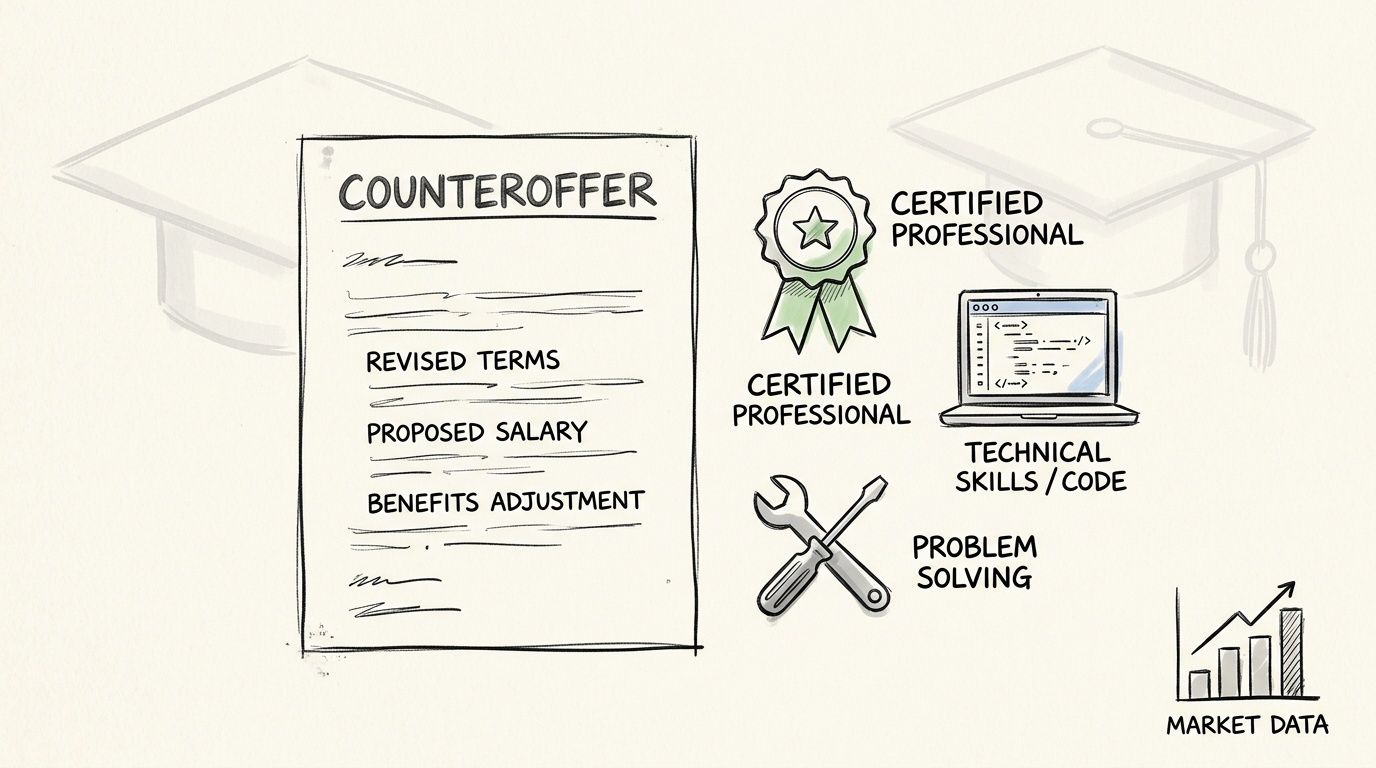
Lead with proof not pedigree
A bootcamp grad going for a junior software role shouldn’t apologize for being nontraditional. Say you completed the program, built projects, and can contribute fast. A veteran moving into logistics should translate leadership, operations, and systems discipline into employer language. A cybersecurity candidate should put Security+, home lab work, and incident response examples right up front.
Use a real pay benchmark before you write. HiredBySkill’s salary calculator for skills-first roles gives you a practical place to start.
Practical rule: Ask for a specific revised number or range. “Can we revisit compensation?” is weak. “I’d like to discuss adjusting the base salary to align with the value I’ll bring in this role” is better.
Template
Subject: Offer for [Job Title]
Hi [Hiring Manager Name],
Thank you for the offer for the [Job Title] role. I’m excited about the chance to join [Company Name] and contribute to [specific team, product, or mission].
After reviewing the offer, I’d like to discuss the base salary. My background is built through [bootcamp, certification, military training, apprenticeship, direct experience], and that path has given me practical skills directly tied to this role. In particular, I bring [specific certification or training], [specific project or accomplishment], and experience with [relevant tools, systems, or responsibilities].
Based on the scope of the role and the value I can deliver from day one, I’d be more comfortable accepting an offer at [your target salary]. I believe that figure better reflects my hands-on experience and the contribution I can make in [specific area].
I’m very interested in joining the team and would be glad to discuss this further. I appreciate your consideration and look forward to finding a package that works for both of us.
Best, [Your Name]
Keep the tone calm. You’re not proving you deserve dignity. You’re pricing a skill set.
2. Benefits and Flexibility Counteroffer Template
Sometimes salary won’t move much. That doesn’t mean the offer is fixed.
A smart counter can win you better hours, remote time, paid training, exam reimbursement, mentorship, or a faster review cycle. For STARs, those things matter a lot because your career growth often depends on stacking skills faster than the next person, not waiting for a degree line on your resume to do the work for you.
When cash is tight ask for leverage
This play works especially well when a company likes you but can’t stretch base comp. If you’re a healthcare support worker taking prerequisite classes, remote flexibility might matter more than a tiny bump. If you’re in cybersecurity, sponsored certs can be worth a lot. If you’re in the trades, access to a senior mentor and paid upskilling can speed up your next jump.
If you want examples of employers already hiring this way, browse remote-friendly skills-first jobs and study how those roles frame flexibility.
Here’s the bigger reason this works. According to research summarized by Achievers, about 67.5% of managers have made counteroffers to employees trying to leave, and 55% of employees accepted those counteroffers, with familiarity and comfort in the current role being the biggest reason people stay, as reported in this counteroffer research summary. People don’t just optimize for salary. They optimize for what makes the job workable.
Don’t ask for ten things. Pick the three that would change your life or your earning power.
Template
Subject: Offer for [Job Title]
Hi [Hiring Manager Name],
Thank you again for the offer. I’m excited about the role and the chance to work with [Company Name].
Before I accept, I’d like to discuss the overall package. I’m very interested in the position, and if there’s limited room on base salary, I’d love to explore a few items that would help me contribute at a higher level and continue growing in the role.
Specifically, I’d like to discuss [remote or hybrid schedule], [professional development budget, certification support, or exam reimbursement], and [additional PTO, flexible scheduling, or a six-month compensation review]. These would make a real difference in my ability to perform well and keep building the skills most relevant to the position.
For context, my path into this field has been hands-on through [bootcamp, direct work experience, certifications, military training, apprenticeship], so continued learning and practical flexibility are especially valuable to me.
If helpful, I’m happy to prioritize the items that matter most and discuss what’s realistic on your end. I’m enthusiastic about joining the team and would love to find a package that works well for both of us.
Best, [Your Name]
3. Conditional Counteroffer with Performance Milestones Template
If an employer likes you but seems nervous about your nontraditional background, don’t argue in circles. Put a performance ramp on the table.
This is one of the strongest counter offer letters for STARs because it flips the concern. Instead of saying, “Trust me,” you’re saying, “Give me clear targets and pay me when I hit them.”
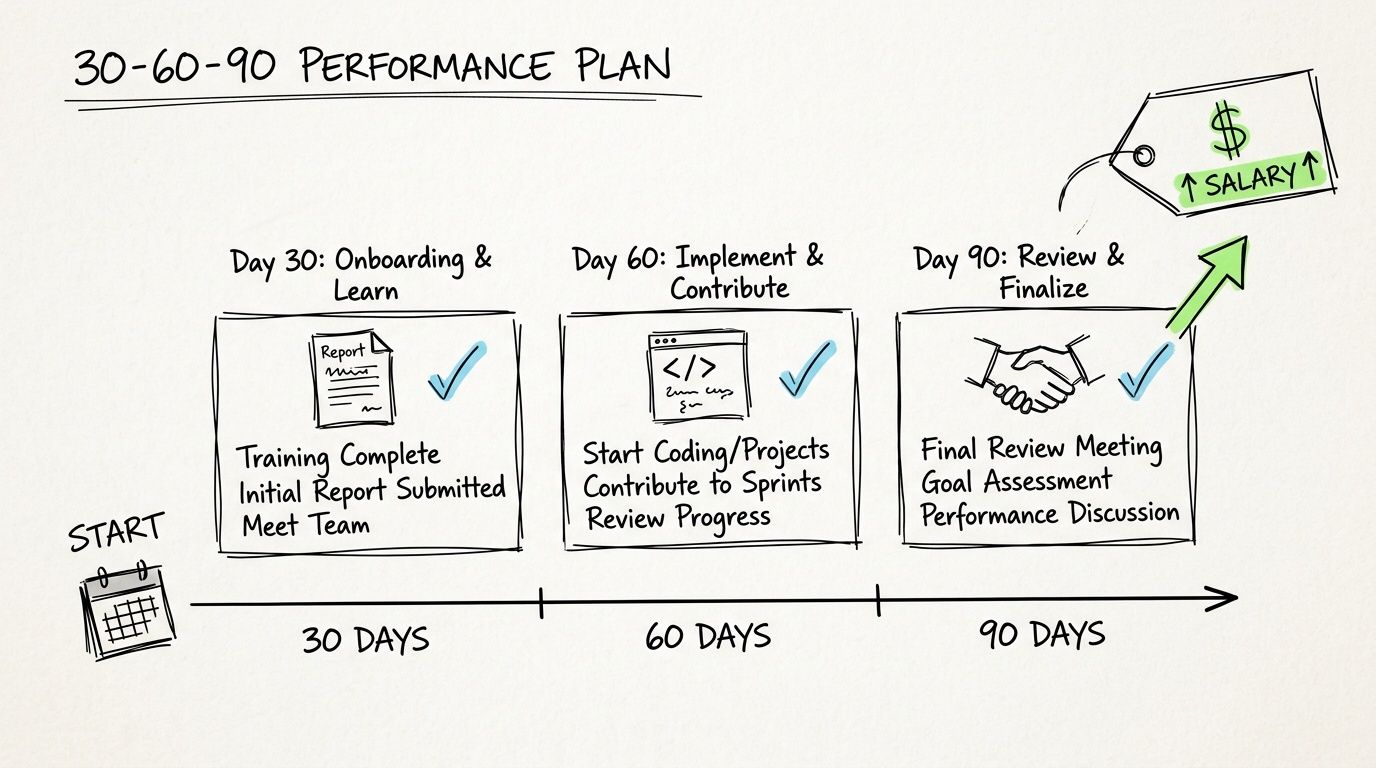
Put your confidence on paper
Say you’re a bootcamp grad entering software engineering. You could propose a starting salary that steps up after you ship agreed features, complete onboarding milestones, and contribute to code reviews. A military veteran entering logistics could ask for a comp review after process improvements are documented. A data analyst could tie the bump to dashboards shipped or stakeholder adoption.
The key is simple. Don’t offer vague goals. Offer job-shaped goals.
- Pick outcomes tied to the role: Features shipped, tickets resolved, response times improved, documentation completed, client handoffs handled.
- Set the review date now: Put the checkpoint in writing before you accept.
- Make the raise automatic if targets are met: Don’t leave it to “we’ll revisit later.”
Template
Subject: Offer for [Job Title]
Hi [Hiring Manager Name],
Thank you for the offer. I’m excited about the opportunity and confident I can make a strong impact in this role.
I understand that my background may be different from more traditional candidates, since I built my experience through [bootcamp, apprenticeship, certifications, military service, direct work experience]. Because of that, I’d like to propose a compensation structure tied to clear performance milestones.
I’d be comfortable accepting the current offer with a written agreement that compensation will be adjusted to [target salary or benefit change] after [time period], provided I meet agreed goals such as [milestone one], [milestone two], and [milestone three]. I like this structure because it gives your team a low-risk path to evaluate my performance while creating a clear roadmap for growth.
I’m confident in my ability to meet those expectations and would welcome the chance to define the milestones together so they align with the team’s priorities.
If this approach works for you, I’d be happy to discuss specific terms. I’m excited about the role and eager to make this work.
Best, [Your Name]
This approach also gives you a paper trail. That matters. Verbal promises around “quick growth” disappear fast once you’ve started.
4. Industry Transition Counteroffer Letter Template
Career changers get discounted all the time. Employers hear “new to this industry” and suddenly forget you’ve been solving real problems for years.
Fix that by translating your old world into their world.
Translate your experience clearly
If you’re a veteran moving into project management, don’t lead with “I’m transitioning.” Lead with team coordination, deadlines, operational planning, and accountability. If you’re a tradesperson moving into logistics tech, show how field knowledge helps you understand supply chains better than someone who’s only seen them on slides. If you worked in customer support and you’re moving into UX, your direct exposure to user pain is valuable, not random.
A strong transition counter points them to the overlap. HiredBySkill’s career guides for degree-optional roles can help you frame that overlap in employer language.
Your old title doesn’t matter as much as the problems you’ve already solved that look like the problems in the new job.
Template
Subject: Offer for [Job Title]
Hi [Hiring Manager Name],
Thank you for the offer and for the conversations throughout the interview process. I’m excited about the role and especially about the opportunity to bring my background in [previous field] into [target field or company function].
I’d like to discuss the compensation package before moving forward. While I’m making an industry transition, the skills I’ve built in [previous field] directly support the work required in this position. My experience with [relevant responsibility], [relevant tool or process], and [leadership, operations, troubleshooting, client communication, or compliance] gives me a strong foundation to contribute quickly.
In addition, I’ve invested in this move through [certification, bootcamp, portfolio, apprenticeship, military training, side projects], which has helped me close the gap between industries and prepare for this specific kind of work.
With that in mind, I’d like to propose a base salary of [your ask] or a package that reflects both my transferable experience and my readiness to perform in this role.
I’m enthusiastic about joining [Company Name] and would love to find terms that reflect the value I can bring from day one.
Best, [Your Name]
For transition roles, confidence matters more than fancy wording. Don’t oversell. Translate.
5. Multiple Competing Offer Counteroffer Strategy Template
If you’ve got more than one offer, use it. Politely. Cleanly. Without turning into the person everyone dreads negotiating with.
This style works best when you already know where you want to go, but you need the compensation or package to make sense. The trick is to signal market validation without sounding like you’re auctioning yourself off.
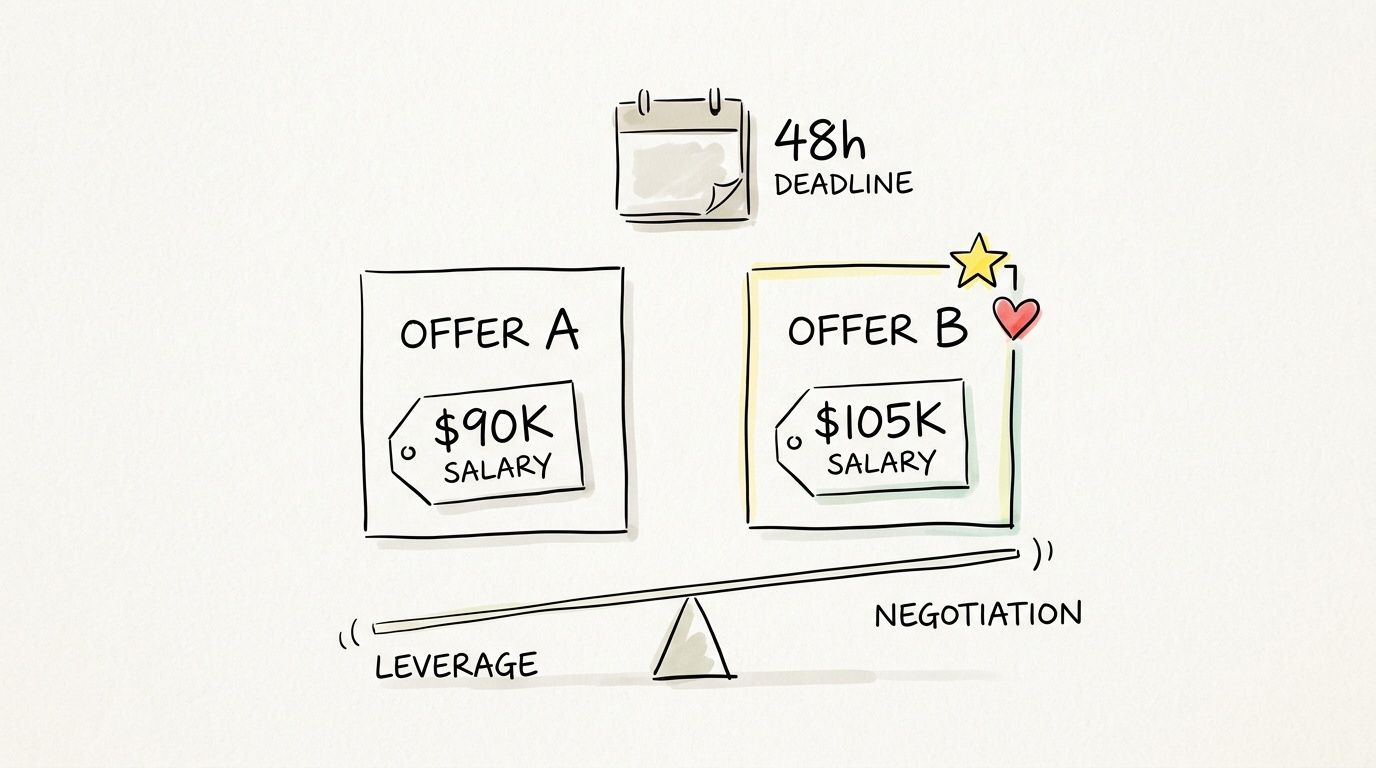
Use leverage without sounding like a jerk
Lead with preference. Then state the competing factor. Then make a direct ask.
This is also the place to stay realistic. If you do not have another offer, don’t fake one. In a recent cautionary write-up on salary counters, the big takeaway was that negotiation with little bargaining power often works better when candidates test flexibility first and pivot to perks if salary won’t move, as discussed in this career guide on how to counter a salary offer.
You can also use this strategy while actively comparing open jobs on HiredBySkill, especially if you’re weighing title, schedule, and growth path alongside pay.
Template
Subject: Offer for [Job Title]
Hi [Hiring Manager Name],
Thank you again for the offer. I’m excited about the opportunity at [Company Name], especially because of [specific reason such as mission, team, tech stack, mentorship, growth path, or schedule].
I want to be transparent that I’m currently considering another offer as well. While [Company Name] is my preferred choice, the other opportunity is stronger on [base salary, remote flexibility, signing bonus, PTO, development support, or another specific point].
If there’s room to adjust this offer to [your target salary or package change], I’d be ready to move forward with much more confidence. I’m not looking to drag out the process. I just want to make the best long-term decision and ensure the package reflects the value I can bring.
Please let me know whether there’s flexibility here. I’d be happy to discuss live if that’s easier.
Best, [Your Name]
Short email. No bluffing. No chest-thumping. Just influence applied effectively.
6. Equity and Stock Options Counteroffer for Startups Template
Startup offers can get weird fast. The salary may be lower. The title may be squishy. The equity section may look important but feel impossible to compare.
Don’t wave that through.
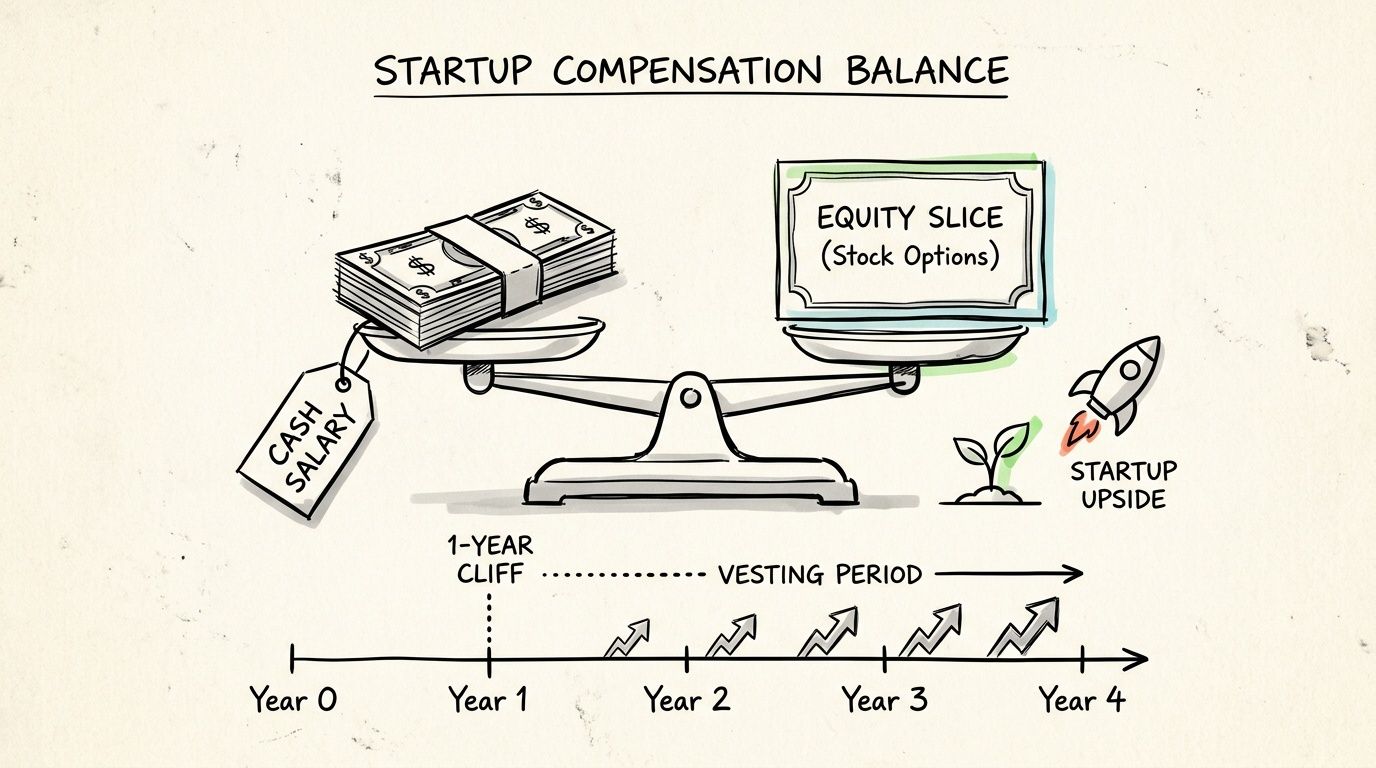
Don’t let startup equity stay fuzzy
If you’re a bootcamp grad joining an early-stage company, you need clarity on what you’re being offered. Ask whether the grant is options or something else. Ask how it vests. Ask what happens if the company is acquired. Ask how they explain the grant to employees. If they get slippery, pay attention.
Harvard’s Program on Negotiation found that counteroffers work better when the other side uses constraint-based reasoning instead of language that devalues the other party. In that research, sellers made smaller concessions when buyers framed their limit around constraints, with average counter-demands of $17,059 versus $18,375 under disparagement rationales, as explained in this Harvard negotiation article on offer rationale. If a startup says, “We’re tight on cash because of stage and budget,” that’s useful information. If they imply your background is the reason they can’t pay, push back.
For candidates comparing teams, products, and growth paths, HiredBySkill’s company directory for skills-first employers is a good place to pressure-test whether the startup story matches the opportunity.
Template
Subject: Offer for [Job Title]
Hi [Hiring Manager Name],
Thanks for sending the offer. I’m excited about the role and interested in the opportunity to join [Company Name] at this stage.
Before I move forward, I’d like to discuss the balance between base salary and equity. I understand early-stage companies often need to manage cash carefully, and I’m open to a package that reflects that, provided the equity piece is clear and meaningful.
Would you be open to revisiting the offer with either a higher base salary, an increased equity grant, or more detail around the equity terms, including vesting schedule, grant type, and any acceleration provisions tied to a change in control?
I’m very interested in the company and want to evaluate the full package accurately. If we can clarify and strengthen that part of the offer, I’d feel much more comfortable moving ahead.
Best, [Your Name]
A quick explainer can help before you send your reply:
If they can explain salary in plain English but not equity, treat that as a warning sign.
7. Non-Profit and Mission-Driven Counteroffer Letter Template
Mission-driven work can pull hard on your heart and hit soft on your paycheck. That tension is real. You can care about the work and still negotiate.
You should, actually.
Respect the mission and still ask
A good counter in this space starts with alignment, then gets specific about what you need. If you’re joining a clinic, school, public agency, or nonprofit, don’t posture like an investment banker. Also don’t undercut yourself because the mission is good. Employers still need to compensate adults with bills.
This matters even more if you’re considering a counter from your current employer instead of taking the mission-driven role. According to a write-up citing SHRM figures, 52% of employees who accepted a counteroffer left within six months, and 80% left within a year, as discussed in this article on why accepting a counteroffer rarely works out. If you’re moving because the work means more, don’t let a last-minute bump distract you from the bigger picture unless the underlying problems are fixed.
“I’m committed to the mission” should be your opener. “Here’s the package I need to do my best work” should be the next sentence.
Template
Subject: Offer for [Job Title]
Hi [Hiring Manager Name],
Thank you for the offer. I’m excited about the opportunity to support [organization mission or community served], and I can see myself doing meaningful work with your team.
Before I accept, I’d like to discuss the compensation package. I’m strongly aligned with the mission, and I also want to make sure the role is sustainable for me long term. Based on the responsibilities of the position and the experience I bring through [direct service work, certifications, military training, apprenticeship, field experience, or community work], I’d like to request [your salary ask] or discuss a package that includes [specific benefits such as remote days, professional development support, PTO, or a scheduled compensation review].
I’m raising this because I want to join with clarity and commit fully, not because I’m uncertain about the role. I’m enthusiastic about the opportunity and hopeful we can land on terms that support both the organization’s constraints and the value I can contribute.
Best, [Your Name]
Mission isn’t compensation. It’s part of the package. Treat it that way.
7 Counteroffer Letter Templates Compared
| Template | 🔄 Implementation complexity | 💡 Resource requirements | ⚡ Speed / efficiency | 📊 Expected outcomes / impact | ⭐ Ideal use cases & key advantages |
|---|---|---|---|---|---|
| Professional Salary Counteroffer Letter Template | Moderate, requires careful tone & calibration 🔄 | Market salary data, certifications, portfolio evidence, research tools 💡 | Medium, typical 48–72h negotiation window ⚡ | ↑ Base pay if credible; establishes transparent pay case; some risk of offer withdrawal 📊 | STARs without degrees; highlights skills over credentials; professional negotiation presence ⭐⭐⭐ |
| Benefits and Flexibility Counteroffer Template | Moderate, align requests with HR policy and company norms 🔄 | Benefits benchmarks, productivity justification for remote work, training proposals 💡 | Fast, benefits often more negotiable than salary ⚡ | Improved total comp (training, PTO, flexibility); less direct cash increase but higher retention 📊 | STARs valuing growth/work-life; remote-first or learning-focused employers; mutually beneficial development plans ⭐⭐⭐ |
| Conditional Counteroffer with Performance Milestones Template | High, defines measurable KPIs, timelines, and review cadence 🔄 | Clear metrics/KPIs, tracking plan, manager buy-in, documentation of achievements 💡 | Moderate, setup takes time but accelerates pay upon success ⚡ | Potential faster progression to market pay; documented proof of value; performance pressure 📊 | Employers wary of non-traditional credentials; confident candidates seeking measurable raises; high-impact roles ⭐⭐⭐⭐ |
| Industry Transition Counteroffer Letter Template | Moderate, requires mapping transferable skills clearly 🔄 | Skills translation matrix, targeted portfolio projects, industry salary guides, references 💡 | Medium, may accept phased compensation while proving fit ⚡ | Better hiring outcomes for career-changers; may start slightly below market with clear growth path 📊 | Career-switchers and veterans translating prior experience; roles needing transferable expertise ⭐⭐⭐ |
| Multiple Competing Offer Counteroffer Strategy Template | High, needs tact, authenticity, and precise timing 🔄 | Documented competing offers, decision deadline, compelling preference rationale 💡 | Fast, creates urgency and often quick employer response ⚡ | Often yields improved offer (10–20%) if credible; risk of damaged rapport if mishandled 📊 | In-demand candidates with real offers (tech, cybersecurity, data); leverages market competition effectively ⭐⭐⭐ |
| Equity and Stock Options Counteroffer for Startups Template | High, complex finance/tax terms and long-term implications 🔄 | Cap table info, equity calculators, knowledge of ISOs/NSOs/RSUs, possible legal/tax advice 💡 | Moderate, negotiations may require deeper review and time ⚡ | Lower cash + potential high upside; vesting/job‑lock risk; complex long-term value estimation 📊 | Candidates joining startups/growth-stage firms; those willing to trade salary for upside; roles with equity norms ⭐⭐⭐ |
| Non-Profit and Mission-Driven Counteroffer Letter Template | Low–Moderate, sensitive, collaborative tone required 🔄 | Sector salary data, budget transparency requests, mission alignment examples, creative benefit ideas 💡 | Slow, budget constraints may limit immediate changes ⚡ | Modest salary improvements; creative benefits or development support; stronger employer alignment and retention 📊 | Mission-driven roles in non-profit/public sector; candidates prioritizing impact and creative compensation ⭐⭐ |
Your Next Move From Template to Signed Offer
A good negotiation doesn’t sound like a lawyer wrote it. It sounds like a capable person who knows what they bring, knows what they need, and knows how to say both without getting weird about it.
That’s the whole game with counter offer letters.
Start with the version that matches your situation. If the issue is base pay, use the salary template. If the employer is tight on cash, move to benefits and flexibility. If they’re unsure about your nontraditional background, give them milestones. If you’re changing industries, translate your experience instead of defending it. If you’ve got multiple offers, use the advantage you possess. If it’s a startup, don’t let equity stay vague. If it’s mission-driven work, lead with alignment and still ask for sustainable terms.
Personalize every line. Swap out generic claims for your real receipts. Name the certification. Mention the systems you’ve worked on. Point to the projects you shipped, the teams you supported, the incidents you handled, the customers you saved, the process you improved, the equipment you maintained. STARs win negotiations when they stop trying to sound traditional and start sounding useful.
Keep your email clean. Be warm. Be direct. Ask for the revision you want. Don’t write five paragraphs of apology. Don’t turn your note into a life story. And don’t negotiate against yourself by lowering your ask before anyone even responds.
One more thing. If your current employer suddenly gets interested only after you’ve got one foot out the door, look hard at why. Counteroffers from current employers can feel flattering in the moment, but they often don’t solve the underlying reason you started looking. A bigger number doesn’t fix bad management, zero growth, or a role that’s already gone stale.
Negotiation is a skill. You get better by doing it, not by reading one article and hoping confidence magically appears. Use these templates as your base, edit them until they sound like you, and send the email. That’s how you turn “pretty good offer” into “yes, this works.”
And when you lock in the new role, keep building. This guide on how to write a cover letter template is a solid next step if you’re still refining the rest of your job search toolkit, and HiredBySkill’s career resources can help you keep leveling up after the offer is signed.
HiredBySkill is built for people who got skilled by doing, not just by collecting degrees. If you want more degree-optional jobs, salary tools, and practical career resources that fit STARs, check out HiredBySkill.
Latest jobs
- Store Counter Sales Associate — J. Lorber Company
- Sales Representative — Kimball Midwest
- Estimator - Marine Construction — Orion Innovation
- Safety Manager — Leadec
- Agent.e d'information — CIUSSS du Centre-Ouest de l'Île de Montréal
- Quality Assurance Technician — Downer
- Industry Marketing Manager – Semiconductors US — Siemens
- Shift Leader Part Time - GYG Castle Towers — Guzman y Gomez