Define Job Lead: Unlock Hidden Opportunities
Tired of job boards? We define job lead & show how to find unadvertised roles, qualify opportunities, & get interviews. Get hired for your skills!
You’re probably here because your job search has started to feel like a bad part-time job. Open laptop. Search. Click. Read “Bachelor’s degree required.” Click away. Repeat until your brain turns into oatmeal.
If that’s where you are, good news. You do not need to win the job search by spraying resumes into the void and hoping a recruiter blesses your application. There’s a smarter path, especially for STARs, people skilled through alternative routes like military service, bootcamps, apprenticeships, certifications, and real-world experience.
That path starts with one simple phrase: define job lead.
A job lead is not fancy career jargon. It’s the clue that gets you closer to a real opportunity, often before the general crowd even knows it exists. Once you understand what a lead is, where to find one, and how to act on it, the whole search starts feeling less random and a lot more strategic.
Table of Contents
- Tired of the Endless Job Board Scroll
- What Exactly Is a Job Lead Anyway
- Your Treasure Map of Job Lead Sources
- Separating Gold from Gravel to Qualify Leads
- How to Turn Hot Leads into Interviews
- Track Your Leads Like a Pro
- Stop Hunting and Start Connecting
Tired of the Endless Job Board Scroll
You search for “entry-level cybersecurity,” “junior developer,” “logistics manager,” or “remote customer support.” You find a role that looks promising. Then the requirements hit you like a folding chair. Degree preferred. Degree required. Degree strongly preferred. Five years of experience for a supposedly junior role.
A lot of talented people get stuck right there.
Not because they can’t do the work. Because the public application process often rewards keyword matching before it rewards actual ability. That’s why so many job seekers feel invisible, especially if they learned on the job, in the military, in a trade program, or through a bootcamp.
Why scrolling feels so bad
Job boards make it easy to browse, but they can train you into passivity. You wait for the perfect listing. You react to what’s posted. You compete with a pile of strangers who found the exact same ad.
A job lead changes the game. It’s the difference between wandering through a huge parking lot looking for an open door and getting a text that says, “Talk to Sam in operations. They’re hiring next month.”
You’re not trying to out-click everyone else. You’re trying to get closer to the actual decision.
That might come from a former coworker, a bootcamp instructor, a veteran network, a recruiter message, or a conversation that points you toward a team before the role gets blasted everywhere.
If you want a smart breakdown of how networking can help you uncover hidden jobs and outsmart job boards, that guide is worth your time. And if writing outreach or tailoring applications feels awkward, tools can help too. This practical guide on using ChatGPT for job search tasks can help you draft messages, refine resumes, and save energy without sounding robotic.
The shift that matters
Stop thinking only in terms of applications. Start thinking in terms of access.
That’s where leads live.
What Exactly Is a Job Lead Anyway
To define job lead in plain English, think of it as a clue that points to a possible job opportunity.
Not always a full job description. Not always a live posting. Sometimes it’s just enough useful information to help you move before everyone else does.
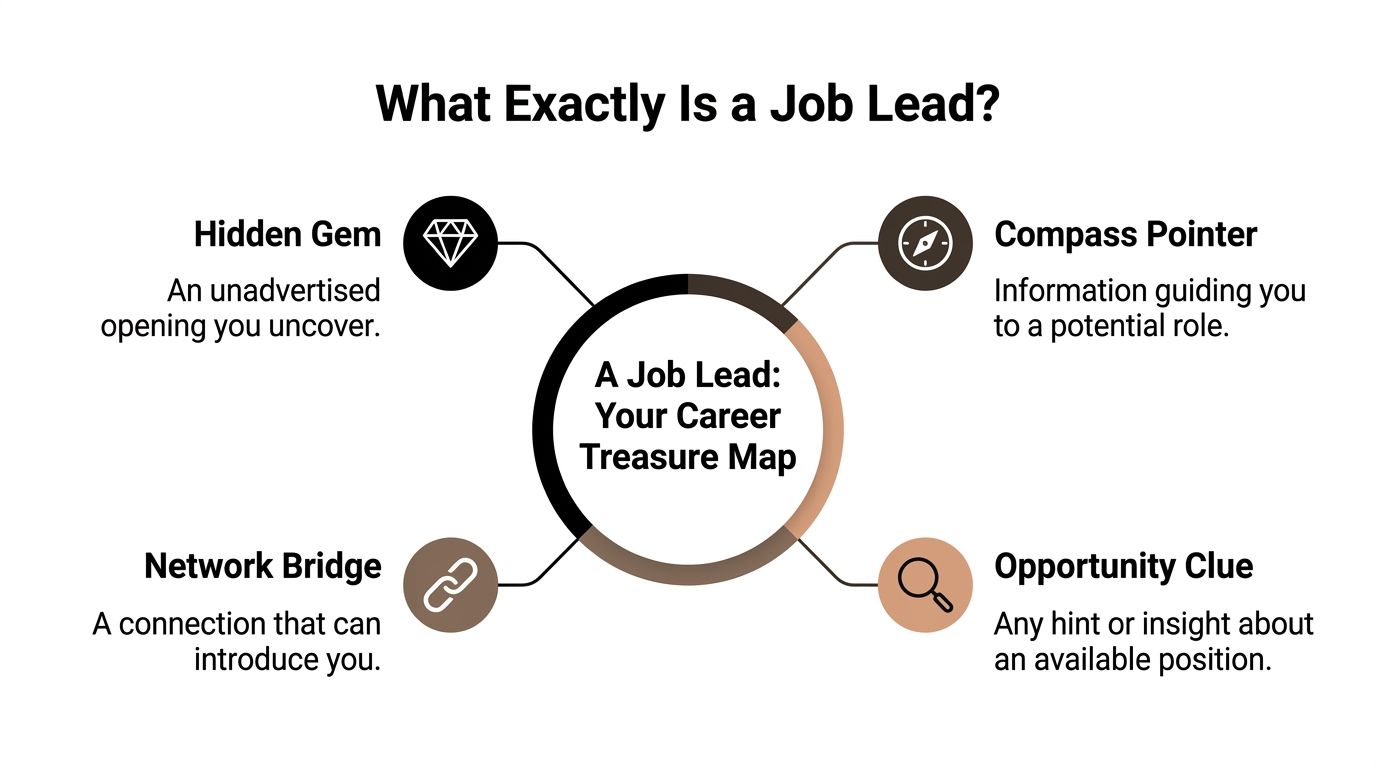
Think detective, not desperate applicant
A posting is the finished billboard. A lead is the breadcrumb trail before the billboard goes up.
Examples help:
- A referral lead means someone tells you their team is about to open a role.
- A recruiter lead happens when a recruiter reaches out because your background matches upcoming needs.
- A network lead could be a former manager saying, “My new company needs someone with your exact mix of skills.”
- A platform lead can be a fresh listing pulled directly from employer systems before it gets buried under noise.
A lead gives you direction. It tells you where to look, who to contact, what team is hiring, or what skill is in demand.
What a job lead is not
Many people find this confusing.
A job lead is not automatically a job offer. It’s also not the same thing as casually seeing a role on a giant board with no inside angle, no contact, and no context.
Here’s the easiest way to separate them:
| Type | What it means |
|---|---|
| Job posting | A public ad anyone can apply to |
| Job lead | Useful information that points you toward a real opening or likely opening |
| Referral | A specific type of lead passed through a person who knows you or the company |
That distinction matters because a lot of hiring activity never shows up in the obvious places. LinkedIn data cited by FlexJobs says 76% of jobs are never publicly posted, which is exactly why leads matter so much, especially if you’re trying to break past credential filters and get seen for your actual skills (FlexJobs on what job leads are and how to find them).
Practical rule: If a piece of information helps you move toward a role faster, warmer, or with more context, it’s a lead.
Why this matters for STARs
If you came up through nontraditional routes, leads can highlight the things automated filters miss. Your GitHub work. Your military operations background. Your HVAC certifications. Your customer-facing track record. Your apprenticeship hours.
Public postings often flatten people. Leads add context back in.
If you want more skills-first career resources beyond this article, browse the full career guides library. It’s useful when you’re trying to translate real experience into language employers understand.
Your Treasure Map of Job Lead Sources
Not all leads show up the same way. Some arrive warm, through people who know your work. Others come through communities, recruiters, or fresh listings you catch early. The trick is knowing where to focus first.
One of the most useful facts for no-degree candidates is this: a 2026 JobLeads study of 426,000+ surveyed seekers found that 62% of no-degree candidates secured tech and trades roles via leads from bootcamps or military transitions, versus 12% via boards alone. The same study noted 40% success rate from bootcamps and 35% from military transitions (Pros Marketplace on job leads).
That’s a giant clue. Your community is not a side quest. It’s often the main road.
The lead sources worth your energy
Some lead sources are high-trust. Some are high-volume. Some are best when you need speed.
| Source | Effectiveness | Effort Level | Best For |
|---|---|---|---|
| Bootcamp and training networks | Strong for skills-first openings | Medium | Career changers, junior tech talent |
| Military transition networks | Strong for trust-based introductions | Medium | Veterans moving into civilian roles |
| Former coworkers and managers | High when they’ve seen your work firsthand | Low to medium | People with solid job history or project experience |
| Recruiter outreach | Useful when your background is clear and searchable | Low after setup | Candidates with polished LinkedIn and resume materials |
| Industry communities | Good for early signals and insider info | Medium | Tradespeople, developers, cybersecurity learners, operators |
| Fresh skills-first job platforms | Good for discovering active roles that fit your background | Low to medium | Anyone who wants targeted listings without degree clutter |
Warm leads beat random clicks
A former supervisor saying, “Apply here and mention my name,” is a lead.
A bootcamp alum posting, “My company is hiring support engineers,” is a lead.
A veteran friend telling you which employers respect military logistics experience is a lead.
These leads are valuable because they come with context. You learn how the team works, what the manager actually cares about, and whether the stated requirements are flexible in practice.
Where STARs often overlook gold
A lot of people ignore the obvious sources because they feel “too small” or “not official enough.”
Don’t make that mistake.
- Cohorts and classmates: Bootcamp Slack groups, Discord communities, and alumni channels often surface openings before the public catches up.
- Service networks: Veterans’ communities can translate military experience into civilian language and point you toward employers who already get it.
- Trade circles: Apprenticeship contacts, union relationships, suppliers, and field supervisors often know who’s expanding.
- Skills-first job platforms: Curated listings can save you from wasting time on degree-heavy noise. If you want to see current opportunities built around capability rather than pedigree, check out degree-optional jobs across industries.
One lead source doesn’t have to do all the work. The strongest searches usually mix a few. One person opens a door. One recruiter confirms timing. One listing gives you the official requisition. That stack is where momentum starts.
Separating Gold from Gravel to Qualify Leads
Not every lead deserves your time.
Some are stale. Some are vague. Some sound exciting until you realize the role has nothing to do with what you want. If you chase every lead, your search turns chaotic fast.
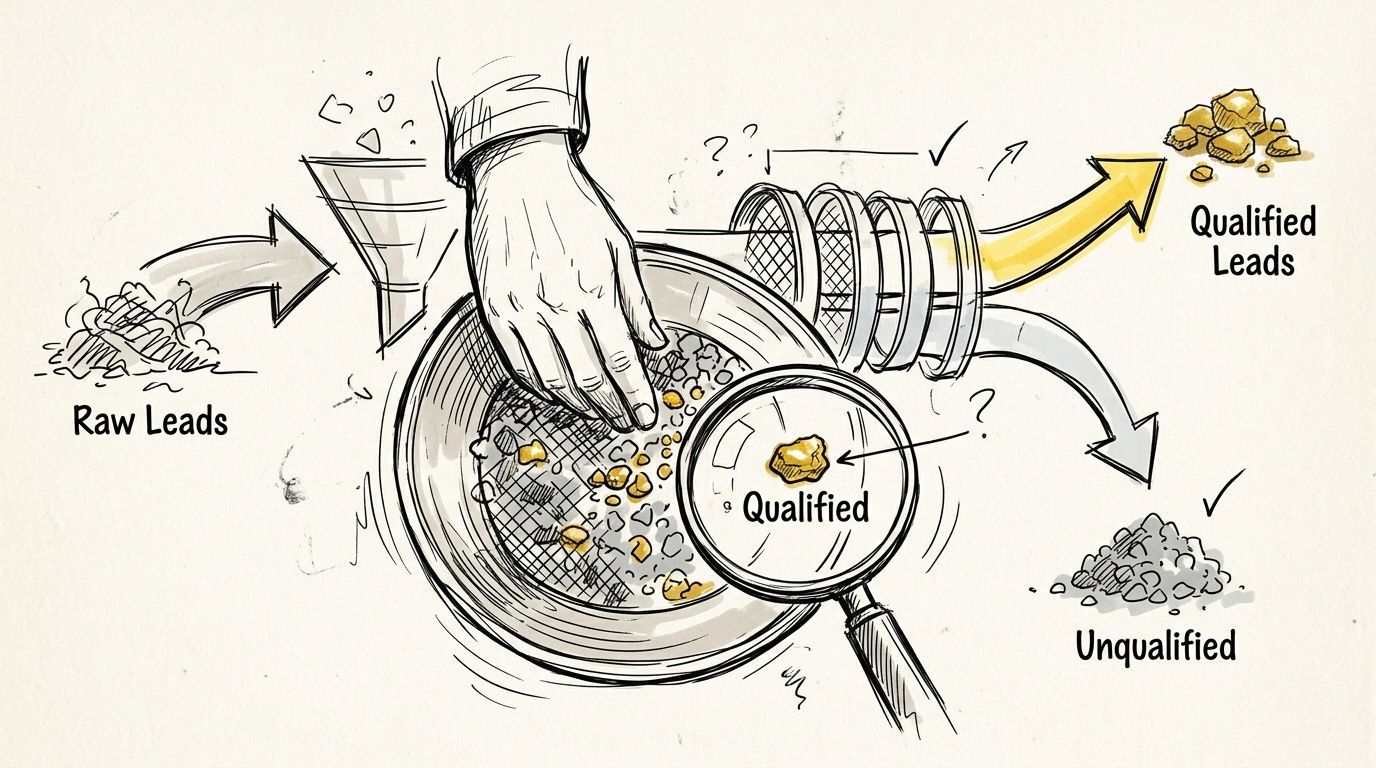
Ask better questions before you apply
A good lead should pass a few simple tests.
- Skill fit: Can you do the core work, even if the title varies?
- Signal strength: Did this come from a real person, a recruiter, or a current company source?
- Timing: Is the opening active, upcoming, or just hallway gossip?
- Employer mindset: Does the company seem open to skills-first hiring, or is it rigid about formal credentials?
- Interest level: Would you still want this job after the initial excitement wears off?
That last one matters more than people think. A lead is only “hot” if it fits your direction.
A simple filter for STARs
When you hear about an opportunity, run it through this mini checklist:
- Can I show proof of skill? Think projects, certifications, shift leadership, customer outcomes, GitHub work, or equipment experience.
- Can I name a relevant story? If you can already think of a real work example, that’s a strong sign.
- Would I want to talk to this team? Don’t ignore culture and environment.
- Do I know the next move? Apply, message someone, request a referral, or ask a clarifying question.
Good lead qualification is really just career due diligence. If you want a clean explanation of what due diligence entails, that concept maps well here. You’re gathering enough evidence to make a smart next move.
The red flags
Some leads are gravel dressed up like gold.
- No contact, no source, no detail: “I heard they might be hiring” is weak unless someone can verify it.
- Title mismatch: The name sounds right, but the actual work is way outside your lane.
- Credential trap: The team says they hire for skills, but everything in the process screams pedigree.
- Zero urgency: Nobody responds, nobody confirms, and the role feels ghostly.
A quick self-assessment can help you spot stronger-fit paths before you spend your week on the wrong ones. That’s where a tool like this career quiz for skills-first roles can be surprisingly useful.
How to Turn Hot Leads into Interviews
A lead only matters if you do something with it.
Often, people freeze. They find a promising opening, or someone introduces them to a hiring contact, and then they send a limp message that says, “Hi, just checking if you’re hiring.” That’s not fatal, but it’s not memorable either.
Start with a cleaner approach.
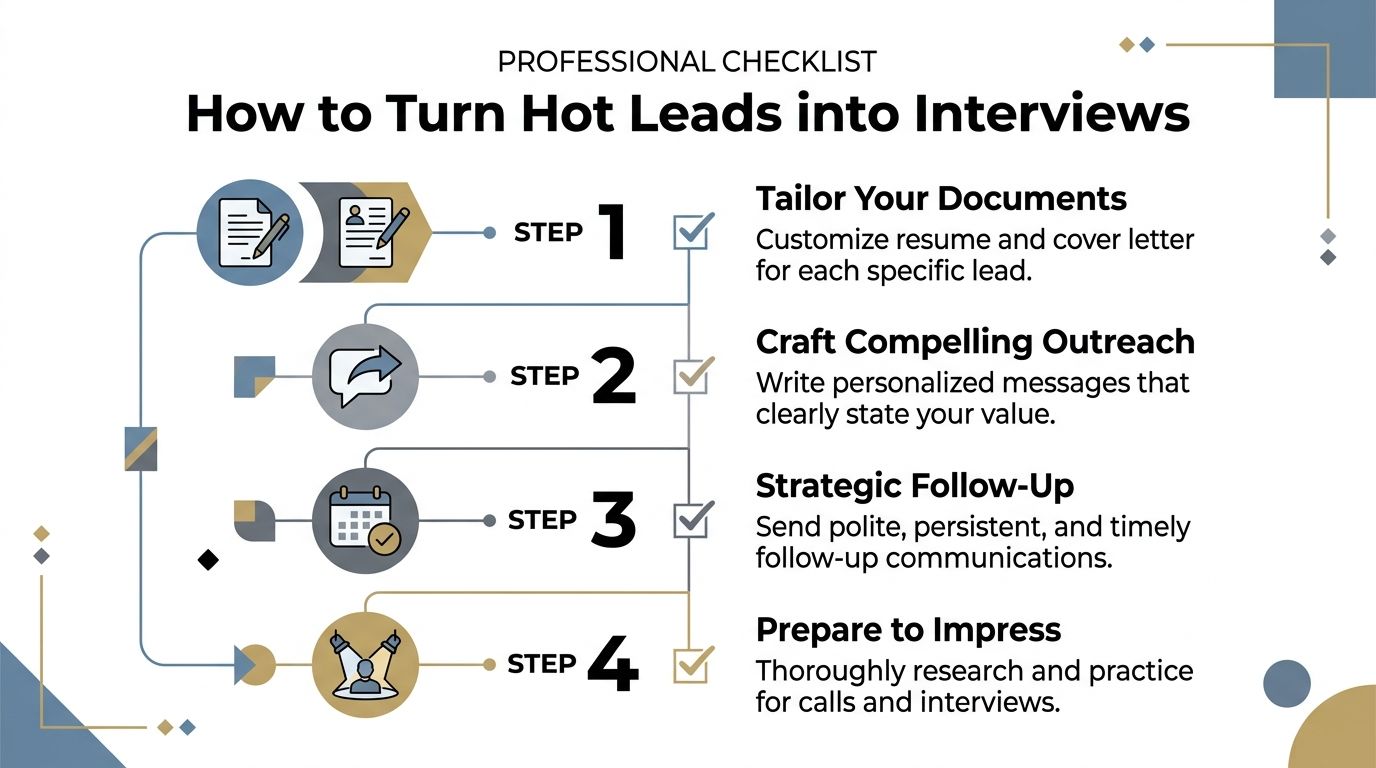
Lead with evidence, not life story
When you reach out, your job is not to tell your entire career tale. Your job is to make it easy for the other person to think, “This person sounds relevant. I should talk to them.”
That means your message should do four things:
- Show context: Why you’re reaching out.
- Show fit: What skills or experience line up.
- Show proof: A quick example of real work.
- Show an easy next step: Ask for a short conversation, a referral, or guidance.
The STAR method becomes useful before the interview, not just during it. Use a compressed version.
Use mini STAR stories in outreach
STAR stands for Situation, Task, Action, Result. You don’t need a giant paragraph. You need a small proof point.
Instead of: “I’m passionate about tech and eager to learn.”
I recently completed a support-to-systems transition project where I documented recurring IT issues, improved ticket handoff, and built a basic workflow guide for the team. That experience pushed me toward IT operations roles.
That’s a short, grounded signal. It tells the reader you’ve done real things.
Use this test: If your message could be sent by a thousand other applicants, rewrite it.
Here’s a short video if you want extra help thinking about outreach and interview conversion:
Templates you can actually use
Referral message
“Hi [Name], I saw your note about the [role/team]. My background is in [relevant area], and I’ve built experience through [work, military service, bootcamp, apprenticeship, certification]. In my last project, I [brief STAR-style proof]. If you think it makes sense, I’d love your advice on the best way to apply.”
This works because it’s respectful and specific. You’re not demanding a referral. You’re making it easy for them to offer one.
Recruiter reply
“Thanks for reaching out. The role looks aligned with my experience in [specific skill area]. I’ve handled [relevant example], and I’m especially interested in teams where hands-on experience matters. Happy to share a resume or portfolio if helpful.”
Short. Clear. No unnecessary fluff.
Warm cold email
Sometimes you have a lead, but no direct relationship.
“Hi [Name], I learned through [shared community/contact/context] that your team may be hiring for [role type]. My background includes [skills]. A recent example: [mini STAR proof]. If the team is still exploring candidates, I’d appreciate the chance to introduce myself.”
This is cold-ish, but not random. The lead gives it legitimacy.
Don’t send generic documents
A hot lead can cool off fast if your resume looks like it belongs to another role.
Tailor the basics:
- Match the language: If the team says “incident response,” don’t bury that under vague terms like “problem solving.”
- Move proof up: Put the strongest relevant experience near the top.
- Trim the clutter: Old jobs and unrelated bullets can sink the signal.
- Include practical assets: GitHub, portfolio, certifications, project summaries, or work samples.
If you need help polishing materials fast, a resume builder for skills-first candidates can make the tailoring process less painful.
Follow up like an adult, not a spam bot
A solid follow-up is simple. Thank them, restate interest, add one useful detail, and keep it moving.
Example:
“Hi [Name], following up on my note from last week. I’m still very interested in the role. Since I last wrote, I pulled together a short project summary showing my work in [relevant skill area]. Happy to share if useful.”
That kind of message feels professional because it adds value. It doesn’t just ask, “Any update?”
Track Your Leads Like a Pro
Once you start working with real leads, your search gets messier in a good way. You’ll have names, referrals, recruiter replies, possible openings, follow-ups, and half-finished conversations floating around. If you don’t track them, you’ll forget something important. Usually the good one.
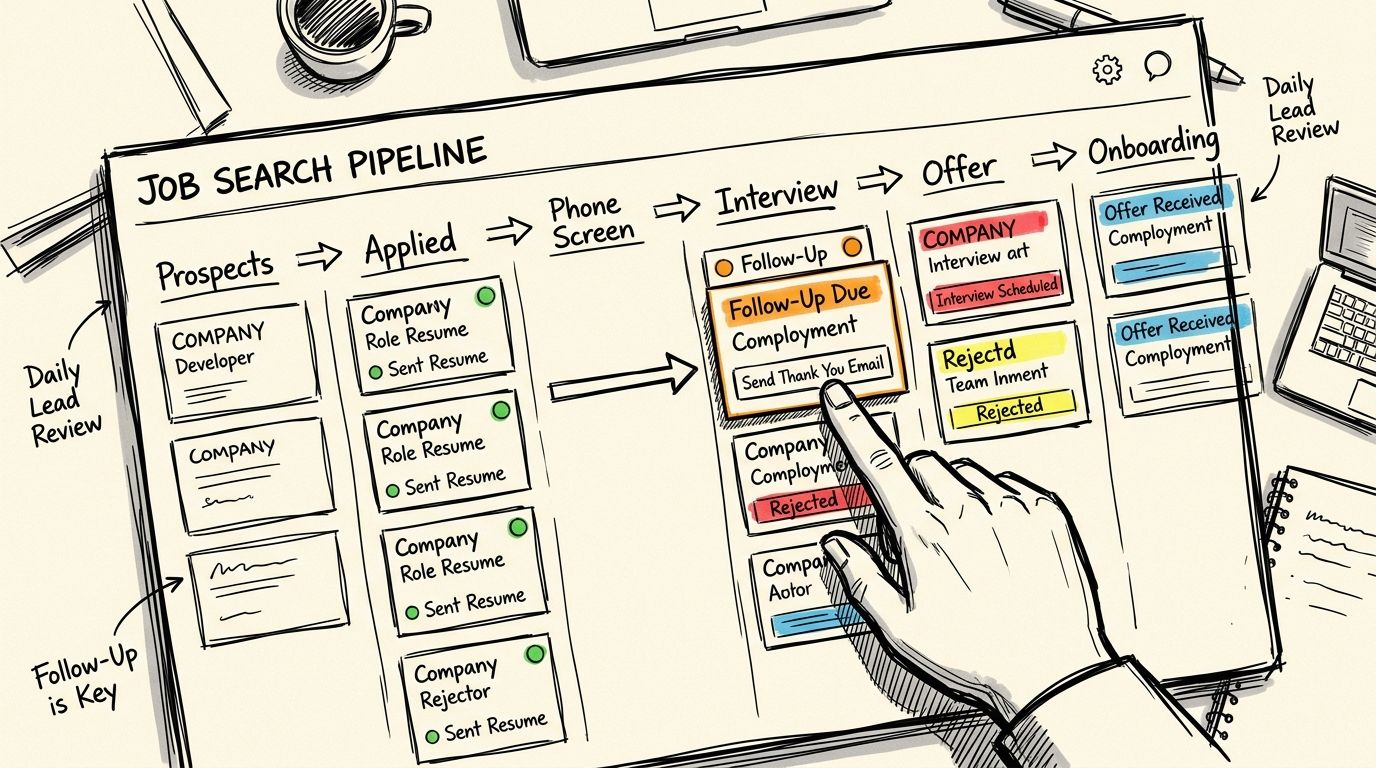
Your tracking system can be boring
That’s fine. Boring works.
A spreadsheet, a notebook, Airtable, Notion, Google Sheets, Trello. Pick one. The best system is the one you’ll update.
Track these fields:
| What to track | Why it matters |
|---|---|
| Company and role | Keeps your search grounded in actual targets |
| Lead source | Helps you see which channels are paying off |
| Contact person | Prevents awkward “who was that again?” moments |
| Last action taken | Shows where each lead stands |
| Next step | Turns vague hope into a task |
| Notes | Captures details like team culture, referral context, or timeline hints |
Keep the pipeline moving
Color-code if you want. Add labels like “new,” “contacted,” “waiting,” “interviewing,” and “closed.” That tiny bit of structure helps you focus energy where it counts.
A job search feels emotional when it lives in your head. It feels manageable when it lives in a system.
Review your tracker every few days. Archive dead leads. Revive warm ones. Update next steps before you forget why a role mattered.
Stop Hunting and Start Connecting
The biggest change isn’t tactical. It’s mental.
When people say “job hunt,” they usually mean searching harder, applying faster, and enduring more rejection. When you define job lead the right way, the whole process shifts. You stop acting like a contestant in a giant keyword lottery and start acting like someone building access to real opportunities.
That matters a lot for STARs.
Your background may not fit every checkbox on a public posting. That doesn’t mean you’re underqualified. It often means the fastest path forward is through context, proof, relationships, and timing. Leads help you bring those things into the process earlier.
So yes, keep some job boards in the mix. But don’t stop there. Ask people what they’re seeing. Reconnect with former teammates. Talk to your cohort. Follow up with recruiters. Pay attention to communities where real work gets discussed.
That’s how hidden opportunities stop being hidden.
And that’s how skilled people get seen for what they can do.
If you're ready to put this into practice, HiredBySkill is built for exactly this kind of search. You can explore degree-optional roles, find employers hiring for skills over diplomas, and use tools that make it easier to present your experience clearly and confidently.
Latest jobs
- General Service Technician — Big Brand Tire & Service
- Foam Dept — WM T BURNETT Holding LLC
- Day Porter - Janitorial (Part-Time) Weekend — Lot Management
- MAINTENANCE TECHNICIAN - PT — SOHUM MOUNTAIN HEALING
- Lead Front Desk Guest Ambassador / Tech Assistant — Precision Imaging Centers
- Counsel — Biourja Advisors LLC
- Workforce Training & Retention Coordinator — AbiMar Foods, Inc
- Business Office Manager — Snohomish of Cascadia LLC