How Far Back Should a Resume Go in 2026?
Wondering how far back should a resume go? See how many years to list for entry, mid and senior roles, plus what to cut and what to keep.
List roughly the last 10 to 15 years in full detail, and let your total experience set the page count, with one page for 0 to 5 years, one to two pages for 5 to 15 years, and two to three pages once you pass 15 years.
So why do strong candidates still open with a job from the late nineties? Conventional advice treats a resume like a birthday cake, one candle for every year you've been working. Hiring people don't eat the whole cake. They look for proof you can do this job now. That proof is an evidence filter, not an age cutoff. Veterans, bootcamp grads, apprentices, and self-taught workers often have their best clips outside a neat recent title, and those clips stay. Everything else gets a shorter line, or it goes.
Table of Contents
- Quick Answers by Experience Level
- Why the Last Decade or Two Carries the Weight
- Keep, Compress or Cut Older Jobs
- Two Pages Work When Page Two Earns Its Space
- Gaps, Graduation Dates and Other Age Clues
- A Trimmed Timeline in Action
- Tailor Your Keywords for Skills-First Hiring and ATS
- Set Your Timeframe Before You Hit Apply
Quick Answers by Experience Level
Match the years you spell out to the years a recruiter still needs, then stop. Career-resume guidance on ideal length ties page count to relevant experience, not to every year you've been employed: about one page for 0 to 5 years, one to two pages for about 5 to 15 years, and two to three pages for senior or executive candidates with 15 or more years. Older jobs get an Earlier Experience line, or they come off, unless they still prove a skill the posting asks for.
| Experience level | Years to detail in full | Typical length | What to cut or compress |
|---|---|---|---|
| Entry level (0-5 years) | Your whole short history | 1 page | Unrelated part-time jobs with no skill link to the target role |
| Mid-level (5-15 years) | Last 10 to 15 years | 1 to 2 pages | Roles older than 15 years, squeezed into an Earlier Experience line |
| Senior or executive (15+ years) | Last 10 to 15 years | 2 to 3 pages | Older roles unless they prove a skill the job still requires |
| Career changer or STAR (veteran, bootcamp, apprentice, self-taught) | Last 10 years plus older proof of target skills | 1 to 2 pages | Duplicate duties and roles with no link to the target job |
Entry level. Your whole short history usually fits on one page. The cut is the part-time job that doesn't touch the target skill. A campus coffee shift can stay if you trained new hires. A summer lifeguard gig usually can't, unless the posting wants safety or customer work.
Mid-level. Spell out the last 10 to 15 years. Squeeze anything older into one Earlier Experience line with employer, title, and dates. You're showing progression, not a scrapbook.
Senior or executive. Detail the recent decade, and stop at two or three pages. Keep an older role only when it still proves leadership level, a license, or a result the job wants today.
Career changers and STARs. Detail the recent decade, then park older proof of the target skill in Additional Experience. Military leadership, an apprenticeship, a bootcamp build, and open-source work belong there when the posting asks for that capability.
If you're unsure which path fits, a quick career quiz can point you at roles that match the skills you already have.
Count your total years. Mark the year 15 years back. For each older role, ask one question: does this add evidence the posting asks for? If yes, keep a tight version. If no, cut it. You're proving fit, not writing a life story.
Why the Last Decade or Two Carries the Weight
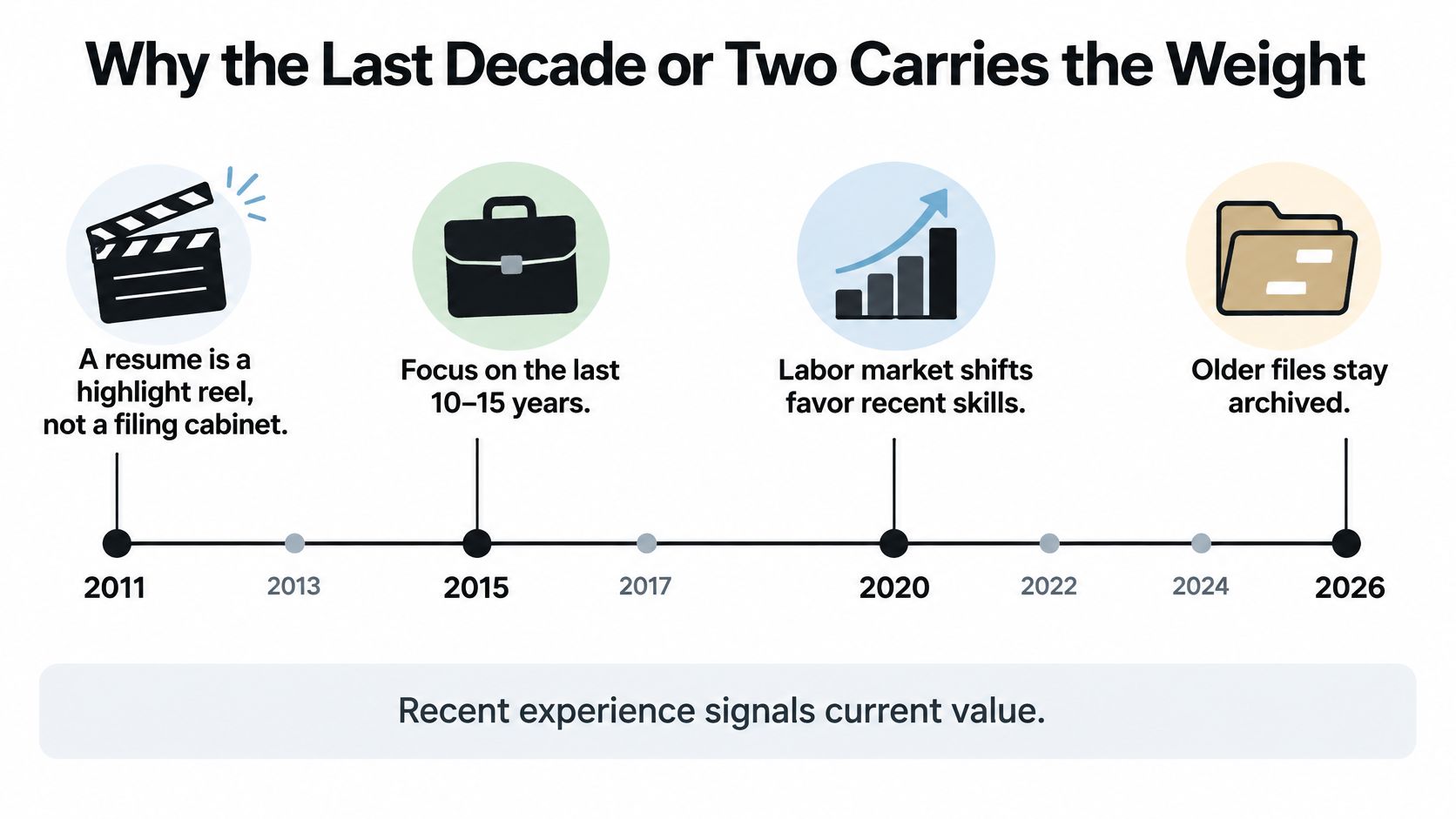
A resume is a highlight reel, not a filing cabinet. Nobody needs every file you ever made. They need the clips that show what you can do now.
Recent roles already tell a full story
The U.S. Bureau of Labor Statistics reported that wage-and-salary workers had a median tenure of 3.9 years with their current employer in January 2024, down from 4.1 years in January 2022, and the lowest level recorded since January 2002. A 10-year window often holds several recent jobs. You rarely need the 2000s to show how you grew.
Tools, methods, and metrics move. A hiring manager wants current fit: the system you run now, the safety standard you still use, the number you moved last quarter. Old bullets about software nobody installs anymore eat the space those proofs should occupy.
What the first glance has to carry
Recruiters often make a first fit or no-fit call in about six seconds, based on eye-tracking work published by The Ladders. Page one has to show the target role, core skills, latest experience, and strongest results before anyone turns a page.
Do the cutoff math once. Take 2026, subtract 15, and you land on 2011. That's the outer edge of full detail. For STARs, the filter is skills, not the calendar. Older military, apprenticeship, freelance, volunteer, or self-taught work stays when it proves a capability the job requires. Repetitive bullets and obsolete tools come off.
Practical rule: If a line doesn't change today's fit, it doesn't earn a full entry.
Keep, Compress or Cut Older Jobs
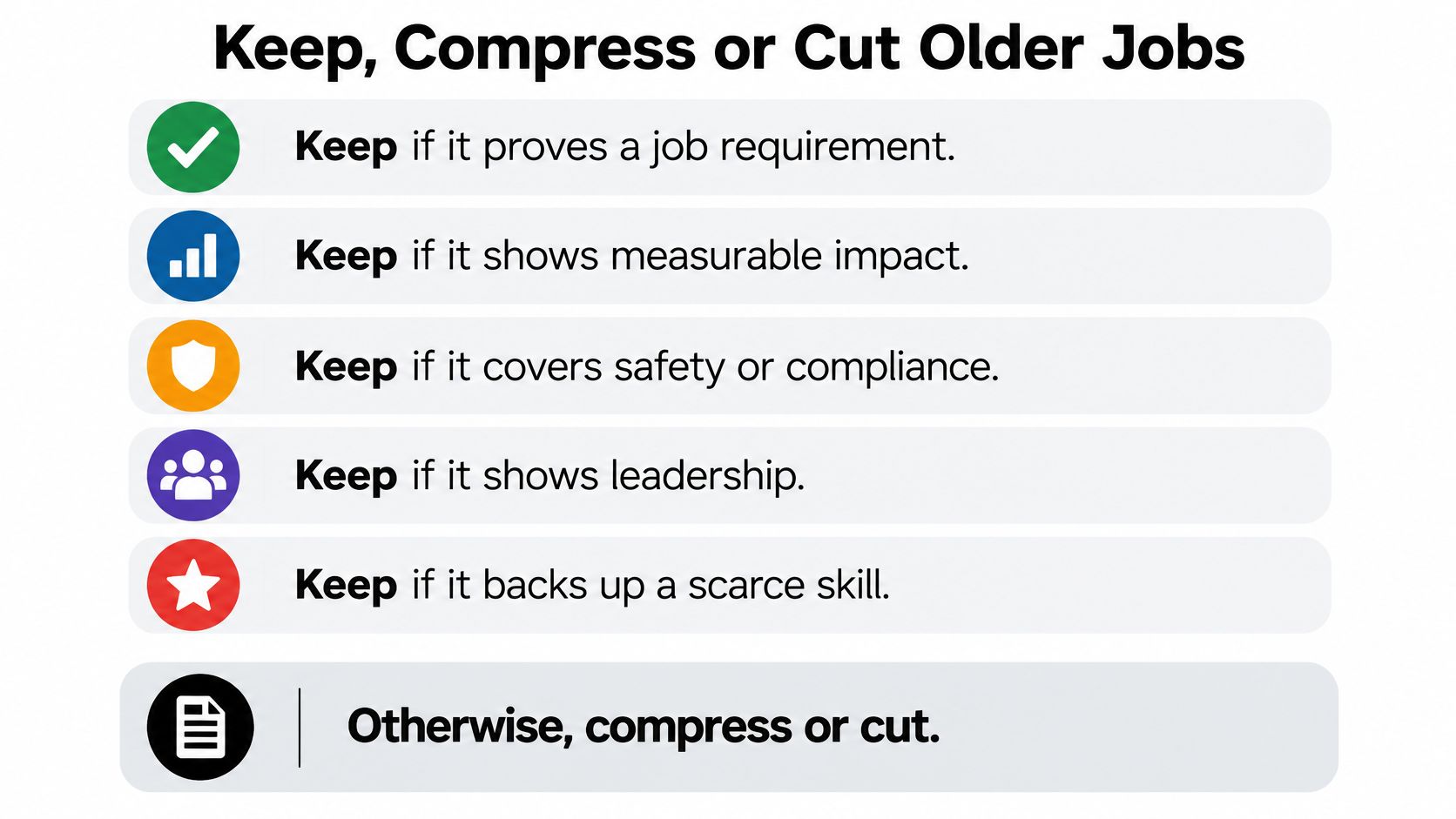
Keep an older role if it proves a requirement in the posting, shows measurable impact, covers safety or compliance, shows leadership, or backs a scarce certification. Compress it when it only repeats newer evidence. Cut it when it adds nothing.
| Older experience | Decision | Why |
|---|---|---|
| Military leadership role from 12 years ago | Keep | Proves leadership and a skill the target job asks for |
| Apprenticeship certification from 2009 | Keep | Scarce credential that backs up the requirement |
| Retail job from 2004 | Cut | Unrelated to the target role and adds no proof |
| Two warehouse roles with identical duties | Compress | Duplicate evidence, so one line in Earlier Experience is enough |
| Bootcamp capstone from two years ago | Keep | Recent, measurable and matches the target tools |
A military lead role from 12 years ago stays in full if the posting wants people leadership. An apprenticeship ticket from 2009 stays because that credential is still scarce. A 2004 retail job with no skill link goes. Two warehouse jobs with the same pick-pack-ship bullets collapse into one Earlier Experience line. A bootcamp capstone from two years ago stays up top, with the tool names and the result.
Skills-first employers still read the file
In TestGorilla's 2025 skills-based hiring report, 85% of surveyed employers reported using skills-based hiring, while resume use fell from 73% to 67% year over year. The file still gets read. It's judged on evidence.
STARs often hold their strongest proof in older military work, an apprenticeship, or an open-source project, not in last year's job title. Keep that proof visible, and write it in the posting's words so a human and a parser both catch it. Employers who hire on experience rather than diplomas are already listing roles this way, including the skills-first openings we group for people who learned on the job, in uniform, or in a bootcamp. If you want a clean layout for that extra section, the resume builder keeps Additional Experience readable instead of cramming it into a graphic.
Otherwise, compress or cut. Duplicate duty lists don't get you a second interview.
Two Pages Work When Page Two Earns Its Space
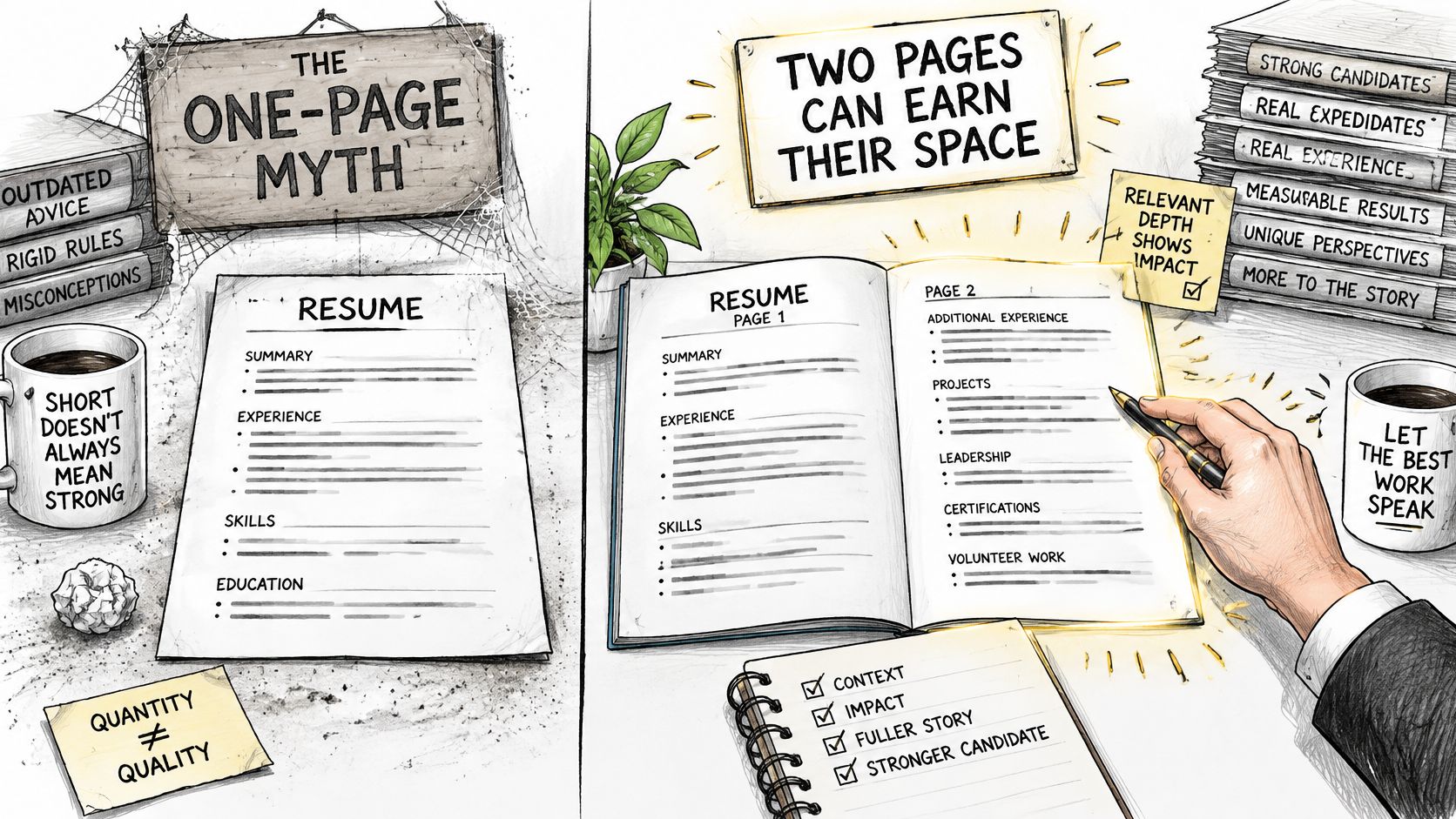
How much proof can you show without making a recruiter search for it? One page is a useful target, not a hard limit. A second page works when it adds relevant evidence and stays easy to scan.
A 2018 ResumeGo hiring simulation, covered by Business Insider's report on resume length, put nearly 20,000 one-page and two-page resumes in front of 482 recruiters, hiring managers, HR professionals, and executives. Of the 7,712 resumes selected for hiring, 5,375 were two pages and 2,337 were one page.
The preference grows with the job
The simulation found that two-page resumes were favored 2.6 times as often for mid-level roles and 2.9 times as often for managerial roles. Entry-level applicants were not automatically penalized for using two pages. Reviewers spent an average of 4 minutes 5 seconds on two-page resumes, compared with 2 minutes 24 seconds on one-page versions.
Page two should add evidence the first page cannot fit: a relevant project, certification, measurable outcome, or clear increase in responsibility. Another paragraph of routine duties adds length without helping a hiring manager judge your fit.
Keep the target title, core skills, recent experience, and strongest results on page one. A recruiter should be able to spot your match quickly; page two can support that case with detail. For layout ideas, browse these resume format guides.
Before you send it, check page two:
- Projects: Each one names a tool or outcome relevant to the posting.
- Certifications: The exact credential name appears.
- Numbers: Each result includes a metric, timeframe, or scope.
- Progression: A later role shows greater responsibility than an earlier one.
- No repeats: Page two does not restate a page-one bullet.
If fewer than three checks apply, edit the second page until it adds distinct, job-relevant proof.
Gaps, Graduation Dates and Other Age Clues
Trimming the timeline also changes what a stranger can guess about your age. That's a side effect, not the mission. The mission is still proof.
The Equal Employment Opportunity Commission says the Age Discrimination in Employment Act protects people who are 40 or older. U.S. federal law does not expressly ban an employer from asking age or date of birth, but those questions can discourage older workers from applying or suggest discriminatory intent. On the resume, leave off birth dates, graduation years, and very early job dates unless a form specifically asks for them.
What you never hide
Licenses, certifications, clearance status, and achievements that match the posting stay. A 2012 electrician license is a qualification. A 1998 high-school graduation year is a clue. Keep the first. Drop the second.
Name a gap in plain language. Caregiving, military transition, training, a bootcamp, independent projects. One line is enough, and it should point at something you built or learned.
Bootcamp, 2024 to 2025: Shipped a warehouse inventory app in Python and SQL, used by a volunteer food bank.
Self-taught stretch, 2023: Completed OSHA 30 and logged 200 hours on a home lab matching the posting's stack.
A photo can also date you faster than a graduation year. If you include one, the AiHeadshots resume photo guide walks through a current, neutral headshot so the picture doesn't do the guessing for them.
Trimming is focus. It is not a cover story. If an interviewer will ask, the resume should already tell the truth in one clean line.
A Trimmed Timeline in Action
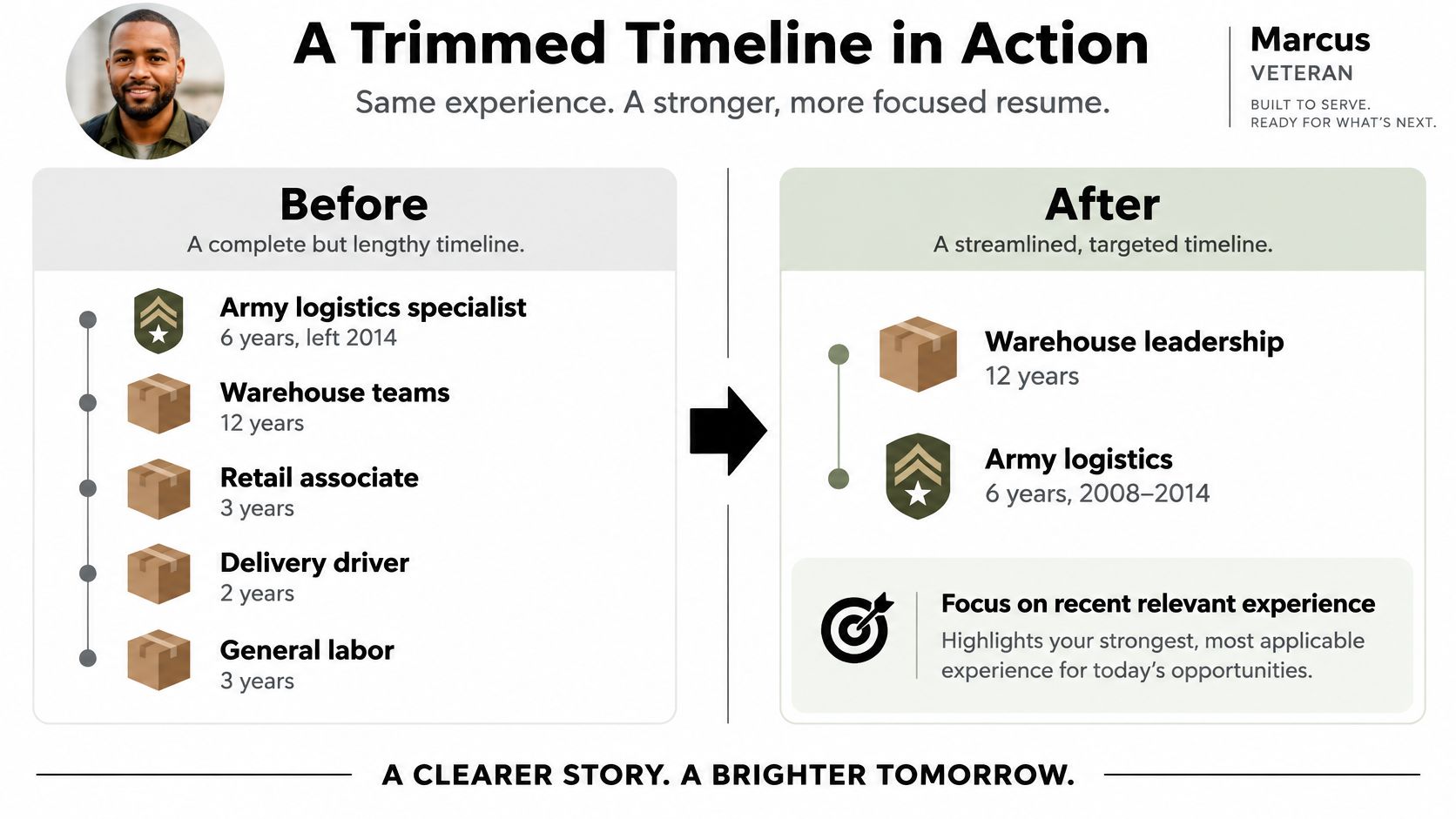
Say Marcus spent six years as an Army logistics specialist, left in 2014, then ran warehouse teams for 12 years. He wants a logistics supervisor role. His first draft is a 25-year chronology that starts in 1999.
Before
Summary: "Hardworking team player with 25 years of experience seeking new opportunities."
Entry: "Warehouse associate, 2003-2008: picked, packed, shipped, hit targets."
Every later warehouse shift repeats those same three verbs. Education ends with a graduation year. The Army block is as long as the current job, and nothing has a number.
After
Summary: "Logistics supervisor with 12 years leading warehouse teams, cut shrink by 18 percent and trained 40 forklift operators."
Entry: "Warehouse Operations Lead, 2014-2026: cut shrink by 18 percent in 18 months, owned dock scheduling for three shifts."
Additional Experience: "U.S. Army, Logistics Specialist, 2008-2014. Forklift Trainer Certification, 2019."
No graduation year.
What changed, and why you can copy the logic
- He stopped full detail at the recent warehouse leadership, because that's the job he's asking for now.
- He collapsed the duplicate pick-pack-ship roles, because one line of identical duties was enough.
- He kept the Army logistics role on a single line, because it still proves leadership and supply work.
- He put the 2019 forklift trainer certification next to that line, because the posting asks for training, not for a vibe.
- He swapped the generic summary for two results, because "hardworking" doesn't survive a skim.
- He removed the graduation year, because the license and the metrics already prove he's qualified.
Copy the decisions, not Marcus's sentences. Your numbers, your credential, your target title.
Tailor Your Keywords for Skills-First Hiring and ATS
Many applicant tracking systems read plain text. Your proof has to work for a parser and a person at the same time.
Use standard headings: Experience, Skills, Education, Additional Experience. Stick to one column. No text boxes, no graphics, and no tables holding the facts that have to be found. Start from the job search posting, not from a generic template.
Mirror the posting's words. If it says forklift operation, inventory control, or OSHA 30, write those phrases. Don't swap in "drove equipment" or "kept stock tidy."
A short skills block, then proof
Put 8 to 12 terms from the posting in a Skills block near the top. Then repeat each term inside a bullet that shows where you used it.
Before: "Taught people to drive stuff around the building."
After: "Forklift Trainer Certification, 2019: trained 40 operators on forklift operation and dock safety."
Save as a text-based PDF or a .docx. Paste the file into a plain text editor. If a certification name vanishes, it was trapped in a box or an image.
Last scan: every target keyword appears at least once, and it sits in a line that proves the skill, not in a lonely list.
Set Your Timeframe Before You Hit Apply
Run this tonight, before you hit apply.
- Count your total years and match them to your level's row, so you know the page budget before you write a word.
- Mark 2011 as the outer edge of full detail, and write everything after that year in full.
- Run each older role through keep, compress, or cut, and move the survivors into Earlier Experience or Additional Experience.
- Add a second page only when it carries a project, a certification, or a measurable outcome. If it doesn't, stop at one.
- Rewrite the top third in the posting's words, then do the plain-text keyword scan.
A good timeframe makes your strongest proof easy to find in seconds. That's the whole job of the page.
If you're also refreshing a photo for on-camera or stage work, casting portrait tips for actors cover a current, well-lit look that doesn't fight the rest of your materials. For the job itself, browse skills-based roles hiring now, from entry level through senior, and send the version that leads with proof.
HiredBySkill lists skills-based jobs that hire on experience, certifications, and hands-on proof rather than a diploma, which is exactly the evidence a trimmed resume is built to show. You can match your recent wins to a posting, then browse roles for veterans, bootcamp grads, and self-taught workers in one place. Start with the openings on HiredBySkill and send the version that leads with the last decade that proves you can do the work.
Latest jobs
- Teamassistenz* IT — Berenberg
- Night Hygiene Operative (Mon-Fri) — 2 Sisters Food Group
- Receptionist — RR Donnelley
- Activity Leader (Fixed Term Summer Contract) 2027 — ALPADIA Language Schools SA
- Logistics Specialist (m/w/d) — Damovo Deutschland GmbH & Co. KG
- Vendeur coordinateur ménager F/H/X — BUT
- Senior Openshift Platform Engineer — KPN
- R&D Chemist — Sika AG