How to Get CDL License in 2026: Step-by-Step Guide
Wondering how to get CDL license in 2026? Follow the 7 steps—permit, ELDT training, skills test—plus costs, timelines and state rules.
You've got a CDL school's enrollment page open, a job ad promising steady work in another tab, and no clear answer about which one comes first. Then somebody mentions a permit, a medical card, and a training registry. Suddenly, learning to back a trailer looks like the simple part.
Getting your commercial driver's license (CDL) is manageable when you treat it as a series of gates, not one big driving test. The trick is clearing them in the right order, without paying for the wrong training or showing up for a test you aren't eligible to take.
Table of Contents
- How to Get a CDL License in 2026 at a Glance
- Pick Your CDL Class and Endorsements First
- Get Your Commercial Learner's Permit
- Complete Entry-Level Driver Training the Right Way
- Pass the Three-Part CDL Skills Test
- State Rules, Fees and Timelines That Change the Plan
- Tips to Get Licensed Faster and Land Your First Job
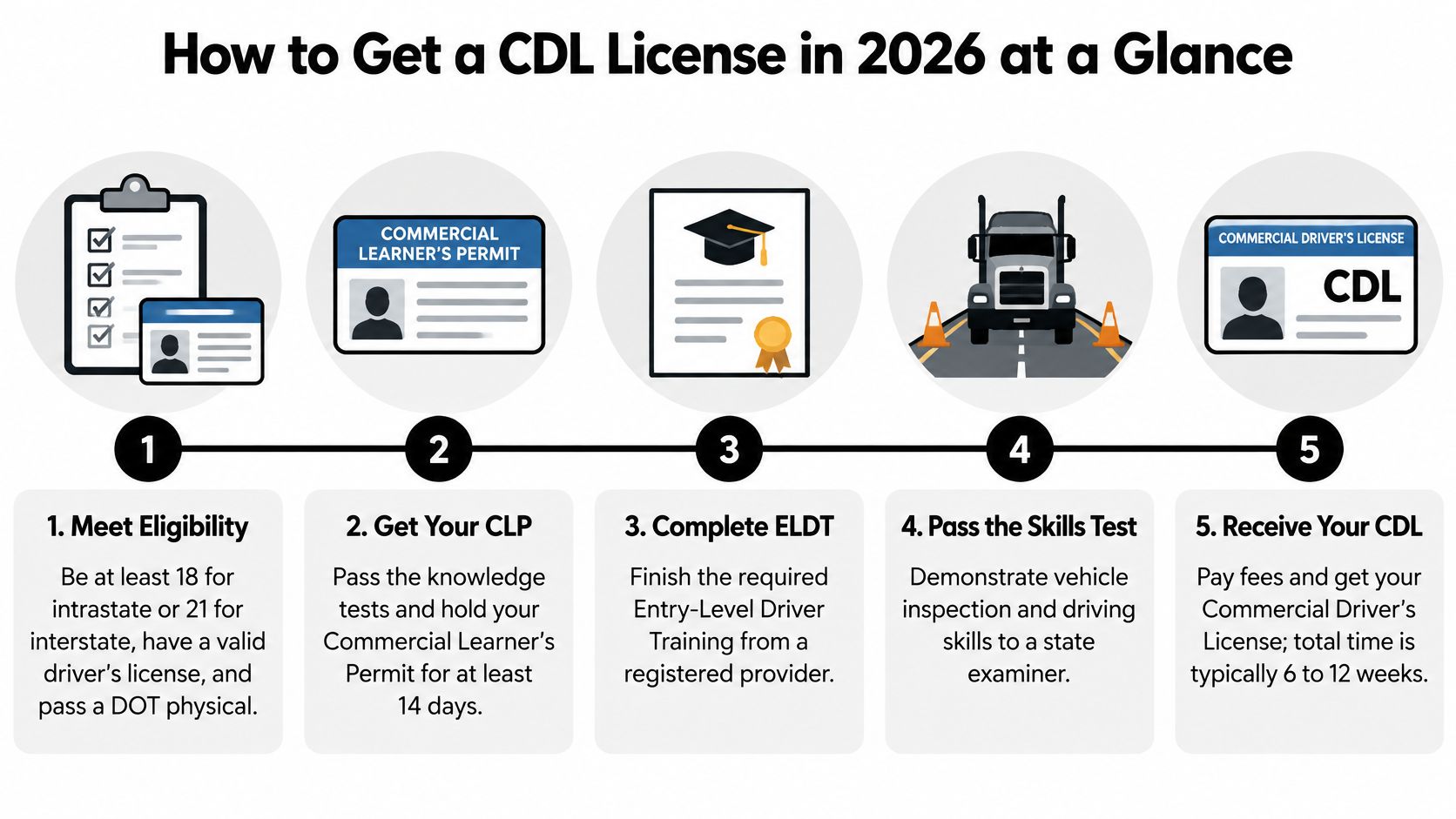
How to Get a CDL License in 2026 at a Glance
The quick answer is to choose your license, qualify for a learner's permit, complete the applicable training, and pass the driving examination. There isn't a reliable nationwide completion time: your school schedule, state requirements, testing availability, and readiness all affect the finish date.
The Bureau of Labor Statistics' truck-driver career guide describes the licensing pathway and the federal training framework implemented on February 7, 2022, which requires registered instruction for most new Class A and Class B applicants before skills testing.
Your route from application to license
- Pick your class and endorsements. Start with the work you want, whether that's tractor-trailers, dump trucks, passenger transportation, or another specialty. Your equipment determines your testing needs.
- Confirm eligibility. Check your existing driver's license, driving history, identity documents, and medical qualification requirements before committing tuition money.
- Study the state CDL manual. Prepare for general knowledge and any equipment-specific or endorsement examinations.
- Obtain your commercial learner's permit. The CLP lets you begin the supervised driving portion of the process under the applicable rules.
- Complete the required training. Use a provider listed in the Federal Motor Carrier Safety Administration's Training Provider Registry, and satisfy your permit-holding requirement.
- Pass the skills examination. Prepare separately for vehicle inspection, basic vehicle control, and on-road driving.
- Finish the state licensing transaction. Pay the remaining fees, confirm the license shows the correct credentials, and start applying for suitable jobs.
Keep the overall route in view while you handle the paperwork:
Scheduling rule: A school graduation date isn't proof that your training record has posted, and an available test appointment doesn't mean your permit is old enough.
Before you set a budget, compare driving work with other skilled occupations using the no-degree salary guide. Consider the schedule and lifestyle alongside earnings. A local delivery route and an over-the-road freight job can require very different commitments, even when both ask for a CDL.
Pick Your CDL Class and Endorsements First
Choose the job before choosing the course. Buying whichever program has the lowest advertised price can leave you qualified for equipment you don't want to drive.
Class A is the usual route for tractor-trailer work. Class B suits many straight-truck, dump-truck, and bus positions. Class C addresses qualifying passenger or hazardous-materials vehicles that don't fit the larger vehicle classes.
Vehicle weight ratings, trailer ratings, seating capacity, and cargo determine the actual classification. Don't classify a vehicle by appearance alone. A small-looking shuttle can still require passenger credentials, while a trailer can change the license needed for a truck combination.
Match the credential to the equipment
The FMCSA's state CDL standards require applicants generally to answer at least 80% correctly on each applicable knowledge test, with additional examinations for equipment and endorsements such as air brakes, tank vehicles, hazardous materials, passengers, and school buses.
That means passing general knowledge isn't a universal permission slip.
- Freight combinations: Regional flatbed or tractor-trailer work generally points toward Class A.
- School transportation: A typical full-size school-bus job calls for the appropriate bus class plus passenger and school-bus endorsements.
- Shuttle service: Check both seating capacity and vehicle rating before assuming Class C with a passenger endorsement is sufficient.
- Air-brake equipment: Prepare for the applicable air-brake requirements. Avoid a restriction that shuts you out of the vehicles your target employer uses.
CDL classes and endorsements at a glance
| Code | Covers | Extra tests | ELDT training |
|---|---|---|---|
| Class A | Qualifying heavy combination vehicles, such as tractor-trailers | Combination vehicles; air brakes when applicable | Yes for first-time applicants, theory plus behind the wheel |
| Class B | Qualifying heavy single vehicles, including straight trucks, dump trucks, and transit buses | Air brakes when applicable; endorsements for the job | Yes for first-time applicants, theory plus behind the wheel |
| Class C | Qualifying smaller passenger or hazardous-materials vehicles | Applicable passenger or hazardous-materials tests | Only when seeking a covered first-time P, S, or H endorsement |
| H (Hazmat) | Hazardous materials requiring the endorsement | Hazmat knowledge test plus TSA threat assessment | Yes, theory only |
| P (Passenger) | Qualifying passenger vehicles | Passenger knowledge and skills tests | Yes for first-time applicants, theory plus behind the wheel |
| S (School bus) | School-bus operations | School-bus knowledge and skills tests; applicable background checks | Yes for first-time applicants, theory plus behind the wheel |
| N (Tank) | Qualifying liquid or gas tank vehicles | Tank knowledge test | No |
| T (Doubles/Triples) | Double or triple trailers | Doubles/triples knowledge test | No |
You don't need to collect every endorsement immediately. Hazmat, in particular, adds a security-screening process rather than just another chapter to study.
Write down your intended class, endorsements, and test-vehicle configuration before applying. That little note can prevent a surprisingly expensive detour.
Get Your Commercial Learner's Permit
The permit phase is a paperwork gauntlet: one missing document, one mismatched address, or the wrong class code can turn a planned DMV visit into an unpaid day off. Build the folder before you join the queue.
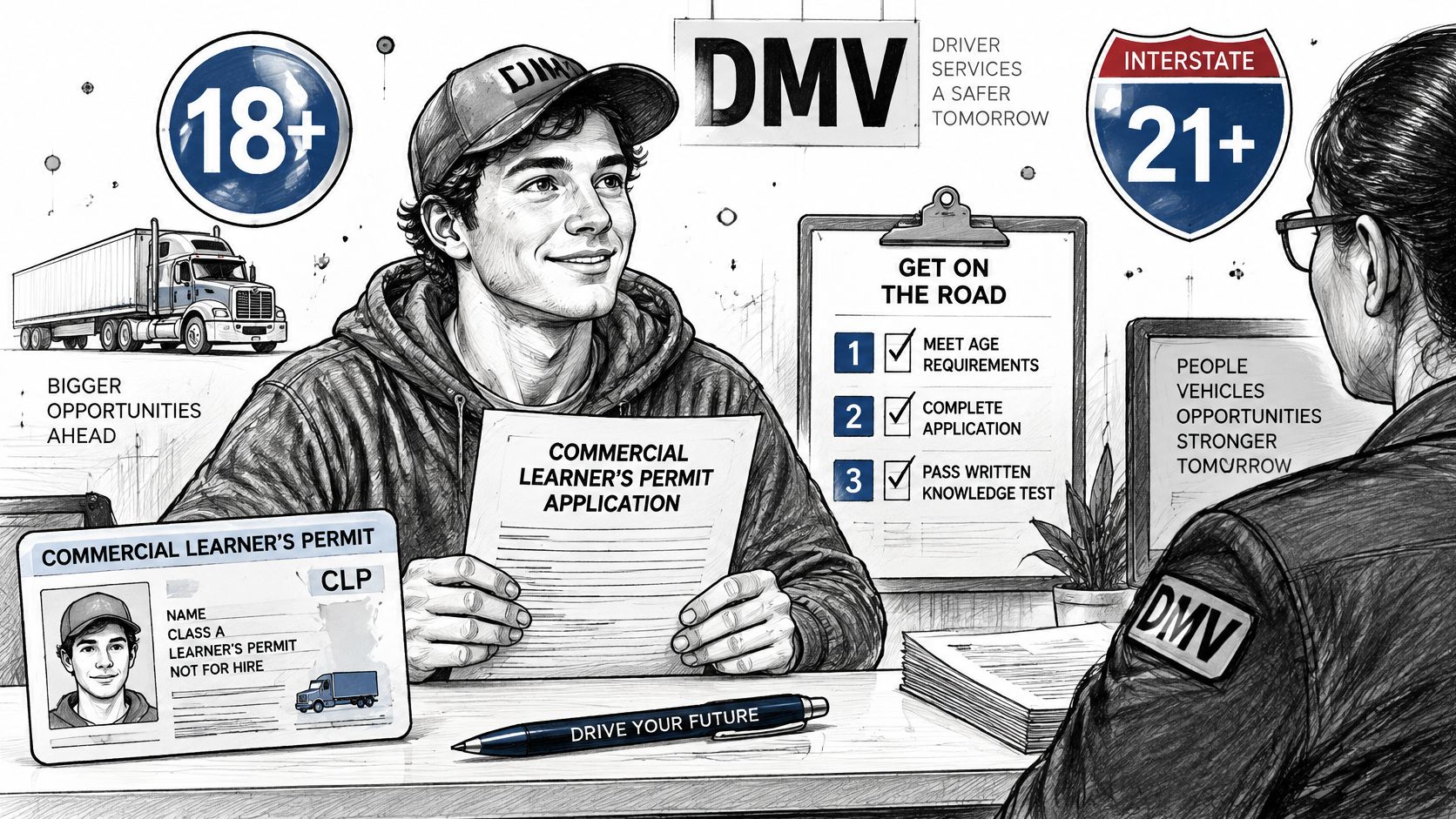
Build the application in order
- Check your eligibility and driving history. The FMCSA's CDL application guidance says licensing agencies check driving records across all 50 states and the District of Columbia for the previous 10 years, and applicants generally must hold their CLP for at least 14 days before skills testing. Pull your record early if old addresses, suspensions, or unresolved tickets might surface.
- Sort out medical qualification. Confirm your operation category and whether you need a medical examiner's certificate. The certificate must come from a certified medical examiner, and your licensing agency sets which documents you submit; a state permit page such as DOT medical exam for truck drivers can show how one office lays out the paperwork, but your own agency's list controls.
- Download your state CDL manual. Study the sections matching your class, brakes, and endorsements. Practice questions help you review, but the manual is what exam wording is built from.
- Practice until you can explain the answer. If you guessed right, mark it for review anyway. Give extra attention to stopping distance, railroad crossings, inspection procedures, and equipment questions with look-alike wording.
- Prepare the documents your state requests. Verify identity, residency, Social Security documentation, medical information, forms, and payment methods before you leave. Names and addresses should agree across documents, and fee rules can differ enough by state to surprise you at the counter.
- Take the required examinations and inspect the permit. Finish the knowledge and vision requirements, then check the printed class, endorsements, restrictions, and expiration date before walking away.
A permit issued for the wrong class is not a harmless typo if it blocks the vehicle you planned to train or test in. Fix discrepancies at the counter, because the 14-day hold makes every correction expensive in calendar time.
Make study time useful
Keep an error notebook with the topic, the correct rule, and why you missed it. Repeated air-system misses mean review that system, not another shuffled quiz.
Use video to make written procedures click, especially when a sequence is easier to understand after seeing it:
Say inspection terms out loud while you study. The later test rewards drivers who can explain what they are checking, not just recognize the right bubble.
Complete Entry-Level Driver Training the Right Way
Entry-Level Driver Training (ELDT) is a licensing requirement, not an optional school certificate you can replace with confidence behind the wheel.
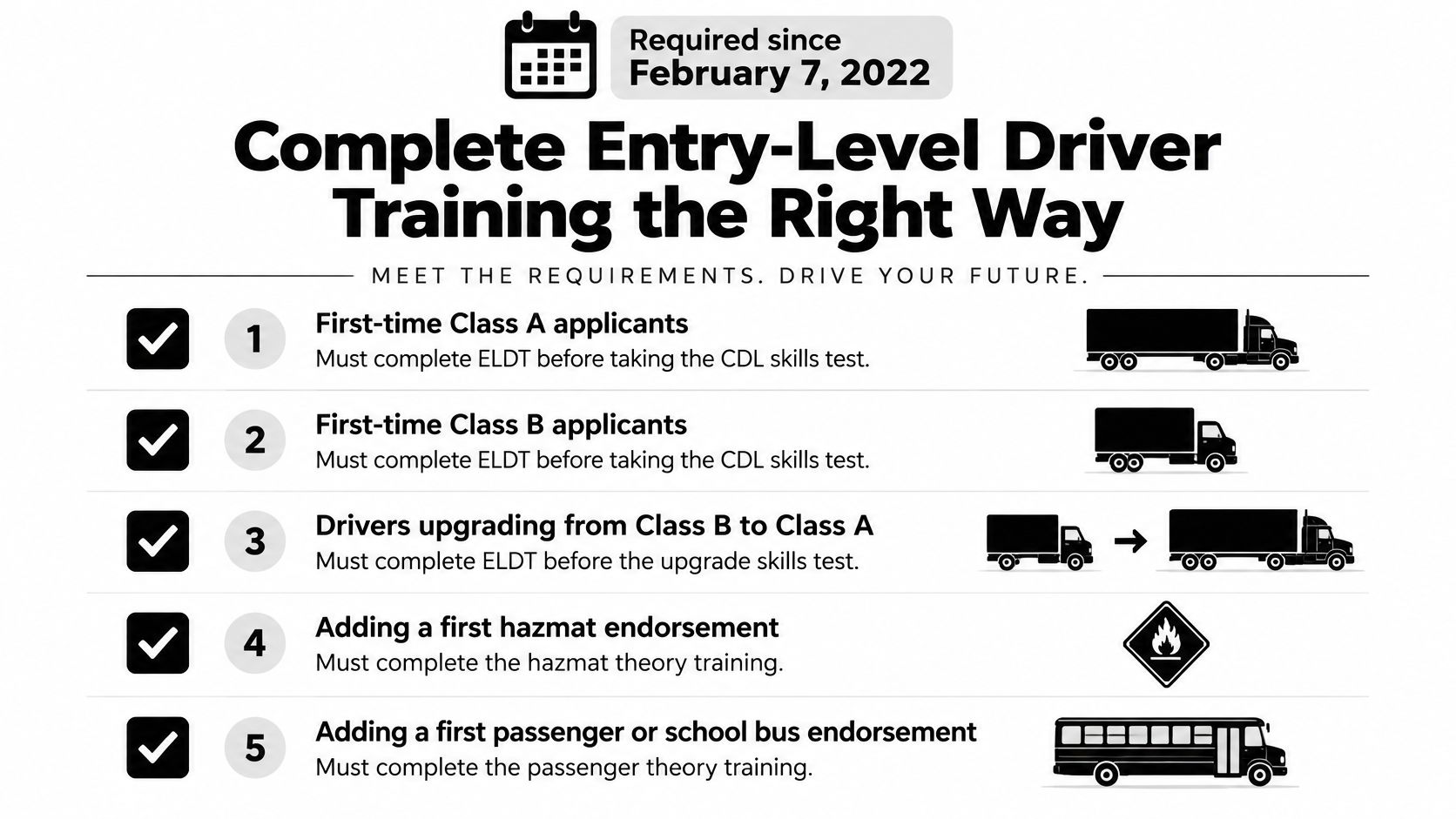
According to the FMCSA Training Provider Registry's driver requirements, since February 7, 2022, covered applicants include first-time Class A and Class B applicants, drivers upgrading from Class B to Class A, and applicants seeking their first hazardous-materials, passenger, or school-bus endorsement. Class A and B training includes theory, range instruction, and public-road instruction; passenger and school-bus training also includes theory and behind-the-wheel work, while hazmat requires theory before its knowledge examination.
Use this checklist to identify the training category, then verify the actual curriculum with the provider:
Check the school before paying
Look up the provider in the federal registry yourself. Match the business name, location, and training offered to the program you're buying, rather than accepting a screenshot or a salesperson's assurance.
- Confirm what tuition includes. Get a written breakdown covering instruction, testing, vehicle use, extra practice, retests, and refund terms.
- Ask about actual driving time. Time standing beside a training truck isn't the same as time controlling it.
- Check equipment and restrictions. Understand whether the test vehicle's transmission or brake configuration could limit the license you receive.
- Identify the reporting owner. Ask who submits completion, how you'll confirm it, and whom to contact if the record doesn't appear.
An FMCSA enforcement announcement reported the emergency removal of more than 110 ELDT providers. That's a concrete reason to verify registration rather than shopping on price alone.
Cheap tuition isn't cheap if you have to buy the training again.
Compare the contract, not just the headline price
Private schools may offer concentrated schedules, but financing terms and extra vehicle rental charges deserve a close read. Community colleges can suit applicants who need an academic calendar or part-time format, though local availability matters.
Employer-sponsored training can reduce the cash needed upfront. In exchange, you may accept a work commitment, repayment obligation, or limited choice of assignments. Read what happens if you leave, fail training, or don't receive the work you expected.
Language preparation belongs in that comparison too. Skills testing is conducted in English, so choose instruction that helps you understand road signs, spoken directions, and inspection vocabulary. Translated study support can help you learn; don't assume an interpreter can assist during the skills examination.
Pass the Three-Part CDL Skills Test
The skills test comes in three scored parts: vehicle inspection, basic controls, and road driving. Each one stands on its own. A smooth highway drive can't rescue a failed inspection, and reciting inspection phrases won't cover up poor vehicle control.
Many states cap how many times you can retest and charge a fee for each new appointment, so confirm your own state's attempt limits and retest costs before test day. Ask the testing office one direct question: if I fail one part, do the parts I passed still count? The answer changes how much a bad morning costs you.
Vehicle inspection without the guessing game
Walk the vehicle in a fixed order: engine compartment, exterior, tires and wheels, coupling equipment where it applies, then in-cab and brake checks. A fixed route matters because nerves make you skip steps. Follow your state's current testing procedure and your instructor's guidance for the exact vehicle you'll test in.
Say what you're inspecting, what condition it should be in, and how you know. Pointing at a component and saying it looks fine shows the examiner almost nothing.
For air-system practice, the SAAT Repairs Corp roadside brake checks page works as supplementary reading on leakage testing. Then rehearse the exact sequence on your test vehicle. A general online walkthrough is no substitute for your state manual.
Basic controls with a plan
Train the maneuvers your state tests. Straight-line backing, offset backing, alley docking, and parallel parking all show up in training yards, but testing sites don't all run identical layouts, so practice the skill rather than one painted course.
- Set up deliberately. A poor starting position creates extra work before you've backed any meaningful distance.
- Make small corrections. Chasing the trailer with large steering inputs usually leaves you chasing it in the opposite direction next.
- Use permitted safety checks. Learn the rules for getting out and looking, pull-ups, and boundary lines before test day, not during it.
- Reset when necessary. Know why a maneuver went wrong before repeating it.
Road driving that looks calm because it is
Practice lane position, mirror checks, signals, turns, stopping space, transmission operation, railroad crossings, and hazard recognition. Work unfamiliar intersections into your sessions. Memorizing a rumored test route isn't the same as learning to drive, and examiners notice the difference within a few blocks.
Before you leave the yard: Check the truck as though nobody else has checked it.
Bring a representative, roadworthy vehicle with functioning lights, mirrors, tires, and safety equipment. Confirm your permit eligibility and training record with the testing office before committing to the appointment, since showing up ineligible burns an attempt and a fee.
Ask your instructor for a full mock examination without coaching. That reveals whether you can perform independently, which is the point of the actual test.
Sleep properly, arrive early, and do a deliberate walk-around. Test morning is a bad time to discover a broken lamp or realize you've only practiced inspections with somebody feeding you the next answer.
State Rules, Fees and Timelines That Change the Plan
Two applicants can clear the same federal process and walk away with very different totals. Your state controls the application details, fee schedule, testing arrangements, and extra conditions that decide what you pay and how fast you can finish.
Start by separating licensing fees from training expenses. A quoted CDL fee covers only the state paperwork. Tuition, medical appointments, transportation, missed work, test-vehicle use, and repeat appointments sit outside that number, and they usually cost more than the license itself.
State rules, fees and timelines compared
| State | Rule or perk to know | Cost figures |
|---|---|---|
| New Jersey | The commercial examination receipt and the license are separate charges | The New Jersey Motor Vehicle Commission lists a 2026 examination receipt fee of $125, plus $42 for a four-year CDL and $2 per endorsement |
| Virginia | Permit-holding and training requirements apply before skills testing | The Virginia DMV lists a $64 standard CDL valid for eight years |
| Illinois | The job's operating scope matters as much as the credential itself | The Illinois Secretary of State sets the age floor at 18 for intrastate operation and 21 for interstate commerce or passenger transportation, and itemizes permit, license, and endorsement charges as separate line items, so each credential you add grows the total |
| California | Skills-test attempts are limited and retesting carries a charge | Each failed attempt adds another state retest fee, and schools commonly bill separately for use of their test truck, so one repeat appointment can hit your budget twice |
| Wisconsin | Published workforce funding can reduce qualifying training expenses | The Wisconsin Department of Workforce Development's 2024 announcement for its 2025 program described reimbursement of up to 50% of training costs or $3,000 per trainee, whichever is less; confirm current availability |
Treat the Wisconsin example as a funding lead worth chasing while you confirm the current award. Ask participating programs about workforce grants, WIOA eligibility, employer sponsorship, and GI Bill coverage at approved programs before signing a loan.
Build a calendar from confirmed dates
Never plan a resignation around a school's fastest advertised graduation. Get real dates for enrollment, required driving sessions, completion reporting, the earliest eligible skills examination, and license issuance, then work backward from the last one.
- Protect your income. Include travel and unpaid training time in the budget before you commit.
- Price the downside. Ask what another practice session, a canceled appointment, or a retest costs, because that is the bill waiting for you when a test day goes wrong.
- Check the driving record early. A conviction or suspension can affect licensing and employer eligibility differently, and a surprise at the counter is an expensive one.
If a DUI is part of your history, this DUI defense guide for CDL holders lays out the questions worth asking a qualified attorney before you spend money on training. A recruiter's casual assurance about a legal disqualification is worth nothing at the DMV counter.
Run the offer math before you borrow. A salary calculator lets you test whether an expected wage supports your household once training debt and commuting costs come out of it. Base the decision on realistic take-home pay, because the biggest number in a recruitment ad rarely survives first contact with a real budget.
Tips to Get Licensed Faster and Land Your First Job
The best shortcut is removing avoidable delays. Rushing weak skills into an examination usually trades a little preparation time for another appointment, another bill, and more nerves.
Spend effort where it saves rework
- Handle medical questions before tuition. Resolve qualification and documentation issues before you're committed to a course.
- Train for an actual job. Read local advertisements and note the equipment, endorsements, experience, and schedule employers request.
- Study consistently. Short daily sessions with an error notebook beat rereading the entire manual in a panic.
- Speak the inspection aloud. Practice without prompts, then have somebody interrupt with a question so you learn the system rather than a speech.
- Verify readiness before booking. Check both administrative eligibility and your ability to complete a mock test independently.
- Add credentials with a purpose. A tanker or hazmat endorsement can broaden suitable applications, but choose it because employers want it, not because more letters automatically mean better pay.
The payoff is worth evaluating carefully. The Bureau of Labor Statistics' truck-transportation figures report approximately 900,880 heavy and tractor-trailer truck-driver jobs in the industry in 2025, with median pay of $60,320 annually, or $29.00 an hour, and project 4% occupational employment growth from 2025 through 2035.
Those earnings aren't a guaranteed rookie offer. Freight, location, experience, endorsements, mileage, and scheduling all matter. Ask whether compensation includes loading time, waiting, orientation, and other work that doesn't put miles on the truck.
Turn the credential into an application
Put your CDL class, endorsements, relevant training, and actual equipment experience near the top of your resume. Describe transferable skills: equipment inspection, safe material handling, customer communication, shift reliability, and following documented procedures can all matter.
Over 70 million Americans are STARs, workers Skilled Through Alternative Routes such as military service, community college, bootcamps, apprenticeships, and on-the-job learning. At HiredBySkill, we serve people who built capabilities through those routes, including veterans, tradespeople, bootcamp graduates, and self-taught professionals.
Start with nearby logistics and warehousing jobs, save suitable searches, and compare entry requirements before applying. Your first driving job should be one you're qualified to do safely, with terms you understand.
Bring your new credential to HiredBySkill, our free skills-first platform with over 100,000 openings, a resume builder, and a career quiz. Build a resume that puts your CDL and practical abilities up front, then search for nearby driving and logistics roles that match your license and preferred schedule.
Latest jobs
- Teamassistenz* IT — Berenberg
- Night Hygiene Operative (Mon-Fri) — 2 Sisters Food Group
- Receptionist — RR Donnelley
- Activity Leader (Fixed Term Summer Contract) 2027 — ALPADIA Language Schools SA
- Logistics Specialist (m/w/d) — Damovo Deutschland GmbH & Co. KG
- Vendeur coordinateur ménager F/H/X — BUT
- Senior Openshift Platform Engineer — KPN
- R&D Chemist — Sika AG