Master Translating Military Experience to Civilian Resume
Translating military experience to civilian resume - Struggling with translating military experience to a civilian resume? Our guide helps decode your service,
You’ve probably done this already. Opened a blank doc, typed your name, then hit a wall the second you tried to explain what you did in uniform.
On your side, the experience is obvious. You led people. You handled pressure. You kept operations moving when conditions were messy and stakes were real. On the civilian side, none of that lands if it’s buried under rank, acronyms, and language only another service member would understand.
That’s the frustrating part of translating military experience to civilian resume. The work itself is valuable. The packaging is usually the problem.
Civilian employers are not hiring your branch, your MOS, or your ribbon stack. They’re hiring for outcomes. They want to know if you can lead a team, manage inventory, train staff, improve processes, solve problems, and show up ready. You probably can. Your resume just has to say it in a way they can use.
Table of Contents
- Your Next Mission Should You Choose to Accept It
- Crack the Code and Find Your Civilian Skills
- Ditch the Jargon and Speak Civilian
- Show Your Impact with Powerful Numbers
- Build a Resume for Modern Skills-First Hiring
- Your True North After the Military
Your Next Mission Should You Choose to Accept It
A lot of veterans think they’re bad at resumes. Usually that’s not true. What’s true is that they’re trying to translate a career built for one system into a hiring process built for another.
That disconnect is common. Nearly 70% of veterans report feeling overwhelmed when converting their military experience into business language, and only one in four of the nearly 200,000 service members transitioning annually has a job lined up, according to Orion Talent’s transition resume guidance.
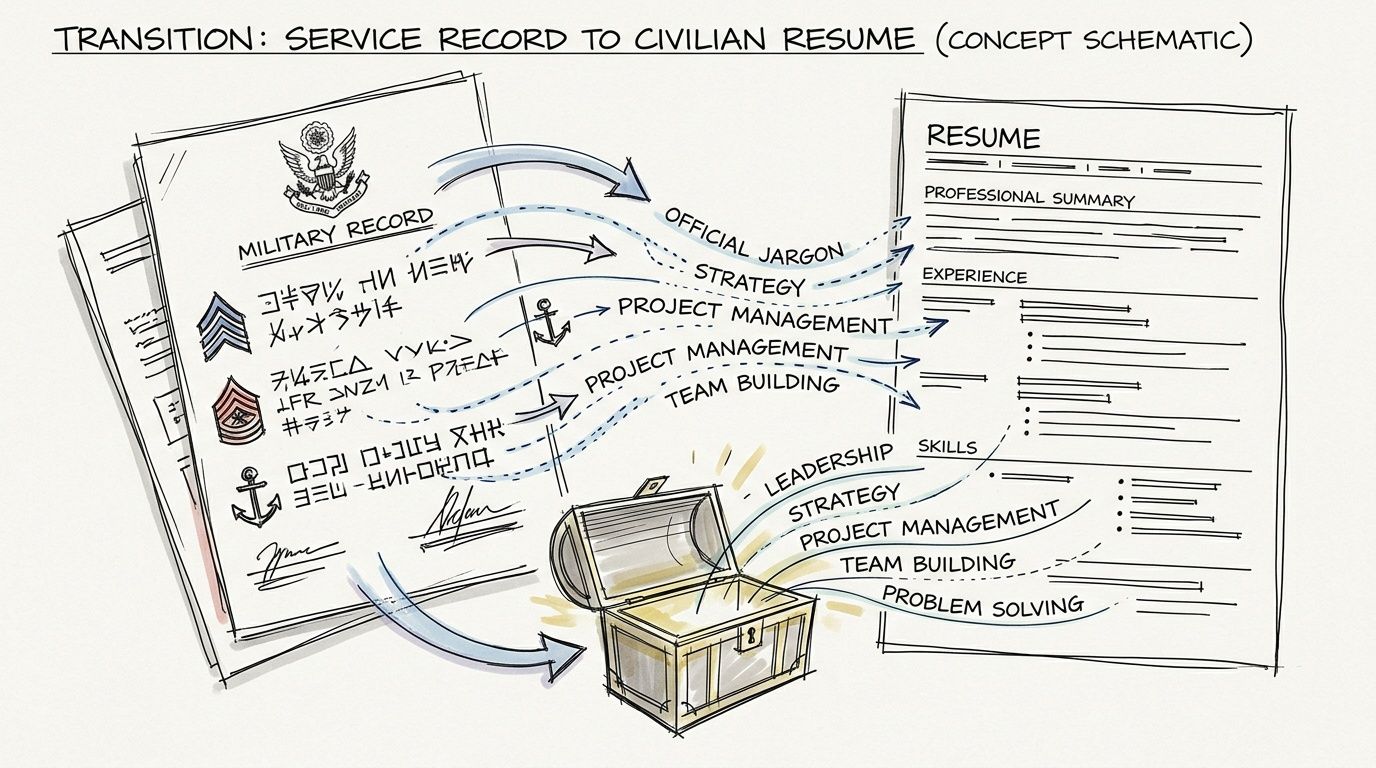
That’s why the blank page feels heavier than it should. You’re not just writing bullets. You’re decoding years of responsibility into language a recruiter can scan in seconds.
The real problem isn’t your experience
The service teaches you to be precise inside the military system. That precision becomes a problem when the civilian reader has no clue what your title means or why your mission mattered.
A bullet like this looks solid to another veteran:
- Military version: Served as NCOIC for unit readiness, supervised junior personnel, maintained accountability of assigned assets
To a civilian hiring manager, that’s fog.
Now look at the same idea in resume language:
- Civilian version: Supervised team operations, coached junior staff, and maintained accountability for high-value equipment in a fast-paced environment
Same work. Better signal.
Practical rule: If a civilian cousin can’t explain your bullet back to you after reading it once, it’s still too military.
Treat this like a briefing, not a writing exercise
The most useful mindset shift is simple. Don’t ask, “How do I describe my service?” Ask, “What business problem did I solve, and how would an employer label that work?”
That’s how you stop writing from memory and start writing for impact.
A civilian paycheck doesn’t go to the person with the most impressive military phrasing. It goes to the person who makes their value obvious. Your resume’s job is to remove friction. Fast.
Crack the Code and Find Your Civilian Skills
Most veterans start with job titles. That’s the wrong starting point.
Civilian employers don’t care much that you were an infantryman, boatswain’s mate, maintainer, corpsman, or signal support specialist in the way the military cares. They care about the functions inside that role. That’s where your real resume material lives.
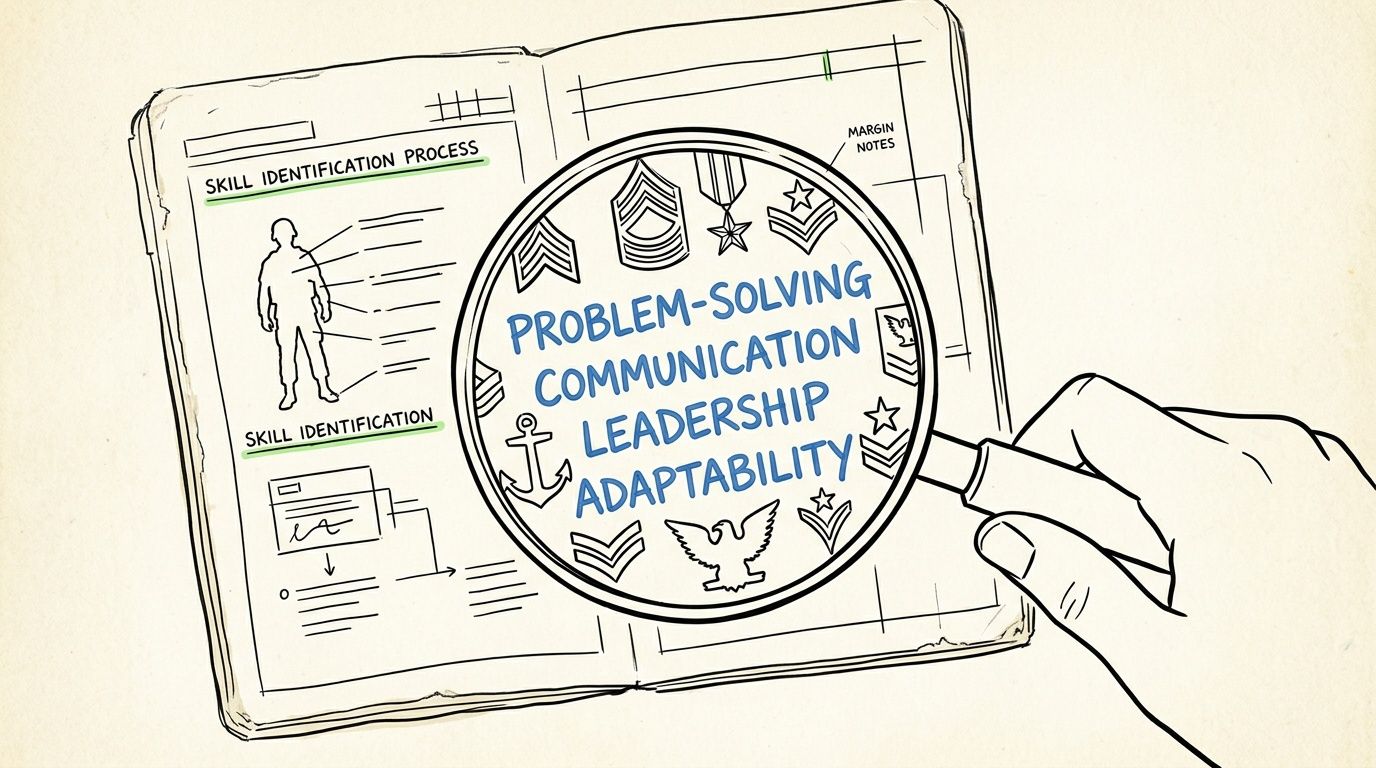
The good news is there’s a big shared pool of experience to work from. 57% of all enlisted servicemembers are in the top 10 most common jobs for their branch, which means a lot of military experience maps into repeatable civilian categories like leadership, logistics, and technical operations, according to the U.S. Department of Labor pilot study on translating military skills.
Start with function not title
Write your role at the top of a page. Under it, ignore the title and list what you did.
Not in military language. In plain English.
Here’s the kind of breakdown that works:
- If you trained people: You did onboarding, instruction, coaching, performance improvement, and skills development.
- If you tracked gear: You did inventory control, asset management, accountability, logistics, and loss prevention.
- If you ran missions or schedules: You did operations coordination, planning, prioritization, and deadline management.
- If you led troops: You did team leadership, supervision, conflict management, mentoring, and quality control.
- If you worked maintenance or comms: You did troubleshooting, systems support, inspection, documentation, and technical operations.
That alone clears up a lot.
An E-9 with years of infantry experience may not look like an obvious corporate candidate on paper. But if that person trained personnel, supported operations across multiple countries, and managed inventory worth $65 million, that’s not “just infantry.” That’s leadership, logistics, training, and operational control.
Build a skills inventory before you write
Don’t open your resume yet. Build a source document first.
Use four columns:
| Category | What you did | Civilian skill | Proof |
|---|---|---|---|
| Leadership | Led shift, squad, shop, section, or crew | Team leadership | Number of people supervised |
| Operations | Planned tasks, schedules, readiness, movement | Operations coordination | Scope, tempo, deadlines |
| Logistics | Tracked gear, parts, supply, maintenance | Inventory and asset management | Equipment value, accuracy, volume |
| Training | Taught standards, qualified new personnel | Training and onboarding | Number trained, timeline, results |
That document becomes your ammo for resumes, applications, and interviews.
Use tools to help if you need a starting point. O*NET can help map military roles to civilian occupations. If you’re not sure where your experience fits best, a career matching tool like the career quiz can help narrow the field before you start tailoring.
A quick visual walkthrough helps too:
Your MOS is background information. Your transferable skills are the product.
Ditch the Jargon and Speak Civilian
Military language is efficient inside the wire. On a civilian resume, it’s expensive. It costs you clarity, and clarity is what gets interviews.
The resume doesn’t need to sound less impressive. It needs to sound immediately understandable.
Why military language fails on civilian resumes
Civilian recruiters move fast. If they hit a line filled with acronyms, rank references, or unit-specific language, they don’t stop to decode it. They skip ahead or move on.
That means phrases like these usually underperform:
- NCOIC
- OIC
- battle rhythm
- force protection
- property book
- command climate
- convoy ops
- mission essential tasking
None of those are wrong. They’re just not buyer-friendly.
A better move is to translate the business meaning of the work. That means swapping military labels for civilian job functions and replacing heroic sounding generalities with plain outcomes.
Don’t write to impress another veteran. Write so a recruiter can match you to a job in one pass.
If you need help tightening phrasing and removing robotic bullets, this guide on AI resume tips is useful for cleanup, especially when your first draft still sounds like an eval.
Military jargon to civilian gold translation
Here’s the table I wish more transitioning service members used early.
Military jargon to civilian gold translation
| Military Phrasing (Before) | Civilian Translation (After) |
|---|---|
| Served as NCOIC for daily operations | Supervised daily operations and team execution |
| Led troops in combat | Managed a team in high-pressure environments with accountability for personnel safety and mission performance |
| Maintained property book accountability | Managed inventory and tracked assigned equipment and assets |
| Responsible for unit readiness | Coordinated training, compliance, and operational readiness across the team |
| Conducted PMCS on tactical vehicles | Performed preventive maintenance inspections and documented equipment status |
| Briefed command staff on mission updates | Presented operational updates and risk information to senior leadership |
| Trained junior enlisted soldiers | Trained and mentored junior staff on procedures, standards, and performance expectations |
| Coordinated convoy operations | Planned and executed time-sensitive transportation and logistics movements |
| Worked in joint operations environment | Collaborated across cross-functional teams in complex operating environments |
| Promoted in combat zone | Recognized for leadership and performance in critical situations |
A good translation keeps the difficulty of the job while stripping out the insider language.
Bad civilianization sounds fake. Good civilianization sounds clear.
For example, don’t turn every veteran into a “dynamic strategic executive leader.” That’s resume costume jewelry. “Team lead,” “operations supervisor,” “logistics coordinator,” or “training specialist” usually lands better because those titles connect to real jobs.
Show Your Impact with Powerful Numbers
Here’s where a lot of military resumes still come up short. They describe duties like a job description instead of proving performance.
Civilian employers assume you had responsibilities. They want evidence that you handled them well.
That’s where numbers do the heavy lifting.
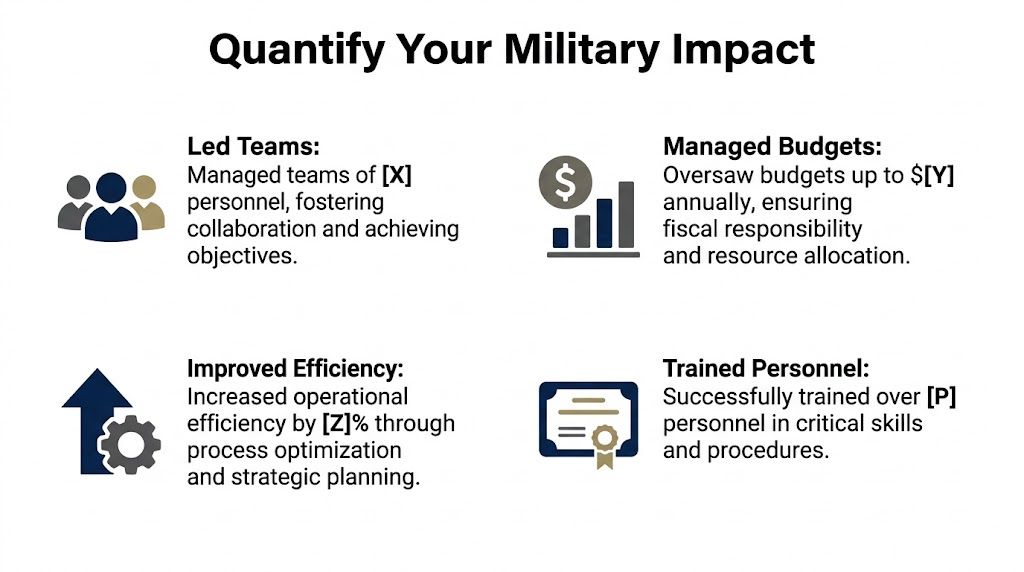
Using the STAR method to create quantified, results-oriented bullet points can yield up to 35% higher interview rates, and 85% of hiring managers prioritize resumes with measurable impact data, according to Operation Family Fund’s skills translation guide.
STAR gives your experience a shape
You don’t need to turn your whole resume into a long narrative. You just need each strong bullet to answer four quiet questions:
- Situation: What was going on?
- Task: What were you responsible for?
- Action: What did you do?
- Result: What changed because of you?
That structure keeps you from writing vague bullets like “Responsible for supply operations.”
Compare these:
- Weak: Managed supplies for unit
- Stronger: Coordinated logistics for 500+ personnel, managing $1.2 million in inventory with 99.8% accuracy
- Weak: Led training
- Stronger: Trained 40 personnel, improving efficiency by 35% and reducing onboarding from 8 weeks to 5 weeks
Those numbers make the work real.
The numbers worth digging up
Veterans usually have more measurable experience than they think. Pull from evals, award bullets, training records, maintenance logs, counseling packets, readiness trackers, and memory if needed.
Look for:
People Number of personnel led, trained, mentored, or supported.
Money and assets Equipment value, inventory value, or budget responsibility. Examples from military-to-civilian translation often include oversight like $5 million in equipment for 100 soldiers, or a mission example involving a 12-person team with responsibility for $2.3 million in equipment.
Scope Sites covered, countries supported, volume handled, or size of operation.
Results Accuracy, mission completion, incidents avoided, readiness gains, processing time, or training speed.
A hiring manager may not understand your mission set. They always understand scale, responsibility, and results.
A practical trick. If you’re applying to a new field and don’t know what compensation should look like, check a tool like the salary calculator before you tailor your bullets. It helps you aim your resume at roles that match the level of responsibility you already carried.
If your draft doesn’t include numbers anywhere, it probably reads like a duty log. Fix that first.
Build a Resume for Modern Skills-First Hiring
A lot of resume advice still acts like every employer hires the same way. They don’t.
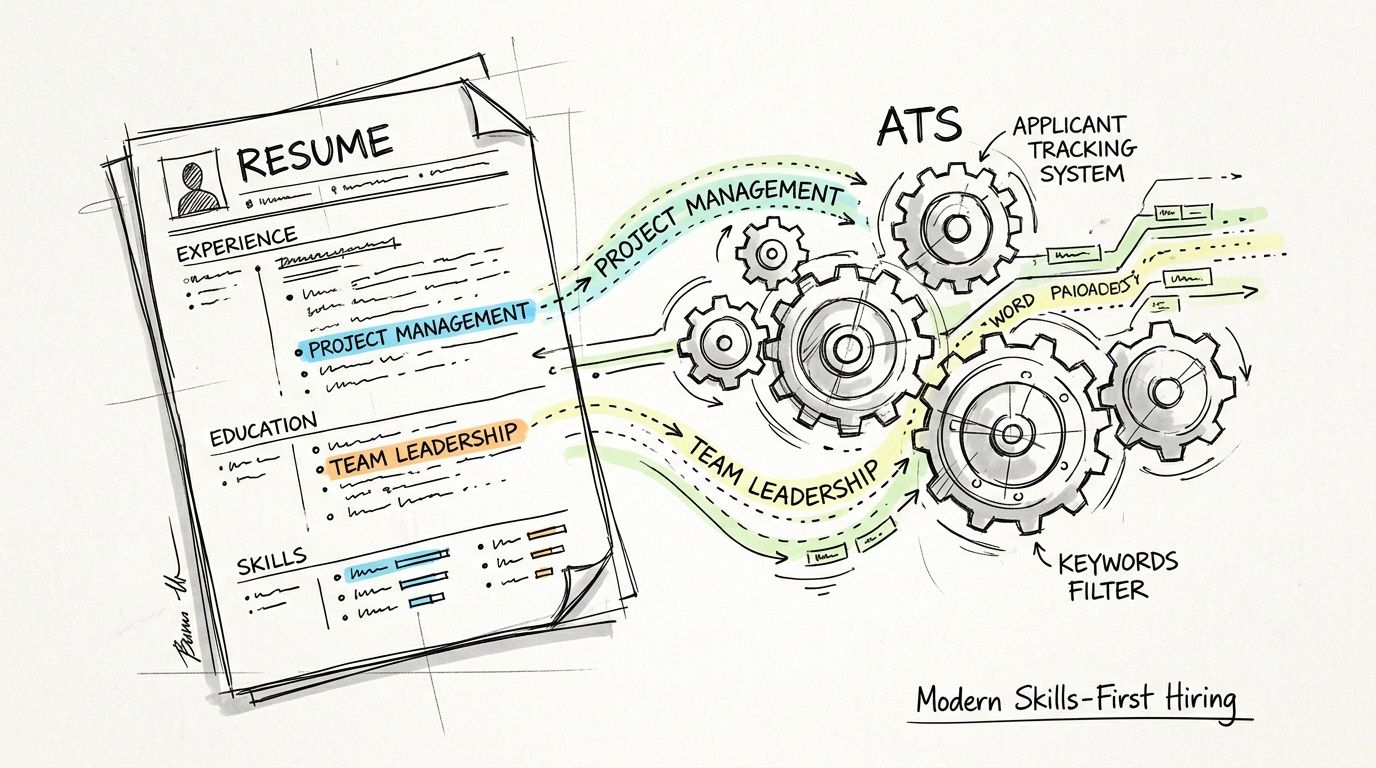
Traditional HR teams may still scan for pedigree. Skills-first employers scan for evidence. They want to know whether you can do the work, whether your keywords match the role, and whether your resume makes that obvious without a decoder ring.
That matters more now because skills-based hiring surged 20% in 2025, and veterans with strong skills profiles saw a 30% faster hiring time, according to the Texas State military resume guide. The same guidance points to platforms listing 100,000+ degree-optional jobs, which changes the game for veterans who built capability through service instead of college.
What skills-first platforms reward
These systems tend to reward resumes that are easy to parse and easy to match.
That means:
- Clear target role: Don’t send the same resume everywhere. “Operations coordinator” and “cybersecurity analyst” should not have the same top section.
- Skills near the top: Put your strongest tools, certifications, and capabilities where both recruiters and applicant tracking systems can spot them fast.
- Civilian keywords: Pull exact language from the job posting when it’s honest and accurate.
- Proof over personality: “Disciplined veteran” is weak. Specific accomplishments are stronger.
- Relevant certs and training: Security, IT, logistics, healthcare support, and trades roles all reward concrete qualifications.
A simple resume structure that works
A hybrid format usually works best for veterans moving into civilian roles, especially if the title transition isn’t obvious.
Try this:
| Resume section | What goes there |
|---|---|
| Summary | Short civilian-facing intro with target role and strongest value |
| Core skills | Skills, tools, certifications, systems, and job keywords |
| Professional experience | Translated military experience with quantified bullets |
| Certifications and training | Licenses, credentials, technical courses |
| Education | Include it if relevant, but don’t force it to carry the resume |
Keep the summary tight. Three or four sentences is plenty.
If you want a tool to speed up formatting and avoid ugly layout mistakes, a dedicated resume builder can help you keep the structure clean while you focus on the wording.
One more unwritten rule. Don’t bury your strongest experience under your exact military title. The title can stay, but the first line under it should explain the civilian function of the role. That’s how you stay honest without losing the reader.
Your True North After the Military
The hard part of transition isn’t only the resume. It’s the identity shift.
A lot of veterans come out of a system built on structure, clarity, and direct standards, then walk into civilian hiring where expectations are fuzzier and job descriptions are full of fluff. That mismatch can throw people off even when they’re highly capable.
40% of transitioning veterans report anxiety from unstructured civilian work settings, according to the Psychological Health Center of Excellence article on translating military experience.
Civilian employers are not asking you to be less military
They’re asking you to explain your strengths in their language.
That’s different.
The ability to stay calm in chaos, adapt fast, learn systems quickly, and lead under pressure is rare. On a civilian resume, that can become “thrives in high-pressure, adaptive environments.” That phrasing works because it translates the strength without turning your background into a movie trailer.
You’re not starting over. You’re repositioning.
Use the job search like a mission plan
Keep it simple:
- Pick a target lane: Operations, logistics, cybersecurity, healthcare support, customer success, skilled trades.
- Match your proof to that lane: Don’t make employers guess.
- Use civilian review: If a non-military friend can understand your bullets, you’re closer.
- Apply where skills matter: Degree screens still exist, but many employers now hire for capability first. A filtered search on jobs saves time and keeps you focused on roles that fit your background.
You already know how to work with incomplete information, adjust under pressure, and execute. That’s half the battle in civilian work too.
The resume is just the translation layer. Your value was there the whole time.
If you want a faster path into degree-optional roles, HiredBySkill is built for people who learned by doing. Veterans, tradespeople, bootcamp grads, and other skilled candidates can search 100,000+ openings, build a cleaner resume, and focus on employers hiring for capability instead of pedigree.
Latest jobs
- New Home Consultant — Fletcher Building
- Accountant - Supervisor Level — Bowman & Company LLP
- Service Technician — DAIOHS U S A INC
- Full Charge Bookkeeper — Bowman & Company LLP
- Substitute Administrative Assistant- St. Peter the Apostle Catholic School — St Peter the Apostle Catholic School
- Media Specialist- St Peter the Apostle Catholic School — St Peter the Apostle Catholic School
- Depot Supervisor — DAIOHS U S A INC
- Court Maintenance Worker — Royal Oaks Country Club Houston