What Is Skills Based Hiring? A Guide for 2026
Wondering what is skills based hiring? Our guide explains the benefits, how it works, and gives actionable tips for employers and non-degree STAR candidates.
A lot of hiring still acts like a diploma is a proxy for ability. But the market is moving fast in a different direction. Skills-based hiring grew from 57% of U.S. employers in 2022 to 81% in 2024, while employers are also recognizing more than 70 million U.S. adults known as STARs, or Skilled Through Alternative Routes (Kelly Services on the rise of skills-based hiring).
That matters if you're a bootcamp grad, veteran, self-taught developer, tradesperson, or someone who's learned by doing. It also matters if you're an employer tired of slow hiring cycles and weak matches.
So, what is skills based hiring in plain English? It means hiring people for what they can do, not just where they went to school or which brand names appear on their resume.
Table of Contents
- So What Is Skills-Based Hiring Anyway
- The Old Way vs The New Way of Hiring
- The Big Wins for Companies and Candidates
- How Employers Can Actually Make the Switch
- How STARs Can Shine in a Skills-First World
- The Future of Hiring and Where To Start Looking
So What Is Skills-Based Hiring Anyway
Think about hiring a chef.
You wouldn't pick one based only on a culinary school diploma framed on the wall. You'd want a taste test. Can they season properly? Can they run a line during a rush? Can they make a great meal, consistently?
That's skills-based hiring.
Instead of treating a degree, a job title, or a company logo as the main evidence, employers look for demonstrated ability. That might mean a portfolio, a work sample, a certification, a practical test, or a clear story about how someone solved a real problem on the job.
What counts as a skill
A skill can be technical, like SQL, welding, network troubleshooting, payroll software, or patient scheduling.
It can also be human, like stakeholder communication, adaptability, customer de-escalation, or leading a team through a messy project. Good hiring teams usually separate must-have skills from nice-to-have skills so they don't reject strong people for things they could learn quickly.
Practical rule: If the job can be learned in the role, don't use it as a gatekeeper.
This shift isn't some small HR buzzword. It's changing how employers think about talent. As noted earlier, adoption has climbed fast, and that rise reflects a simple reality: a lot of capable people learned through military service, apprenticeships, bootcamps, certifications, and on-the-job experience rather than a four-year degree.
Why people are paying attention now
Hiring managers are under pressure to fill roles and stop missing solid candidates. Skills-first hiring widens the lens.
It also makes the process feel more fair. A resume can tell you where someone has been. It doesn't always tell you whether they can do the work sitting in front of you right now.
If you're new to this topic, that's the core idea. What is skills based hiring? It's a more direct question: can this person perform the job?
If you want a broader look at career paths built around real ability, the guides at HiredBySkill are a useful starting point.
The Old Way vs The New Way of Hiring
The old model often treated hiring like paperwork review. The newer model treats it more like evidence review.
That sounds subtle. In practice, it's a big difference.
Side by side comparison
| Hiring step | The old way | The new way |
|---|---|---|
| Job post | Lists degrees, years, and pedigree filters | Lists core tasks, must-have skills, and expected outcomes |
| Resume review | Screens for school names, employers, titles | Looks for projects, results, certifications, and relevant skill signals |
| Screening | Keyword matching | Skills-based screening and practical evidence |
| Interview | General conversation and gut feel | Structured questions tied to job competencies |
| Final decision | “Feels experienced” | “Showed they can do the work” |
A traditional post might say, “Bachelor’s degree required. Five years of experience. Must have worked in X industry.”
A skills-first version sounds more useful: “Must be able to analyze spreadsheet data, explain findings to non-technical teammates, and spot errors before reporting.” That's easier for candidates to understand and easier for employers to evaluate.
What gets missed in the old system
The old way filters out people who can do the job but don't match the expected biography.
That includes a mechanic who became great at logistics planning, a military technician moving into IT support, or a self-taught analyst who learned SQL through contract work and side projects. Resume filters often toss these people out before a human even looks closely.
The business case is getting hard to ignore. Organizations using skills-based hiring are 107% more effective at placing the right talent in the right roles and 98% more likely to retain high performers, while traditional practices still leave nearly 50% of new hires leaving or being terminated within 18 months (MuchSkills on why skills should be a top priority).
Hiring based on pedigree answers “Does this person look familiar?” Skills-first hiring answers “Can this person solve the problem?”
What changes for candidates
Candidates need different proof.
Instead of leaning only on job titles, they need to show what they built, fixed, improved, sold, supported, designed, or delivered. That can feel unfamiliar at first, but it's often better news for people with nontraditional backgrounds because the conversation shifts from labels to evidence.
The Big Wins for Companies and Candidates
When skills-based hiring works, both sides get something they want.
Employers get stronger matches. Candidates get a fairer shot.
Why employers like it
A degree filter is easy to use, but easy isn't the same thing as accurate. Employers report that skills-based hiring reduces mis-hires by 88% and decreases hiring costs by up to 74%. They also report stronger retention, with non-degree holders staying 34% longer in their roles.
Those are big operational wins. Fewer bad hires means less backfilling, less retraining, and fewer teams stuck cleaning up after the wrong fit.
There’s also a practical morale benefit. When someone gets hired because they can do the work, managers usually spend less time defending the hire and more time helping that person ramp up.
Why candidates like it
For candidates, especially STARs, this approach removes a weird old barrier. It says your path counts if your skills are real.
A veteran with equipment troubleshooting experience, a bootcamp grad with strong GitHub projects, or a hospitality worker with serious customer operations skill can finally compete on the thing that should matter most: performance.
Here’s the part people often miss. Skills-first hiring doesn't lower standards. It changes how standards are proven.
A degree requirement can screen for access. A skills assessment can screen for ability.
That opens doors to better-paying work that used to be blocked by default credential rules. If you want to compare pay across degree-optional career paths, this no-degree salary guide can help you think more strategically about your next move.
Why this feels more honest
Most jobs don't happen on paper. They happen in systems, on phones, in codebases, on job sites, in customer conversations, and inside messy team workflows.
So a hiring process built around real tasks tends to match real work better. It's closer to a test drive than a brochure.
That doesn't mean every company gets it right. Some still say they care about skills but fall back on old filters. Even so, once you've seen the logic of this model, it's hard to unsee how many qualified people the old model leaves behind.
How Employers Can Actually Make the Switch
Switching to skills-first hiring isn't just deleting “bachelor’s degree required” from a job ad and calling it progress.
The process has to change. The good news is that many teams already are doing this. 81% of organizations use competency-based job descriptions, 65% use skills-based screening, and 87% use skills-focused interviews, while 79% of HR professionals rate skills assessment scores as equal or superior to traditional criteria (AIHR on skills-based hiring).
Start with the job, not the pedigree
Begin with the actual work.
Ask the hiring manager what success looks like in the first few months. Not the dream candidate. Not the inflated wishlist. The actual work.
Then rewrite the posting around that reality.
- List must-haves only: Focus on skills people need on day one.
- Cut vague prestige filters: School brand, “rockstar,” and arbitrary year counts don't tell you much.
- Describe outputs: Say what the person will produce, fix, manage, or improve.
A customer support role, for example, might need ticket triage, calm writing, and CRM accuracy. It probably doesn't need a degree requirement copied over from a template someone used six years ago.
Use short, relevant assessments
Assessments work best when they're simple and tied to the role.
For a data role, ask candidates to clean a messy spreadsheet and explain two findings. For a support role, use a sample customer scenario. For a designer, review a portfolio and give a small critique exercise.
Keep it focused. Nobody wants a five-stage obstacle course for an entry-level job.
A practical walkthrough helps here:
Manager check: If your assessment doesn't resemble the real job, you're probably measuring test-taking, not skill.
Train interviewers to look for evidence
Interviewers need a common playbook.
Instead of asking broad questions like “Tell me about yourself,” ask for examples tied to the role. “Tell me about a time you had conflicting priorities and how you decided what to do first.” Then probe for actions, tradeoffs, and outcomes.
A solid skills-focused interview should look for:
- Specific actions: What did the candidate do personally?
- Reasoning: Why did they choose that approach?
- Transferability: Can they apply that thinking in your environment?
For employers hiring into degree-optional roles, tools like assessment platforms, portfolio reviews, and structured scorecards can help. If you want a place to publish roles aimed at skills-first candidates, post a job through a degree-optional platform and pair that with a clear, evidence-based process.
How STARs Can Shine in a Skills-First World
If you're a STAR, this shift can work in your favor. But you still need to make your skills visible.
A lot of talented people undersell themselves because their experience doesn't come wrapped in the “right” labels. That's fixable.
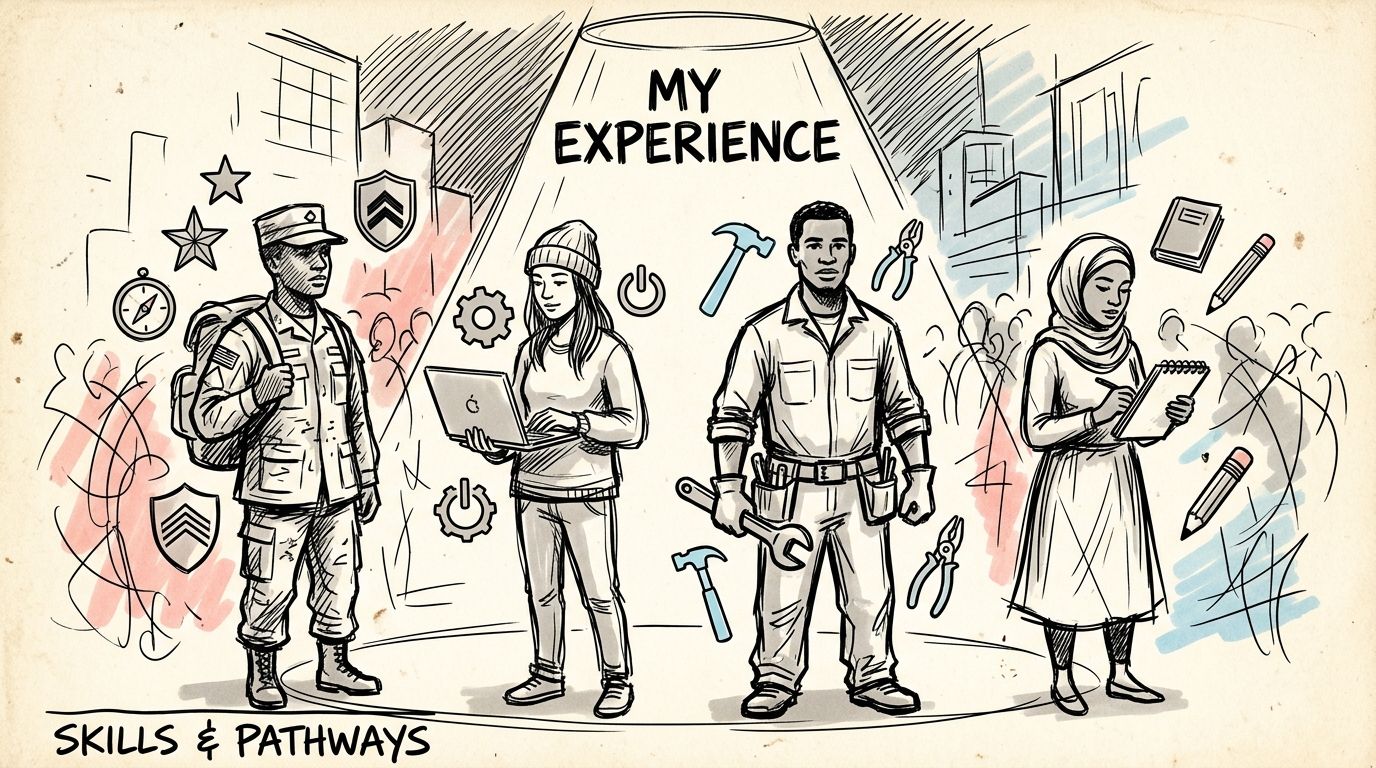
Over half of U.S. states have dropped degree requirements, and employers increasingly value examples that connect alternative routes like military service or apprenticeships to job skills, including through the STAR method (Phenom’s guide to skills-based hiring).
Turn experience into proof
Your resume shouldn't just list duties. It should show capability.
If you worked in hospitality, don't stop at “provided customer service.” Translate it into skills: resolved customer issues, handled high-volume workflows, trained new staff, managed point-of-sale systems, coordinated across teams during peak demand.
If you were in the military, avoid assuming civilian recruiters will decode your title. Spell out the skills behind the title: equipment maintenance, safety procedures, documentation accuracy, team leadership, logistics coordination, troubleshooting under pressure.
Build a proof of work trail
A portfolio isn't just for designers.
You can create a proof trail in lots of ways:
- Projects: GitHub repos, dashboards, repair photos, process docs, sample reports
- Credentials: Certifications, licenses, bootcamp completions, manufacturer training
- Results: Before-and-after examples, customer feedback, efficiency improvements
- Artifacts: Slide decks, checklists, workflows, screenshots, mockups
If you don't have paid experience yet, use class projects, volunteer work, freelance jobs, lab work, or personal builds. Real skill often shows up before a formal title does.
Use the STAR method without sounding scripted
The STAR method means Situation, Task, Action, Result.
It's useful because it keeps your answer grounded in evidence. Interviewers don't just hear that you're “a problem solver.” They hear a story that proves it.
Try this shape:
- Situation: What was happening?
- Task: What were you responsible for?
- Action: What did you do?
- Result: What changed because of your work?
“I was handling a backlog of customer issues during a system outage. My task was to prioritize urgent cases and keep customers updated. I built a simple triage tracker, grouped issues by severity, and coordinated updates with the ops lead. That reduced confusion and helped the team respond in a more organized way.”
That kind of answer works because it's concrete. If you need help translating your background into stronger bullet points and project summaries, a resume builder can help you frame your experience around skills instead of titles.
The Future of Hiring and Where To Start Looking
Skills-first hiring is growing, but job seekers should keep one foot in reality.
Some employers talk about hiring for skills. Their process still defaults to old habits. A 2024 Burning Glass Institute report found a real implementation gap between ambition and reality, with many organizations still lacking the infrastructure to do skills-first hiring well (TechRSeries on the implementation gap in skill-based hiring).
That means two things can be true at once.
First, this trend is real. Second, not every company that uses the phrase “skills-based” has rebuilt its process to match. Some job posts are degree-optional. Others are degree-optional in theory and still filtered in practice.
What job seekers should look for
A company is more likely to be serious if you see signs like these:
- Clear skill language: The post names tasks, tools, and outcomes.
- Evidence-friendly application: It invites portfolios, certifications, work samples, or project links.
- Structured interviews: The questions focus on how you solve problems.
- No hidden pedigree traps: The company doesn't treat school brand as the deciding factor.
For job seekers, the easiest move is to search in places built around that reality. A focused job board can save you from wasting time on roles that say one thing and do another. You can browse degree-optional jobs by industry, location, and remote preference, then target roles where skills and experience are part of the screening logic.
Skills are becoming the more useful currency because work changes faster than credentials do. If you can show what you know, you're in a stronger position than a lot of old hiring systems used to allow.
If you're ready to look for roles that value what you can do, explore HiredBySkill. It brings together degree-optional openings across tech, healthcare, logistics, hospitality, and the trades, along with tools that help STARs present their experience in a skills-first way.
Latest jobs
- Driver - Mini Bulk/Coolift/Rapid/Utility - Macon — Ozarks Coca-Cola-Dr Pepper Bottling Company
- Business Services Manager - Macon — Ozarks Coca-Cola-Dr Pepper Bottling Company
- Merchandiser - Macon — Ozarks Coca-Cola-Dr Pepper Bottling Company
- Field Sales Manager - Macon — Ozarks Coca-Cola-Dr Pepper Bottling Company
- Order Builder Loader - Macon — Ozarks Coca-Cola-Dr Pepper Bottling Company
- Automotive Yard Hand - Prestige Used Cars — Dutton Automotive
- Cashier — Gas N Wash
- Bakery Technician — Polly Country Market