Can Coding Be Self Taught? Yes, Here's How
Can coding be self taught? Yes — 82% of developers learned online. See proven paths, timelines, pitfalls, and the proof employers actually want.
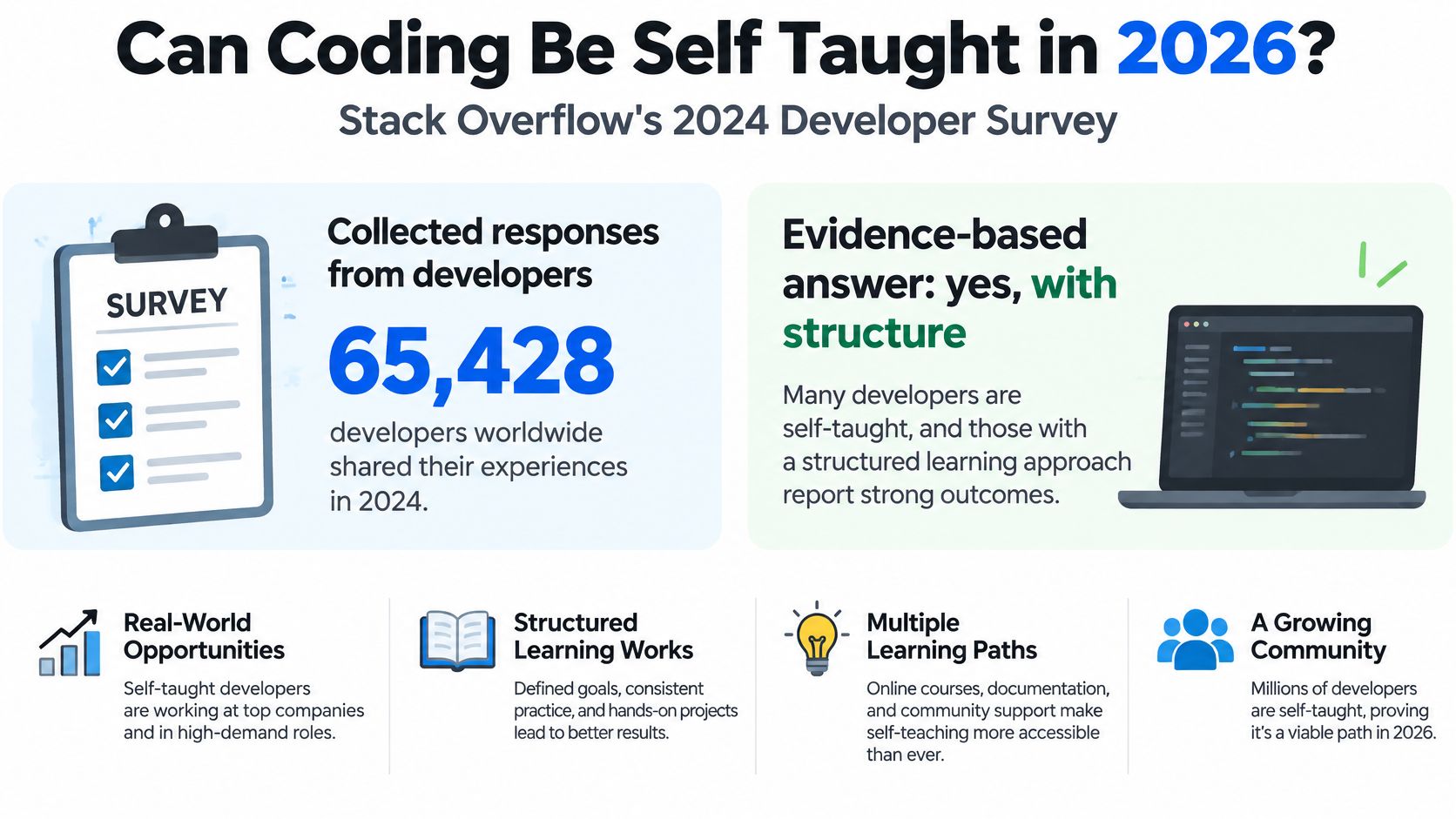
Yes, coding can be self-taught: Stack Overflow's 2024 survey of 65,000+ developers found that 82.1% learned through online resources, making it the most common pathway. The catch isn't learning syntax, it's proving you're ready to do the job without a degree.
That's a different challenge from finishing a course. You need to make decisions, untangle broken code, and explain why your solution works when someone asks an awkward follow-up question.
You don't need a mythical programmer brain. You need a learning process that produces evidence, not just an increasingly impressive collection of browser bookmarks.
Table of Contents
- Can Coding Be Self Taught in 2026
- The Main Routes Into Coding Without a Degree
- How Long Self Teaching Actually Takes
- Building a Self Study Routine That Survives AI
- The Portfolio That Replaces a Degree
- Skills Employers Screen For Beyond Syntax
- Common Mistakes That Stall Self Taught Careers
- Your Next Step Toward a Coding Job
Can Coding Be Self Taught in 2026
Learning to program and getting hired are separate problems. You can solve the first through independent study and still struggle with the second.
The opening figures come from Stack Overflow's 2024 Developer Survey, which also reported learning through school at 49.1%, books or physical media at 50.3%, e-courses or certifications at 50.0%, and on-the-job training at 45.1%. Bootcamps accounted for 10.7%, while friends or family accounted for 10.6%; technical documentation and Stack Overflow were used by 84% and 80%, respectively.
These categories describe overlapping learning experiences, not competing teams. Someone can attend school, consult documentation, take an online course, and learn from colleagues.
The survey findings give useful context for the question.
Learning independently isn't the same as working independently
Following a JavaScript lesson can teach you how a function works. It doesn't necessarily teach you how to investigate an unfamiliar application, clarify a vague requirement, or decide whether a dependency belongs in the project.
That's the distinction to keep in view:
- Learning evidence: You can complete exercises and explain programming concepts.
- Hiring evidence: You can take an imperfect requirement, implement it, investigate failures, and communicate what you changed.
- Professional judgment: You can identify what you don't know and ask a useful question before making an expensive assumption.
Being self-taught describes how you learned. It doesn't tell an employer what you can handle.
A realistic outcome isn't knowing everything a computer-science graduate might study. It's developing enough relevant depth to contribute within a defined role, while recognizing the gaps you still need to close.
Self-teaching remains viable. But treating course completion as a ticket to an interview is a weak strategy. The useful question isn't “Can coding be self taught?” It's “What would convince someone to trust me with their code?”
The Main Routes Into Coding Without a Degree
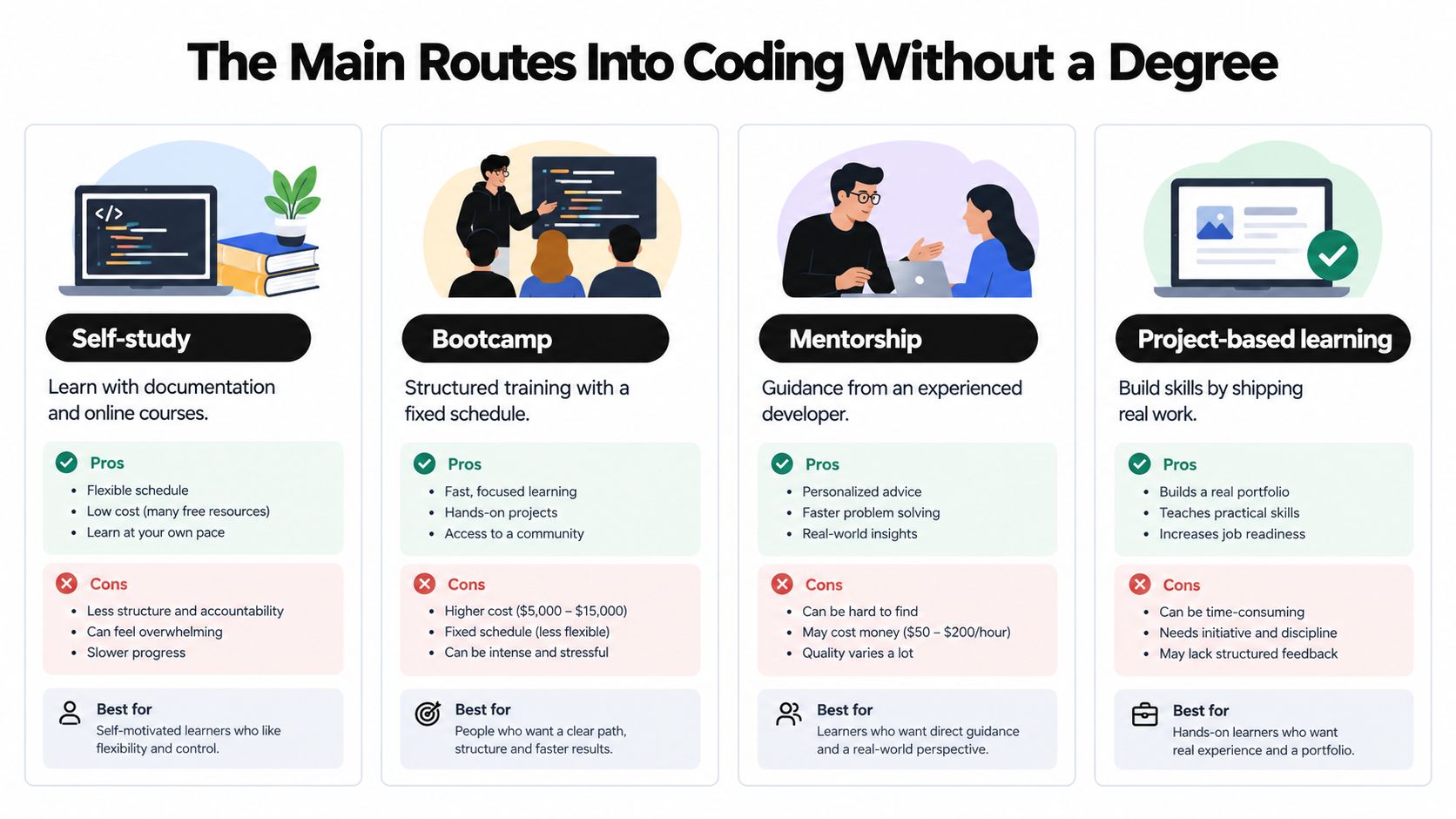
Choose a route based on the support you need, not the loudest success story in your feed. A fixed schedule helps some learners; others need flexibility more than another deadline.
The main options differ in structure, feedback, and opportunities to build something useful.
Match the route to your constraints
Self-study gives you control over pace and subject matter. Use a coherent course as your starting point, then consult official documentation when something doesn't make sense. The trade-off is that you must decide when to stop watching and start struggling productively.
A bootcamp offers a fixed sequence and schedule. Before committing, inspect the curriculum, feedback process, and career-support terms. Structure can be valuable, but paying for structure doesn't remove the need for independent practice.
Mentorship and community learning work best when you bring specific questions. Share the error, the relevant code, what you expected, and what you've tried. “Please review how I handle failed requests” is easier to answer than “Can someone teach me backend?”
On-the-job learning starts with problems you already understand. An operations worker might automate a repetitive report; a support specialist might investigate recurring technical issues. Get permission before touching workplace systems or data, and keep experiments separate from anything business-critical.
For a mobile project, you could build your first app with AppLighter, then extend it with a requirement you choose yourself. Treat a walkthrough as scaffolding, not the finished building.
Practical rule: Combine resources freely, but keep a clear learning objective. Switching resources isn't progress if you keep restarting the same material.
Use video as a companion to hands-on work, with your editor open rather than your brain on autoplay.
Before choosing a curriculum, compare entry-level tech roles. You'll make better decisions when you know whether you're aiming for application development, testing, or another technical path.
How Long Self Teaching Actually Takes
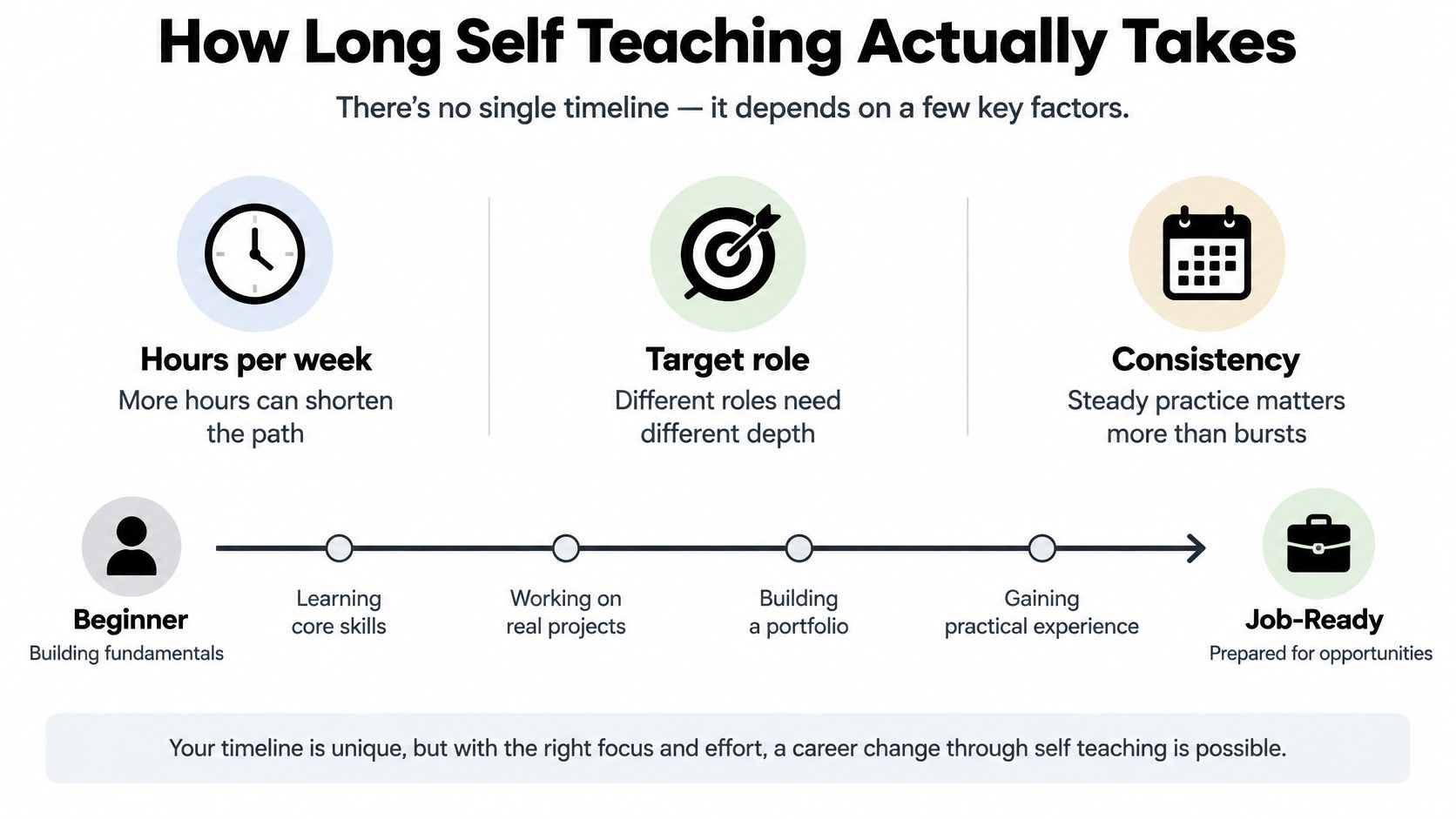
There isn't a defensible universal countdown from beginner to employable. Your available study time, target role, starting knowledge, and project scope all affect the schedule.
A narrowly scoped interface and a service involving authentication, databases, and deployment don't demand the same preparation. Nor should you assume that every front-end role is easier than every backend role. Read the actual requirements.
Before attaching dates to your plan, separate the factors you can control.
Schedule milestones instead of promises
| Learning situation | Sensible approach | Main risk |
|---|---|---|
| Part-time study around work | Keep tasks small and leave clear restart notes | Spending every session remembering where you stopped |
| Full-time study | Alternate learning, implementation, and review | Mistaking a long day for retained knowledge |
| Learning through workplace projects | Limit scope and agree on supervision | Taking responsibility for systems you can't safely maintain |
For an early learning block, focus on language fundamentals and small programs you can explain. In the following block, build a complete feature without following a matching tutorial.
Then work toward a deployed application that someone else can use without you sitting beside them. After that, gather feedback, investigate failures, and revise the implementation. Move forward when you can demonstrate the milestone, not because a calendar reminder says you're ready.
If you're considering mobile development, Capgo's app planning guide for mobile teams is a useful starting point for thinking about scope before committing to a build. A smaller, finished application is a better planning target than an ambitious collection of unfinished screens.
Frustration doesn't automatically mean you lack aptitude. Sometimes the task is too large, the prerequisite knowledge is missing, or your study schedule assumes energy you don't have.
If you need supervised experience rather than more solo study, investigate tech apprenticeship programs. The right learning environment matters more than winning an imaginary speed contest.
Building a Self Study Routine That Survives AI
AI can help you explore an unfamiliar concept. It can also leave you with a working application you're unable to explain. That second outcome is false competence, and it's a terrible interview companion.
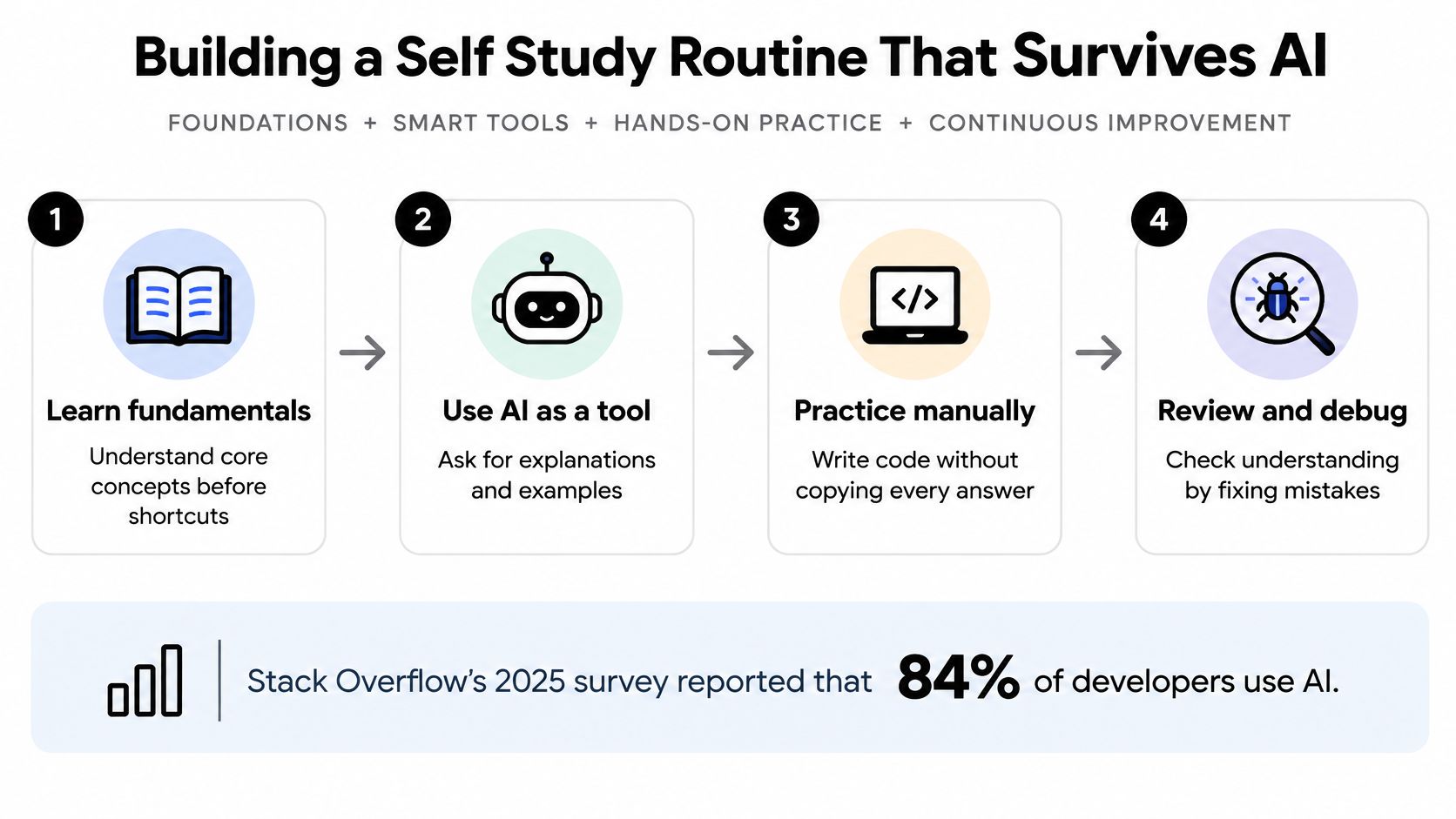
A discussion of AI and early-career development reports that 84% of developers use or plan to use AI tools. That's broader than saying they all currently use them, and it certainly doesn't establish that accepting generated code is good learning practice.
Keep fundamentals, manual practice, and review connected rather than treating generated output as the finish line.
Use a repeatable practice loop
- Attempt the problem independently. Write down your approach and make an honest implementation attempt. Getting stuck gives you a specific question.
- Ask for hints or review. Request an explanation of an error or a critique of your approach before asking for replacement code.
- Test every change. Check ordinary inputs, invalid inputs, and failure cases. Code that runs isn't necessarily code that behaves correctly.
- Explain it without the assistant. Describe the data flow, dependencies, and failure modes. If you can't, return to the unclear part.
- Keep a human-written project log. Record your decision, the alternatives, what failed, and what you'd change.
Build your week around implementation, a documentation session, and a review of unresolved problems. Keep a small backlog so the next session starts with a task rather than another search for the perfect course.
Continued study isn't remedial. Stack Overflow's 2025 Developer Survey found that 69% had learned a new technique or language during the previous year; learning resources included technical documentation at 67.8%, other online resources at 58.7%, Stack Overflow or Stack Exchange at 51.4%, and coding videos at 50%.
Don't paste private workplace information into a tool to get a better explanation. Use synthetic examples, inspect unfamiliar dependencies, and verify security-sensitive advice against official documentation.
The goal is to become better at reasoning about code, not merely faster at requesting it.
The Portfolio That Replaces a Degree
A portfolio can help compensate for a missing degree. It can't override every employer's screening rules, and pretending otherwise sets people up for unnecessary disappointment.
The U.S. Bureau of Labor Statistics' computer programmer guidance identifies a bachelor's degree as typical entry-level education, while noting that some employers hire candidates with relevant experience or expertise in particular programming languages. That distinction is where a degree-optional candidate should focus.
Build a small set of substantial applications rather than a crowded gallery of near-identical exercises. Deployed software, automated tests, source control, and readable documentation let someone inspect your work instead of taking your résumé on faith.
Portfolio Evidence Mapped to Target Roles
| Target Role | Core Artifacts | What It Proves |
|---|---|---|
| Backend developer | REST API, SQL schema, migrations, integration tests | You can manage data and define predictable behavior |
| Front-end developer | Accessible interface, loading and error states, component tests | You consider users beyond the happy path |
| QA or test automation | Reproducible bug reports, automated checks, failure analysis | You can investigate defects and prevent regressions |
| Cybersecurity-focused role | Authorized lab, identity controls, threat model, remediation notes | You can identify risks and explain defensive choices |
Make the engineering decisions visible
For each project, explain the user's problem, your constraints, and your implementation choices. Include setup instructions that work from a clean checkout, not just on the laptop where the project was born.
Use issue tracking, a reviewable change history, data validation, and appropriate security controls. If someone reviews your code, preserve the discussion and explain how you responded.
- Measure accurately. Record actual latency, test coverage, error behavior, or hosting costs where relevant. Don't manufacture impressive-looking results.
- Show a trade-off. Explain why you chose a simpler design, deferred a feature, or changed a database query.
- Make inspection easy. Put the demo, repository, limitations, and technical write-up where a reviewer can find them.
A certificate says you completed something. A well-documented project lets someone examine what you can do.
Use this guide to creating an online portfolio to organize the presentation. Keep the emphasis on decisions and working evidence, not animated skill bars declaring your JavaScript confidence.
Skills Employers Screen For Beyond Syntax
A useful technical conversation starts where the tutorial ends. Can you reproduce an intermittent bug? Can you change unfamiliar code without breaking unrelated behavior? Can you explain a disagreement without turning a pull request into courtroom drama?
The BLS guidance for software developers, quality-assurance analysts, and testers lists a bachelor's degree as typical and emphasizes a strong programming background. That describes a common hiring route, not a universal government-issued license to write software.
Your practical response is to demonstrate the behaviors a team needs, while recognizing that some employers will still insist on credentials.
Practice working inside someone else's constraints
Starting from an existing repository changes the exercise. You must read contribution guidelines, understand naming conventions, reproduce behavior, and make a change that fits the project.
GitHub's Octoverse 2024 report recorded 1.4 million first-time open-source contributors, including more than 450,000 GitHub Education users. Those figures don't promise employment, but they demonstrate that contribution isn't reserved for established maintainers.
Start with useful, bounded work:
- Reproduce an issue. Provide clear steps and expected versus actual behavior.
- Improve a test. Capture a failure before proposing the fix.
- Clarify documentation. Verify the instructions rather than merely rewriting sentences.
- Respond to review. Explain changes calmly and accept corrections without treating them as a personal verdict.
A focused review of software engineering skills can help you identify gaps beyond your preferred language.
Find hiring processes that recognize alternative routes
STARs, workers skilled through alternative routes, benefit when employers change the initial credential screen. A 2024 National Bureau of Economic Research paper examined commitments by 25 U.S. states and estimated that bachelor's-degree requirements in state-government postings fell by 2.5 percentage points for each additional year of policy exposure.
That finding concerns particular public-sector policies, not every employer or every technical vacancy. Still, it gives degree-optional candidates a concrete reason to examine public-sector postings alongside private employers.
The combination matters: accessible screening gets your application considered; credible technical and collaborative evidence gives the hiring team something substantive to evaluate.
Common Mistakes That Stall Self Taught Careers
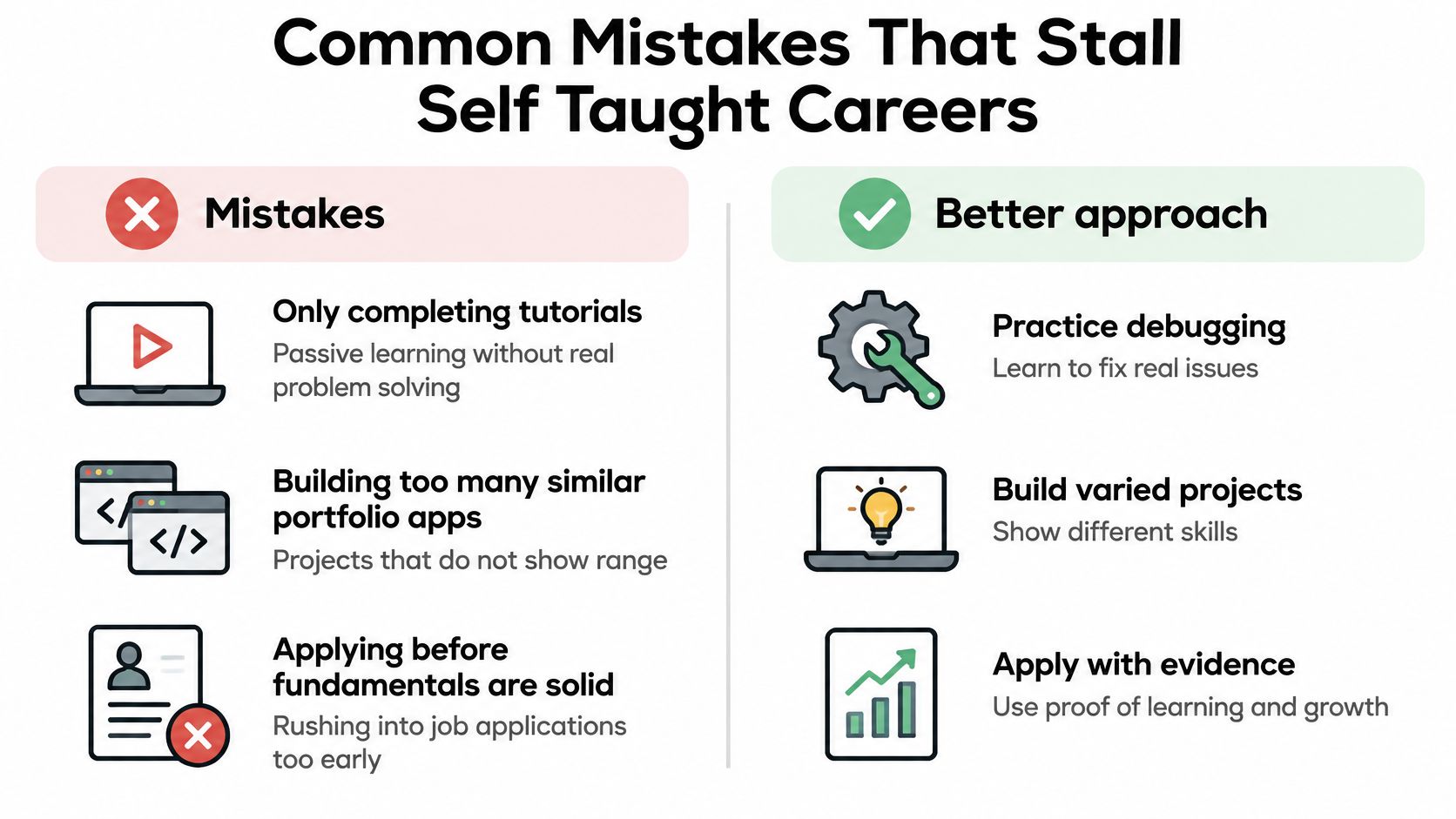
Completing tutorials, publishing familiar demo apps, and sending generic applications isn't a convincing plan by itself. It leaves the employer to guess how much of the work you can own.
The entry-level context deserves honesty. Los Angeles Times reporting on research into young developers' employment described a decline of nearly 20% among software developers aged 22–25 from late 2022 to July 2025, with more experienced workers less affected.
That finding doesn't establish that self-taught applicants can't succeed, or that AI alone explains every hiring decision. It does make breezy promises about an easy first job harder to defend.
The better response is to identify weak evidence and replace it with something inspectable.
Stop optimizing for the feeling of progress
Tutorial hell feels productive because the instructor keeps removing uncertainty. Break the pattern by changing the requirement: add an unfamiliar input, remove a dependency, or implement a feature without a matching lesson.
Certificates can provide structure, but don't ask them to substitute for demonstrated problem-solving. Likewise, use the AI practice loop above rather than accepting code you couldn't defend in a review.
- Untargeted applications: Match your résumé and project evidence to the actual responsibilities, rather than listing every technology you've encountered.
- Oversized projects: Cut features until the remaining work is deployable and explainable. An unfinished platform isn't automatically more persuasive than a modest working tool.
- Invisible reasoning: Write down why you made a decision. Screenshots show appearance, not technical judgment.
- Pretending to know: Say what you'd investigate next. Guessing confidently is less useful than identifying a safe next step.
Don't confuse rejection with a precise diagnosis of your ability. Review the evidence you supplied, the role's requirements, and where the process stopped. Improve the part you can inspect rather than reinventing your entire career plan after every unanswered application.
Your Next Step Toward a Coding Job
Pick a target role this week and save a real job description. Highlight the responsibilities, required skills, and degree wording separately so you don't mistake a preference for a hard requirement.
Turn that description into a project specification. If the role involves APIs and SQL, define a small service with persistent data and explicit failure behavior. If it emphasizes testing, build a reproducible defect investigation with automated checks.
Make the next task small enough to finish
You don't need to complete an entire hiring portfolio this week. You need to leave the week with a clear target, a repository, and a working slice of the problem.
Use this checklist as your direction:
- A deployed project: Let someone try it without a guided tour.
- An open-source contribution: Participate in an existing project and respect its review process.
- A documented problem solved: Explain the symptoms, investigation, fix, and remaining limitations.
When you're ready to apply, prioritize postings that explicitly accept equivalent experience or omit degree requirements. Check public-sector opportunities, apprenticeships, employer career pages, and skills-first job platforms; inspect each listing rather than assuming a whole organization hires the same way.
This guide to getting a software engineering job with no experience can help you connect that evidence to your applications.
Yes, you can teach yourself to code. Your next move is to build something you can show, explain, and improve when it breaks.
HiredBySkill offers a skills-first job search focused on roles that don't require a college degree, with browsing by industry, city, and remote options. Bring your target role and project evidence, then look for openings where demonstrated capability can support your application.
Latest jobs
- Director of Safety & Security — Rock Creek Cattle Company
- Project Accounting Assistant, Mechanical — Hooper Corporation
- Dining Server — Cogir at the Narrows
- Project Accounting Supervisor, Mechanical — Hooper Corporation
- Senior Project Accountant, Mechanical — Hooper Corporation
- Ophthalmic Technician — Sight Partners Physicians
- Elementary School Music Teacher: Full-Time Position — Bl Miguel Pro Catholic Academy
- Digital Financial Representative 1 or 2 - Mirabeau (Spokane Valley) — Numerica Credit Union