Detailing Jobs Near Me: How to Find and Land Local Work
Searching for detailing jobs near me? Discover where to look, how to stand out, realistic pay, and smart next steps to land local auto detailing work fast.
You're probably typing detailing jobs near me after a long shift, a busted paycheck, or one of those days where you're done being stuck in a job that doesn't use your hands. Then the search results hit you with a mess. Some listings say auto detailing, some say product detailer, and a few sound like they want a warehouse worker who can wipe a dashboard.
That confusion is normal. The local detailing market is fragmented, mostly small, and a lot of the hiring happens through shops, dealerships, fleets, and mobile operators rather than giant brands. If you want actual work, you've got to search like someone who knows how this industry works, not like someone hoping a glossy job board will magically sort it out.
Table of Contents
- What You're Really Looking For When You Search Detailing Jobs Near Me
- Where to Find Local Detailing Openings
- Shop Roles vs Mobile Detailing vs Dealership Jobs
- Realistic Pay, Hours, and What Local Offers Look Like
- How to Apply and Stand Out Without a College Degree
- Where Detailing Work Can Take You Next
What You're Really Looking For When You Search Detailing Jobs Near Me
You type the phrase, hit enter, and suddenly the internet decides “detailing” means three different jobs. One listing wants someone to clean vehicles, another wants a Product Detailer in manufacturing, and a third is just badly labeled enough to waste your time. That's the first lesson here, don't trust the keyword alone.
The actual market is scattered. An industry overview estimates roughly 55,000 to 60,000 car wash and detailing businesses in the U.S. in 2024, with about 197,800 workers and around $14 to $15 billion in annual revenue Maher Commercial Real Estate's industry overview. That kind of structure tells you a lot. You're not dealing with a neat chain of corporate openings, you're dealing with owner-operated shops, dealership reconditioning bays, fleets, and mobile crews that hire when they need bodies.
Practical rule: if a search result doesn't clearly say vehicles, cars, SUVs, or reconditioning, assume it might be the wrong kind of detailing job until you prove otherwise.
The employers that actually matter
For local work, the targets are boring in the best way. Neighborhood detail shops, car dealerships, fleet maintenance outfits, car washes with detailing bays, and mobile-detailing operators are where most openings live. That fragmentation matters because local demand can shift fast with weather, dealership volume, and seasonal rushes, so one shop may be hiring this week and silent next week.
If you want to search smarter, use skills-first thinking. A broad search often hides the best leads, while a tighter approach based on the work you can do will get you closer to interviews. A clean way to rethink that search is to focus on your skill set first, then match it to the employer type, like the approach outlined in this skills-based job search guide.
A lot of people think they're looking for “a detailing job.” What they're really looking for is one of three things, steady shop work, flexible mobile work, or dealership volume work. Once you sort that out, the search stops feeling random.
Where to Find Local Detailing Openings
Start local and stay local. The detailing world is built around small businesses, so the best openings usually show up in places that big job boards barely cover. If you only scroll the major sites, you miss a lot of real opportunities.
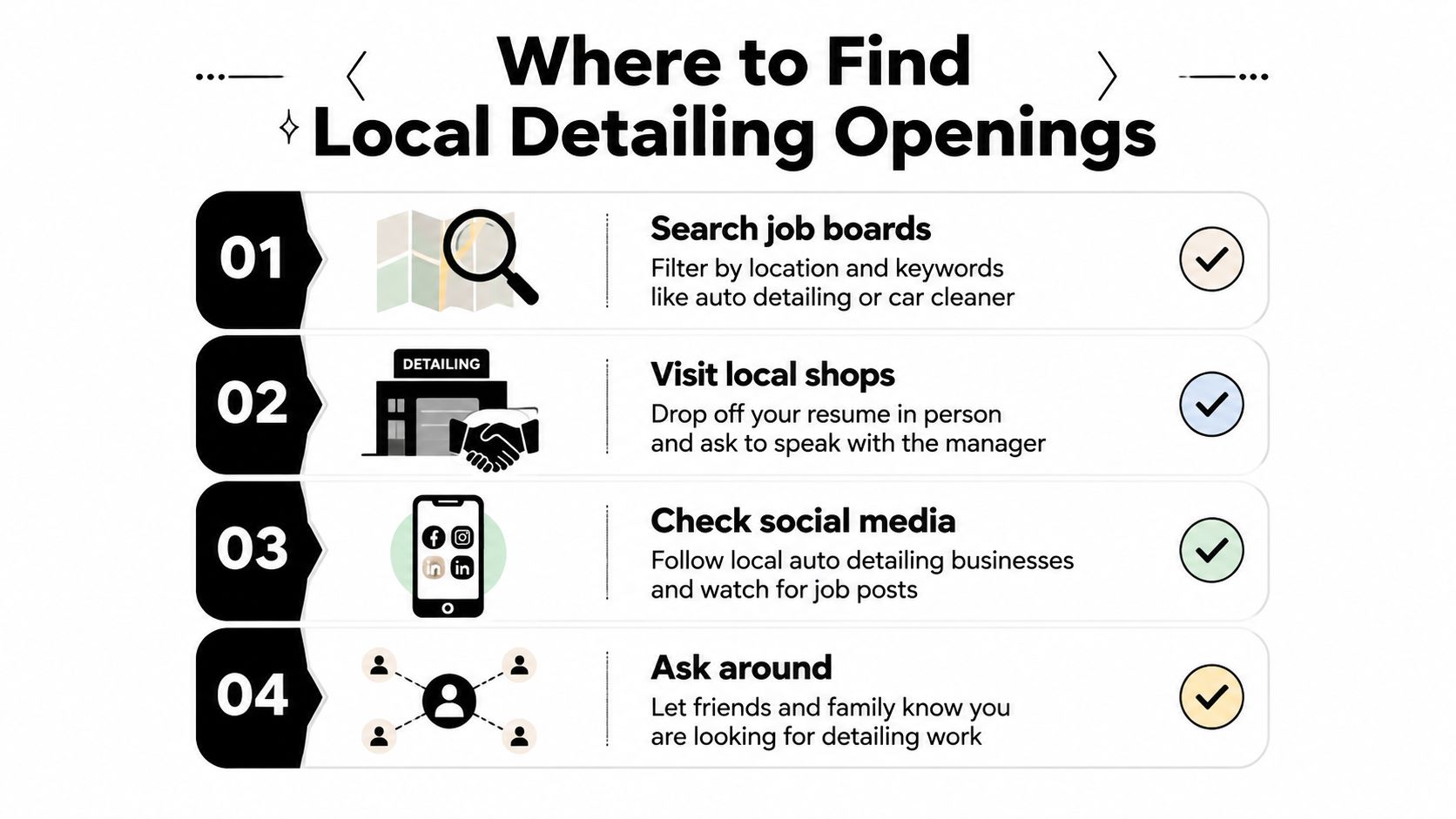
Use a local search stack
Search job boards, yes, but do not stop there. Use Google Maps to find nearby detail shops, wash businesses, and dealerships with service departments, then check their websites and social pages for hiring posts. Small operators often post there first.
A good weekly routine looks like this:
- Search job boards by city and neighborhood. Use phrases like auto detailing, car detailer, vehicle reconditioning, and wash technician.
- Walk into local shops. Bring a short resume, ask for the manager, and be polite but direct.
- Check social media. Many small operators post openings on Facebook or Instagram before they ever update a job site.
- Ask around. Friends, family, and car people usually hear about hiring long before a listing goes live.
A few listings are worth studying even if you do not live in those exact cities. For example, Lionheart Detailing's service locations show how local service businesses organize around geography, and the same model applies to hiring. If a company serves multiple nearby areas, it may also hire across those areas.
Keep your search tight. A shop that never posts online can still hire fast if you show up with the right attitude and a clean resume.
The trick is consistency. Set alerts, check them once a week, and keep a running list of places you have contacted. If a shop says “not now,” follow up later. Small businesses change course fast.
If you want a broader place to scan degree-optional roles by location, the HiredBySkill jobs page is worth checking. The local route still wins for detailing, though, because most hiring happens through shops, referrals, and direct outreach.
Shop Roles vs Mobile Detailing vs Dealership Jobs
Not all detailing jobs are built the same. Some are steady and sheltered, some are flexible but rougher on your own vehicle, and some are high-volume with tighter expectations. Pick the wrong lane and you'll hate the schedule before the first month ends.
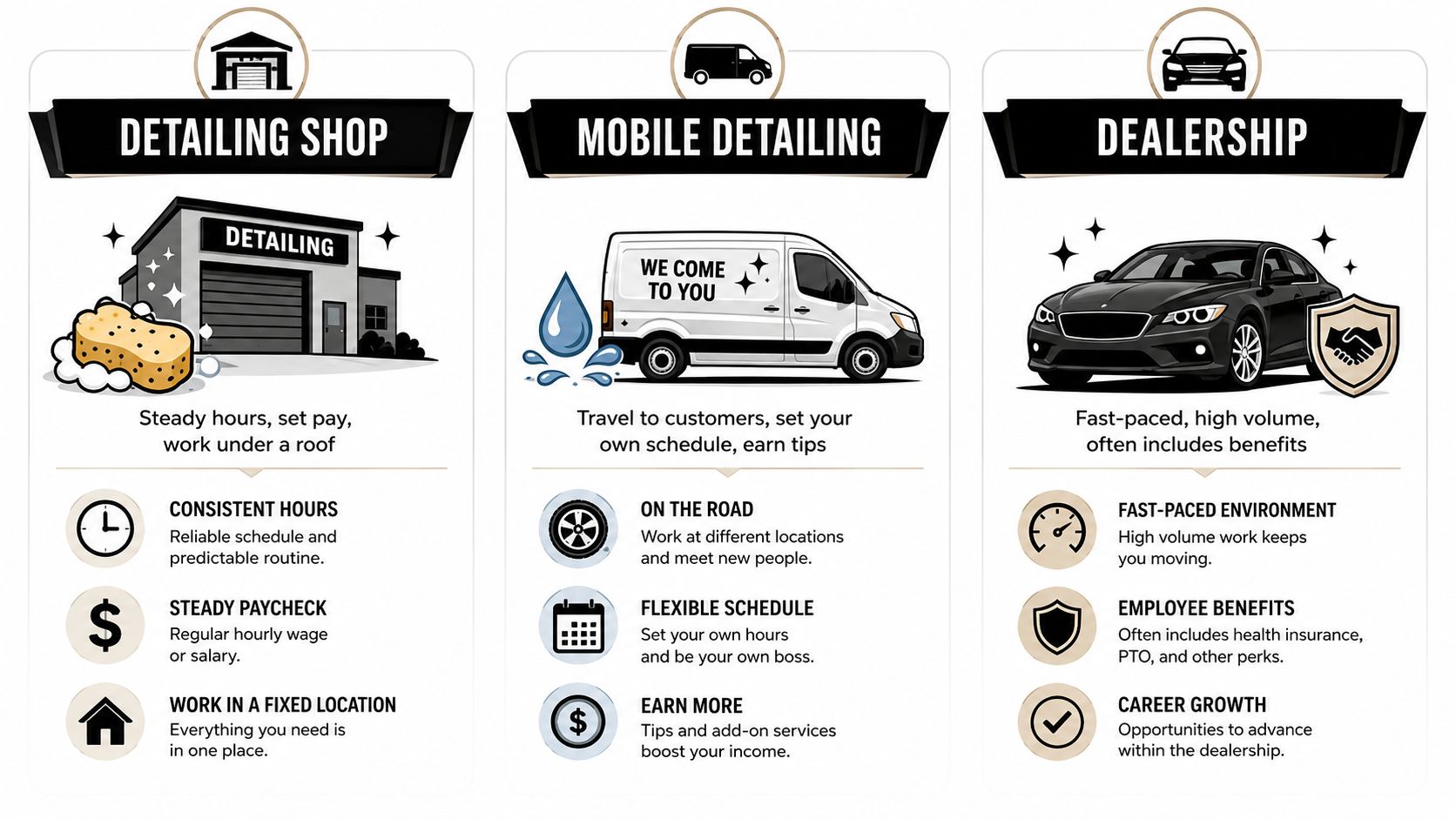
Traditional shop work
A detailing shop gives you a roof, a fixed base, and usually a cleaner learning curve. You're around the same tools, the same products, and the same crew every day. That's a good setup if you want to get sharp fast and don't care about driving all over town.
The downside is simple. Shop work can be repetitive, and the pace is often set by the owner's calendar and the vehicles stacked outside. If the shop is busy, great. If not, you're waiting.
Mobile detailing
Mobile work is a different beast. You travel to customers, carry your own gear, and deal with heat, rain, parking, and setup time. It's the most freedom-heavy option, but it also punishes people who hate logistics.
This path works best if you're organized and don't mind being half detailer, half road warrior. It can feel more personal, because you're handling the customer face-to-face at their home or office, but you also own the chaos when the weather turns ugly or the customer's driveway is a nightmare.
Dealership reconditioning
Dealership jobs are often the fastest way into volume work. The pace is higher, the process is tighter, and the expectations are usually straightforward, get cars clean, get them moving, and don't slow the line. That suits people who like structure and can work quickly without getting sloppy.
Best fit test: if you want variety and autonomy, go mobile. If you want repetition and mentorship, go shop. If you want steady volume and a foot in the automotive door, go dealership.
One more thing. Dealership roles can be a good entry point even if you're not chasing a long-term detailing career. They teach speed, consistency, and how to handle pressure without melting down. That matters more than people admit.
Realistic Pay, Hours, and What Local Offers Look Like
A lot of listings hide behind “competitive pay,” which usually means the employer wants to avoid a straight answer. Ignore that language. Judge each offer by hourly rate plus expected hours, because a decent wage with ten shaky hours is still a weak deal.
| Detailing Pay Snapshot by Market | Typical Hourly Range | Example Annual Pay |
|---|---|---|
| Lafayette, Louisiana | $9 to $12 an hour | Not provided in the source |
| Baton Rouge, Louisiana | $10 an hour | Not provided in the source |
| Framingham, Massachusetts | $19 an hour | Not provided in the source |
| San Francisco, California | Not provided in the source | $40,410 average annual wage |
The local spread is real. Indeed listings in Lafayette show starting pay from $9 to $12 an hour, and nearby Baton Rouge shows $10 an hour for auto-detailing roles Indeed Lafayette listings. On the higher end, a Carvana listing in Framingham shows $19 per hour with a Monday through Friday, 6 a.m. to 3 p.m. shift and mandatory overtime based on business need Indeed Boston-area listing. That range is the normal reality in local detailing hiring. One shop is paying entry-level money, another is paying for speed and attendance, and both will call it competitive.
Zippia reports an average annual salary of $28,746 in 2025, up from $23,110 in 2021, and ZipRecruiter's June 2026 salary data puts average hourly pay at $16.17, with most workers between $14.42 and $17.79 per hour Zippia trends. Those numbers do not guarantee what your local shop will offer. They give you a ceiling and a floor so you stop guessing when a manager throws out a vague rate.
What to watch in the fine print
Some listings are part-time, some are contract-heavy, and some swing from 6 to 40 hours a week depending on demand Indeed Oswego listing. That kind of variability is normal in this trade, especially with small shops that staff up only when the bays are full. You need to price the offer against the actual schedule, because a higher rate with no hours can lose to a lower rate with steady work.
Ask about the ugly details before you apply. How many hours do they really give? Is overtime mandatory? Do you supply tools, chemicals, or your own vehicle? Those questions matter more than the headline pay, especially if you are looking at mobile work where gas, mileage, and setup time come out of your pocket. If you want a broader way to judge no-degree pay across industries, the no-degree salary guide is a useful reference for sorting real offers from fluff.
How to Apply and Stand Out Without a College Degree
Detailing is a skills-first job. Nobody cares if you have a diploma framed on the wall if you can't vacuum fast, avoid swirl marks, and leave a car better than you found it. A clean resume and a calm in-person attitude will beat a fancy credential almost every time.
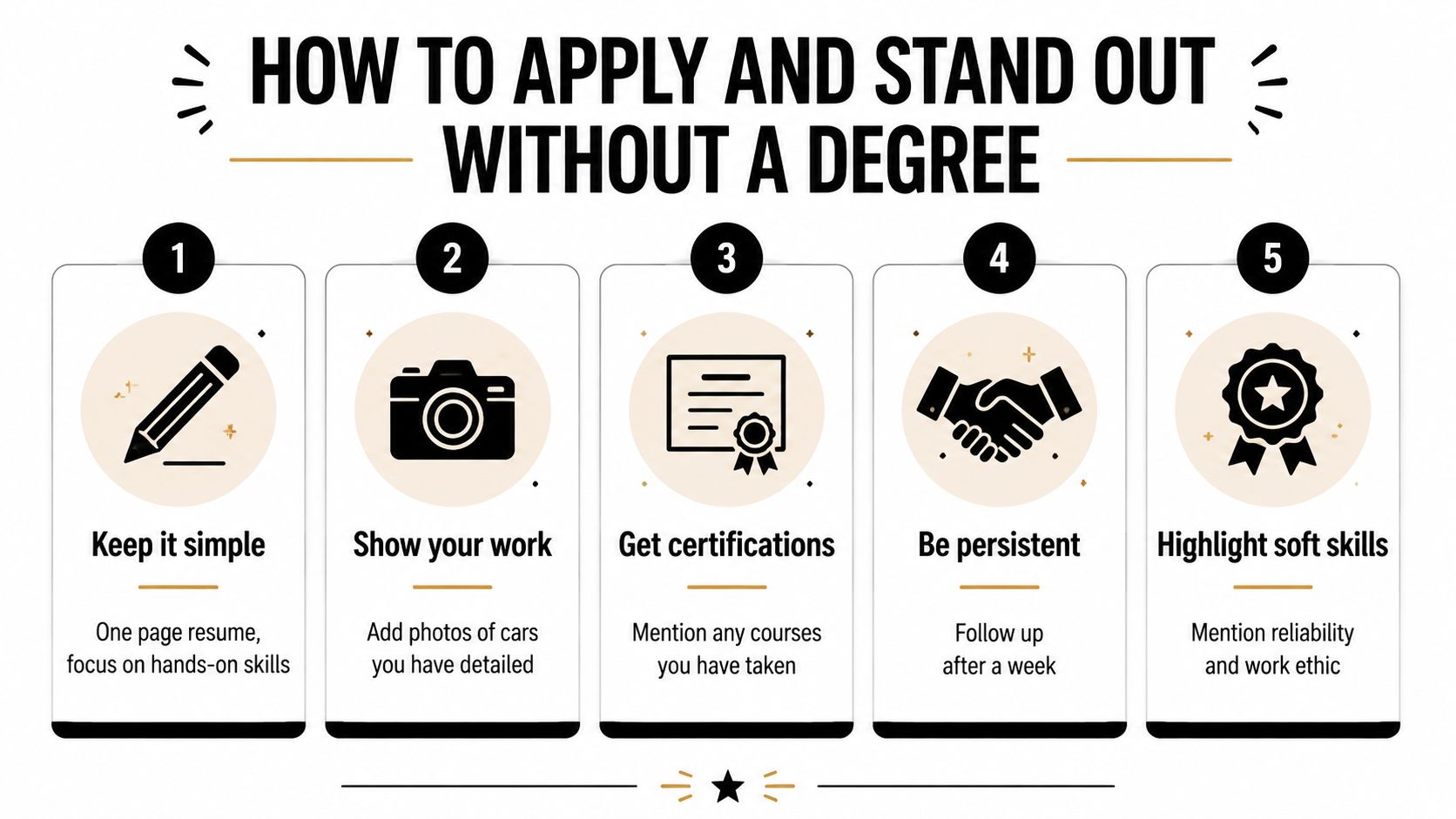
Make the resume about proof
Keep it to one page. List what you've done, washing, vacuuming, trash removal, sanitizing, waxing, polishing, inspecting finished work, and coordinating with team members. Those are the concrete tasks employers recognize because they show up in real job descriptions Indeed car detailing tasks.
If you've only done this for your own cars, say that. If you've helped a friend, worked in a wash bay, or done side jobs on weekends, say that too. Small operators care more about reliability and technique than polished corporate wording.
Show that you learn fast
If you've taken a course, mention it. If you've learned from the job, mention that too. A reputable training path can help you advance your detailing career, and a solid overview of certification options is available through SwiftJet's detailing career resource. Use that kind of training as a credibility boost, not as a substitute for hands-on work.
Interview rule: talk about tools, methods, and judgment. Don't just say you “clean cars.” Say what you clean, how you avoid damage, and how you check your own work.
Follow up like you mean it
A lot of people apply once, hear nothing, and quit. That's weak. Walk into the shop if it's appropriate, ask for the manager, and follow up a week later if you haven't heard back. The small-shop world rewards persistence because owners are busy and hiring gets pushed aside.
If you're worried about the degree question, keep your answer simple. You don't need one for this work, you need proof you can do the job. A good skills-first approach, like the one in this no-degree job guide, fits detailing perfectly.
Where Detailing Work Can Take You Next
A first detailing job is not the finish line. It is paid training if you treat it like one. The people who move up are the ones who learn how to inspect, correct, communicate, and stay clean under pressure.
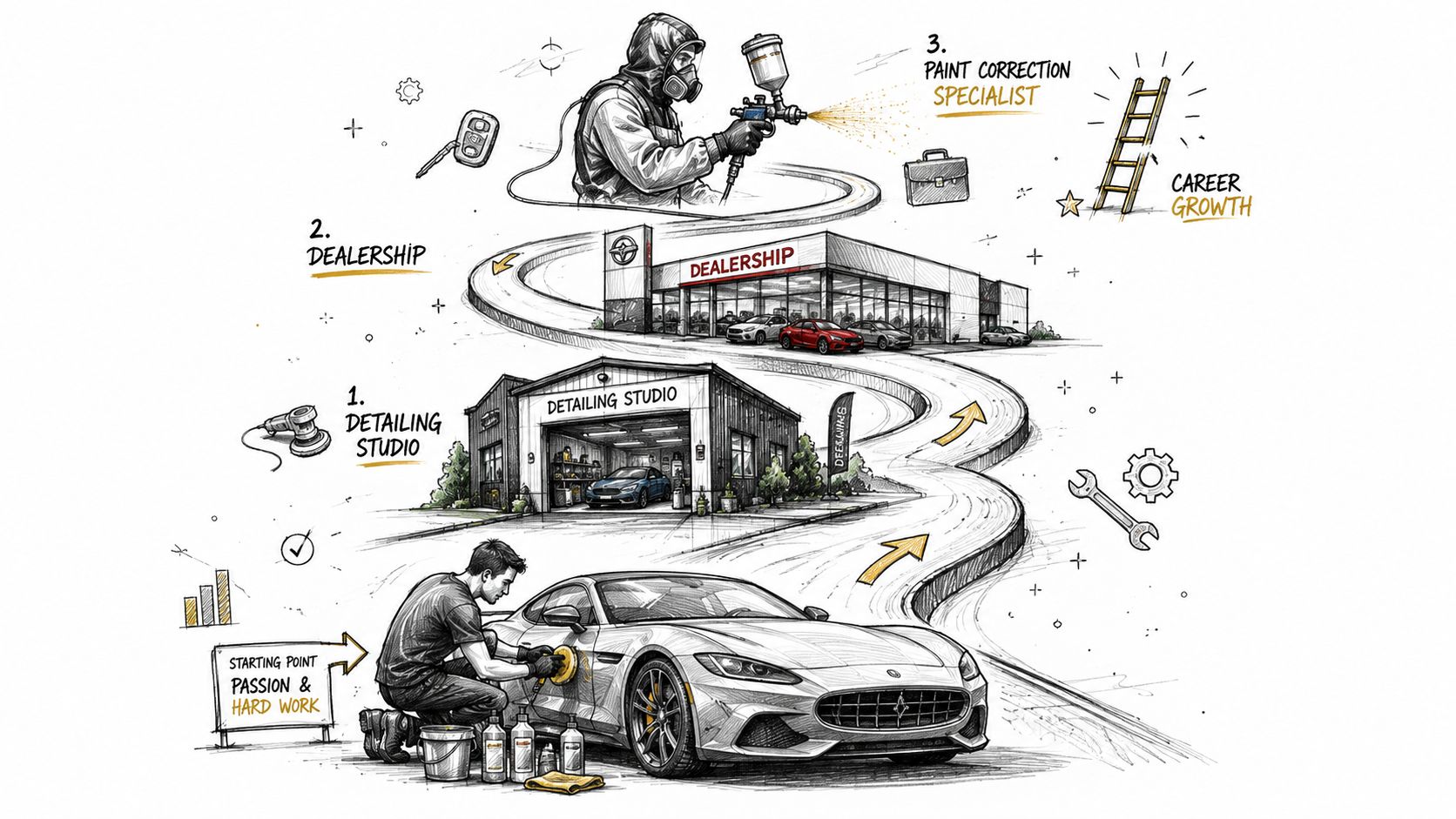
The next moves that make sense
The most natural step up is usually into paint correction or ceramic coating, because those jobs reward the same eye for finish quality that makes a strong detailer. Fleet maintenance and dealership reconditioning are also smart moves if you want steadier volume and broader automotive exposure.
A lot of detailers stay hands-on and eventually start a mobile business. That path works when you already know how to price work, protect your body, and keep customers satisfied without overselling. If you want to see how that route is built from the ground up, the mobile detailing business startup guide gives you a practical starting point.
An apprenticeship program can also be the cleanest next step if you want structure without school debt, and this overview of apprenticeship programs shows how that path works in hands-on trades. You can also move sideways into service advisor roles, body-shop prep, or other automotive jobs where attention to detail matters. The point is simple, detailing builds habits that transfer. You learn to spot defects, follow process, and communicate with customers who want their vehicle handled like it matters.
Keep your first detailing job like a training ground. Learn the products, learn the pace, learn the mistakes people make, then decide whether you want to specialize or go out on your own.
If you want to keep building, take the next 30 days seriously. Apply to five local shops, walk into two dealerships, follow up with every place that looked decent, and write down what each employer offered. That is how you move from scrolling to working.
If you're serious about landing detailing work, stop guessing and start filtering by skill, schedule, and pay. HiredBySkill makes that search simpler, especially if you want degree-optional roles that reward actual ability. Visit HiredBySkill and use it to find jobs that match the work you can really do.
Latest jobs
- Restaurant Supervisor — Dreamscape Hospitality
- Manager, Airport Operations — Avelo Airlines, Inc.
- Website Coordinator - NAVSAFECOM (On-Site) — Vistra Communications
- Donor Greeter — Goodwill of the Finger Lakes
- Wares Processor — Goodwill of the Finger Lakes
- Lead Pricer - Apparel — Goodwill of the Finger Lakes
- Kitchen Assistant — The Harpenden Arms, Harpenden
- Part Time Waiting Staff — Miller & Carter - Worcester Park