Your Path: How to Get into Cybersecurity Without a Degree
Discover exactly how to get into cybersecurity without a degree in 2026. This guide details skills, certifications, and strategies to land your first job.
You’re probably in one of three spots right now.
You’ve been watching cybersecurity videos after work and wondering if this could be your way out of a job that’s gone stale. Or you work in IT support, networking, or the military and want to move into security without going back to school. Or you’ve looked at job posts, seen degree requirements, and assumed the door was closed.
It isn’t.
I’ve mentored enough career-changers to say this plainly. The people who break in are rarely the ones with the prettiest academic story. They’re the ones who pick a target role, build proof, and keep going long enough to get a hiring manager’s attention. If you want to learn how to get into cybersecurity without a degree, treat it like a project with milestones, not a vague dream with a pile of bookmarks.
Table of Contents
- Your Ticket to the Cyber World No Degree Required
- Build Your Foundational Skills and Pick a Path
- Earn Certifications That Get You Interviews
- Get Your Hands Dirty with Projects and Home Labs
- Your Cybersecurity Career Launch Plan in 30, 90, and 180 Days
- Land the Job with a Killer Resume and Interview Strategy
- Frequently Asked Questions
Your Ticket to the Cyber World No Degree Required
A lot of people start with the same worry. “I’m interested in cyber, but I don’t have a computer science degree, so I’m already behind.”
That fear makes sense. It’s also outdated.
In 2025, there were 4.8 million unfilled cybersecurity roles globally, and that shortage has created a real opening for people coming in through certifications, labs, military experience, bootcamps, and self-study, not just traditional degrees, according to this breakdown of the cybersecurity talent gap. That’s the big picture behind the shift you’re seeing in job posts and hiring conversations.

I’ve seen this play out with people from all kinds of backgrounds. Retail managers who got obsessed with log analysis. Help desk techs who built a home lab and finally had a way to prove they could think like analysts. Veterans who already had discipline, incident mindset, and process awareness, and just needed the right technical bridge.
The degree wasn’t the thing holding them back. Lack of a plan was.
Practical rule: Don’t ask whether you’re “qualified enough” to start. Ask which entry-level role you want to be credible for first.
That shift matters. “Cybersecurity” is too broad to study as one blob. SOC analyst, junior pentester, GRC analyst, and security support roles all reward different strengths. Once you choose a lane, the path gets much less foggy.
There’s also a money question behind all this. If you’re trying to weigh the jump against your current work, this no-degree salary guide is useful for getting a reality check on skills-first career paths.
The short version is simple. You do not need permission from a university to start building cyber skills. You need a target, a timeline, and visible proof that you can do useful work.
Build Your Foundational Skills and Pick a Path
A lot of career-changers lose their first two months here.
They binge pentesting videos, collect tool names, and start talking about exploits before they can explain what DNS does or why a Windows event log matters. Hiring managers spot that gap fast. The candidates who get interviews usually look less flashy and more usable.
Start by building enough IT fluency that security work makes sense in context. Security sits on top of systems, networks, identities, and applications. If those basics are fuzzy, every cert topic and every lab exercise feels harder than it should.
Build the base before you specialize
Focus on two layers.
First, learn core IT skills:
- Networking: DNS, DHCP, TCP/IP, ports, routing, subnets, and what a packet is doing from source to destination
- Operating systems: Windows and Linux basics, file systems, users and groups, permissions, services, logs, and command-line navigation
- Web fundamentals: How browsers talk to servers, how sessions and cookies work, what APIs do, and where common mistakes happen
Then add security fundamentals:
- Identity and access: Authentication, authorization, MFA, least privilege, account hygiene
- Common attack paths: Phishing, credential abuse, malware, misconfigurations, privilege escalation
- Detection and response: Log review, alert triage, basic investigation steps, containment concepts
- Risk judgment: Which assets matter, what exposure looks like, and how to prioritize fixes
This is the part people rush past. Don’t.
A SOC analyst who understands logs but not Windows internals struggles to investigate. A junior pentester who runs scans but doesn’t understand web requests misses obvious findings. A security admin who knows policy terms but not identity tooling gets stuck on day-one tasks. Foundations save time later because every specialty in security depends on them.
Common Entry-Level Cybersecurity Roles
| Role | What They Do | Key Skills | Top Starting Cert |
|---|---|---|---|
| SOC Analyst | Monitor alerts, investigate suspicious activity, escalate incidents | Log analysis, SIEM basics, Windows/Linux familiarity, clear writing | Security+ |
| Junior Penetration Tester | Test systems and apps for weaknesses under supervision | Networking, web basics, Linux, note-taking, methodology | PenTest+ |
| Network Security Specialist | Help secure firewalls, switches, segmentation, and access controls | TCP/IP, routing, switching, troubleshooting | CCNA |
| Security Support or Security Administrator | Handle access reviews, endpoint tooling, basic hardening, tickets | Identity basics, endpoint awareness, documentation, admin habits | Security+ |
Pick one target role early, even if you change it later.
That choice turns vague studying into a project plan. If your target is SOC analyst, spend more time on Windows logs, basic Linux commands, SIEM workflows, and writing clean incident notes. If you want junior pentesting, put more hours into networking, web apps, Burp Suite, Linux, and documenting findings clearly. If network security clicks for you, spend your time on routing, switching, firewalls, segmentation, and troubleshooting.
I usually tell beginners to choose the role that fits how they naturally solve problems. People who stay calm in repetitive alert queues and write clearly often do well in SOC work. People who like testing assumptions, tracing weird behavior, and breaking systems in a methodical way often prefer offensive work. People who enjoy tracing traffic and fixing connectivity issues should commit to network-focused roles.
For people still exploring, degree-optional IT jobs can help you compare adjacent roles too. In practice, many people get into security through support, sysadmin, or network roles first, then use that production experience to move sideways into a dedicated cyber title.
That matters because this is a career plan, not a random list of topics. The goal is to match your learning, certs, and projects to one believable first job, then show that evidence on skills-first platforms like HiredBySkill. Employers are much more likely to respond when your resume, lab work, and target role all point in the same direction.
Your first path does not need to be permanent. It needs to be specific enough that someone can hire you for it.
Earn Certifications That Get You Interviews
You are applying for a junior SOC role. The recruiter scans your resume for 15 seconds. No degree. Limited experience. One relevant cert tied to a clear target role often keeps you in the pile long enough for the manager to look at your projects.
That is the primary job of certifications at this stage. They help you pass the first screen and give your learning some structure. They do not replace hands-on skill, but they do give recruiters and hiring teams a familiar signal that you covered the basics in a disciplined way.
For most career changers, Security+ is still the best first cert. It shows up on a lot of entry-level cybersecurity job listings, especially for SOC, support-to-security, and general analyst paths. It covers the core topics employers expect you to recognize, including access control, networking, common attacks, incident response, and risk.
Security+ has limits, and that matters.
It is broad, not deep. You can pass it and still struggle in an interview if you cannot explain what a SIEM does, how MFA reduces risk, or what you would check after a suspicious login alert. I have seen candidates make that mistake. They treat the cert as the finish line, when it works better as the frame around your first 60 to 90 days of study.
After Security+, choose one next step that matches the role you picked earlier.
If you want defensive work, CySA+ is a reasonable second cert because it moves closer to alert triage, detection logic, and response thinking. If you want network security, CCNA often gives you more value than another security cert because weak networking knowledge shows up fast in interviews. If you want junior offensive roles, PenTest+ can help, but only if you are also spending real time in labs and documenting what you tested.
The trade-off is simple. One cert that supports your target role is useful. A pile of unrelated certs usually tells employers you are still guessing.
Use a sequence like this:
- Pick one target job title
- Study Security+ with that job in mind
- Tie each domain to something you can explain from practice
- Add one role-specific cert only if it strengthens your story
- Show both on your resume, LinkedIn, and skills-first profiles
That last step gets missed more than it should. If your cert says Security+ but your resume only lists generic coursework, you are wasting the signal. Spell out the relevant skills you built while studying. Name the tools, concepts, and tasks you can discuss.
If you need help organizing that learning path, career guides for skills-first roles can be handy as a planning reference.
Treat certifications as part of a career project plan, not a trophy shelf. The best version looks like this: one baseline cert, one clear role target, and enough proof behind both that a hiring manager can picture you doing the job.
Get Your Hands Dirty with Projects and Home Labs
You finish a course, pass a quiz, and feel like you made progress. Then an interviewer asks, “Tell me about a time you investigated an alert or hardened a system,” and the answer falls apart. That gap is why projects matter.
Security hiring is not just a test of what you know. It is a test of what you can do, explain, and repeat. Home labs turn study time into proof, which is exactly what career-changers need if they want to compete with candidates who already have related IT experience.

Build a lab that teaches real habits
A useful lab does one job well. It gives you repeatable practice tied to the role you want.
Start simple. Use VirtualBox or another VM platform. Set up one Windows VM and one Linux VM. If you are aiming at SOC or blue team work, add basic log collection with Splunk free tier or a similar tool. If you are aiming at offensive work, keep your testing inside legal training platforms and your own lab targets.
The trade-off is straightforward. A flashy lab with five tools you barely understand helps less than a small lab you can rebuild from scratch and talk through calmly in an interview.
Practice tasks that mirror entry-level work:
- User and privilege changes: Create users, modify group membership, and check what gets logged
- Basic hardening: Disable unnecessary services, patch the system, and note what changed
- Alert investigation: Trigger simple events, trace them in logs, and write a short incident summary
- System administration basics: Start and stop services, review scheduled tasks, check running processes
- Documentation: Record the setup, steps taken, results, and what you would improve next time
Documentation is part of the project, not cleanup after the project.
I have seen plenty of candidates with decent lab work lose the advantage because they could not explain their own screenshots. Hiring managers are listening for clear thinking. They want to hear what you changed, why you changed it, what evidence you checked, and what you would do next.
For role ideas, entry-level cybersecurity jobs can give you a reality check on what employers ask for.
Projects that help your job search
Good portfolio projects are small, finished, and easy to discuss. They should connect your learning path, your cert study, and the kind of role you plan to apply for. That is how this becomes a career project plan instead of a pile of random exercises.
Strong beginner options include:
- A SIEM mini-lab: Forward logs from Windows and Linux, search for suspicious activity, and explain your detection logic
- A phishing analysis write-up: Review a sample email, inspect headers, list indicators, and document your triage decision
- A hardening project: Apply baseline security changes to a VM, test the result, and record the impact
- A Python helper script: Automate a small task such as parsing logs or checking simple indicators
- CTF walkthrough notes: Show your process, failed attempts, and how you verified the final answer
If you want a visual walkthrough on building skills this way, this video is worth a watch:
Keep the bar practical. Three finished projects with clean notes beat ten half-built repos every time.
Publish them on GitHub. Give each project a short README with the goal, tools used, setup steps, screenshots, and lessons learned. Then add those projects to your resume, LinkedIn, and any skills-first profile you use, including platforms like HiredBySkill. That is how your certs, hands-on work, and target role start telling one consistent story.
Proof gets interviews. Clear proof gets callbacks.
Your Cybersecurity Career Launch Plan in 30, 90, and 180 Days
The fastest way to stall out is to make “learn cybersecurity” your plan. That goal is too big, too fuzzy, and impossible to measure.
A working plan has deadlines, output, and visible wins.
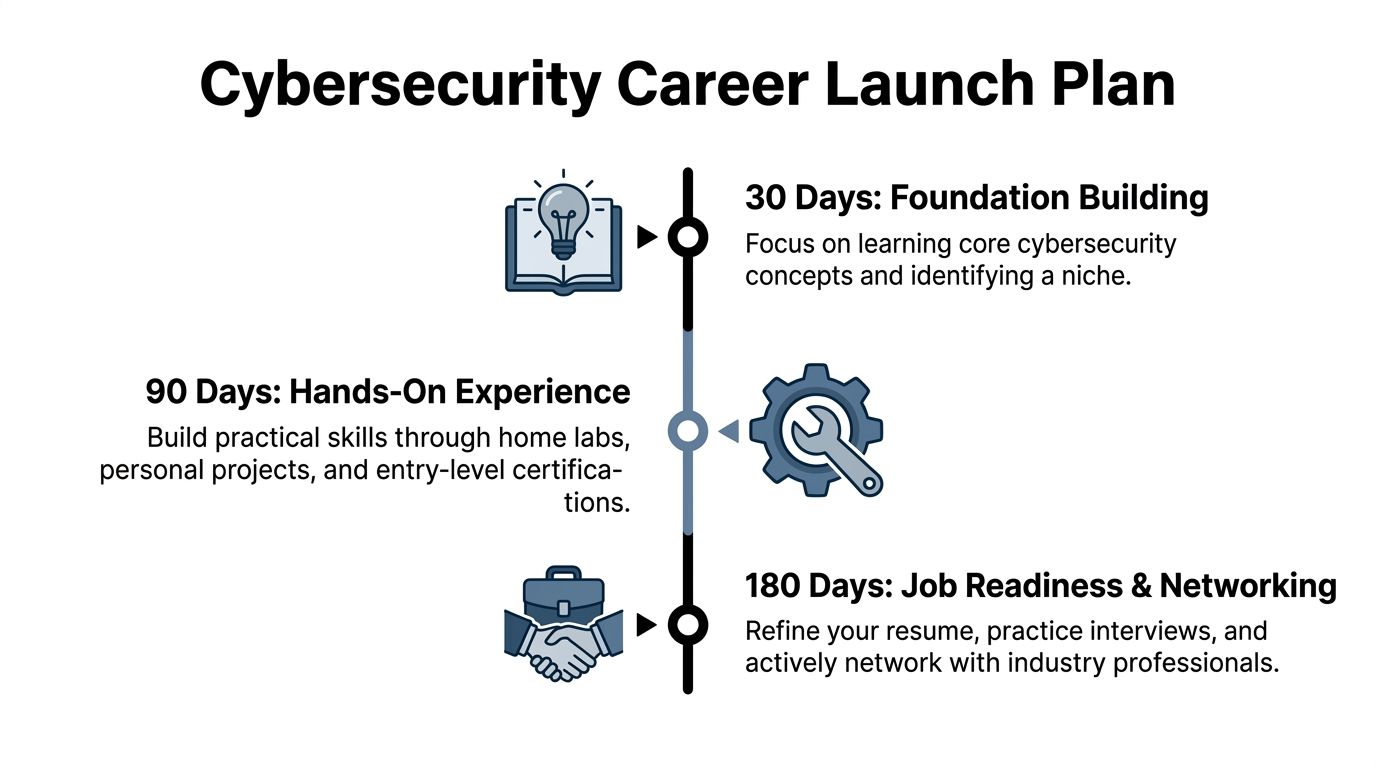
The first 30 days
Pick one target role. Not three.
Then spend the first month getting your bearings and building study rhythm.
- Choose your lane: SOC analyst, junior pentester, security admin, or network security
- Start foundational study: Networking, Windows, Linux, and security basics
- Set up your lab: Install your virtual machines and start a notebook for findings
- Map your first cert: A good starting point for many is Security+
Your only job in this phase is consistency. If you can study and practice several times a week without waiting for motivation, you’re already doing the thing many people never manage.
By day 90
By this point, your learning should be visible.
You should have:
- A working lab
- One or two documented projects
- A clearer idea of your weak spots
- A scheduled exam or completed first cert
This is also where many people need to tighten focus. If you’re watching random content every night but can’t explain a basic incident workflow or network concept, pull back. Narrow beats broad.
“Can I explain what I built, why I built it, and what I’d improve next time?” If the answer is yes, you’re moving in the right direction.
By day 180
Now the career switch becomes public.
You’re no longer “learning about cybersecurity.” You’re applying, networking, refining your resume, and collecting interview reps.
A good day-180 checklist looks like this:
| Milestone | What done looks like |
|---|---|
| Resume | Skills-first format with certs, lab work, and project bullets |
| Portfolio | GitHub or simple public portfolio with clear write-ups |
| Networking | You’ve joined meetups, online communities, or mentor circles |
| Applications | You’re applying consistently to realistic entry-level roles |
| Interview prep | You can explain your projects without rambling |
This timeline is flexible. Real life gets in the way. Some people move faster because they already work in IT. Some take longer because they’re balancing family and a full-time job.
The point isn’t speed. The point is momentum and evidence.
Land the Job with a Killer Resume and Interview Strategy
A lot of career changers sabotage themselves right at the finish line.
They do the hard part. They study, build labs, pass certs, document projects. Then they write a resume that reads like an apology for not having formal experience.
Don’t do that.

Build a resume around proof
Recent data notes a 25% rise in remote cyber roles in major markets, and 72% of global cyber postings on skills platforms prioritize certifications over degrees, according to this summary of hiring trends for no-degree cyber candidates. That’s good news, but only if your resume makes your skills obvious fast.
Lead with what matters most:
- Certifications
- Technical skills
- Projects and labs
- Relevant work history
If your current job isn’t in security, translate the overlap. Maybe you handled access requests, troubleshooting, documentation, customer incidents, compliance steps, or device setup. That counts when framed correctly.
Try bullets like these:
- Investigated system issues and documented findings for repeatable resolution
- Managed user access tasks with attention to permissions and process
- Built a home lab using Windows and Linux virtual machines to practice logging, hardening, and incident triage
- Documented security projects on GitHub with screenshots, steps, and lessons learned
Use the STAR method in your bullets. Situation, task, action, result. You don’t need to label it. Just write like someone who solved a problem.
If you need a starting template, a resume builder for skills-first applications can make the formatting part less painful.
Interview like a practitioner, not a student
The hardest interview question for non-degree candidates is usually some version of “Tell me about your experience.”
The wrong answer sounds like this: “I don’t have professional cybersecurity experience yet, but I’m passionate and eager to learn.”
That tells them almost nothing.
A better answer sounds like this:
- the environment you built
- the tools you used
- the problem you investigated
- the decision you made
- what you learned from it
For example, if you built a Splunk lab, be ready to explain:
- what data you ingested
- how you searched it
- what normal vs suspicious looked like
- what was confusing at first
- how you improved the setup
That’s how practitioners talk.
A few interview habits help a lot:
- Bring one project story per role requirement: If they ask about incident response, have a lab example ready.
- Admit what you don’t know cleanly: Then explain how you’d find the answer.
- Write clearly during take-homes: Security teams care a lot about communication.
- Show your process: Good teams hire thinkers, not trivia machines.
You don’t need to pretend your lab was a Fortune 500 SOC. You need to show that you approach problems the way a useful junior analyst would.
Frequently Asked Questions
Can I really get into cybersecurity without a degree?
Yes. The field has opened up for people who can prove skills through certifications, labs, projects, and relevant experience from adjacent jobs.
What’s the best first certification?
For most beginners, Security+ is the cleanest starting point because it gives you broad coverage and shows up often in entry-level hiring.
Should I start with hacking?
Usually no. Start with networking, operating systems, and core security concepts. Offensive skills make much more sense once the basics are solid.
Do I need to know how to code?
You don’t need to be a software engineer. Basic scripting helps a lot, especially for automation and parsing logs, but it shouldn’t stop you from starting.
What if I have no IT background at all?
That’s common. The path is still open, but your first win may come from a support, admin, or adjacent technical role that gets you closer to security work.
How do I stand out?
Pick a role, build a lab, finish a few real projects, and get good at explaining them. Often, individuals quit at the “consume content” stage. The people who publish proof get interviews.
If you’re ready to turn this into a real job search, HiredBySkill is built for exactly this kind of move. You can browse degree-optional roles, find employers using skills-first hiring, and use tools like resume support and career resources without paying to get started.
Latest jobs
- Restaurant Supervisor — Dreamscape Hospitality
- Manager, Airport Operations — Avelo Airlines, Inc.
- Website Coordinator - NAVSAFECOM (On-Site) — Vistra Communications
- Donor Greeter — Goodwill of the Finger Lakes
- Wares Processor — Goodwill of the Finger Lakes
- Lead Pricer - Apparel — Goodwill of the Finger Lakes
- Kitchen Assistant — The Harpenden Arms, Harpenden
- Part Time Waiting Staff — Miller & Carter - Worcester Park