Best Network Administrator Certifications: Your 2026 Guide
Master network administrator certifications for 2026. Discover top certs, how to get them without a degree, and secure a high-paying network admin career.
You know the feeling. You can fix Wi-Fi issues faster than half the office, you've built a gaming PC, maybe you've helped friends untangle router chaos, and then you open a job posting for a junior networking role and get hit with the same line again: bachelor's degree required.
That line scares off a lot of smart people who would do just fine in IT. It shouldn't. In networking, employers care a lot about whether you can install, troubleshoot, document, and keep systems stable. That's where certifications come in. They're not magic. They are, however, one of the clearest ways to prove skill when you don't have a degree.
If you're a STAR candidate, self-taught, bootcamp-trained, military, or career-switching from another field, network administrator certifications can open doors that look locked from the outside. The trick is knowing which certs matter, which ones are overpriced detours, and how to pair them with hands-on practice so hiring managers take you seriously.
Table of Contents
- Your Ticket to a High-Paying Tech Career Without a Degree
- The Big Three Certifications Every Network Admin Needs to Know
- Level Up Your Career with Advanced Certifications
- Certifications Versus Experience: What Matters More
- Your Step-by-Step Game Plan to Get Certified and Hired
- How to Pass Your Certification Exam
- Turning Your New Certification into a Job Offer
- Your Future in Networking Starts Now
Your Ticket to a High-Paying Tech Career Without a Degree
A lot of people treat networking like it's some hidden back room of IT. That's great news for you. It means there's a solid career path here that doesn't depend on having a fancy diploma framed on the wall.
Network admins keep the digital world usable. They handle connectivity, user access, troubleshooting, monitoring, and the ugly “nothing works and everyone is mad” moments. If you like solving problems under pressure and making systems behave, this work fits.
Here's the part most degree-filtered job ads won't tell you. The U.S. Bureau of Labor Statistics projects about 14,300 openings for network and computer systems administrators each year on average, and Cyberseek data shows that certifications enable nearly half of workers to bypass traditional four-year degree requirements. That's one of the clearest signs that networking is still a strong skills-first lane.
Practical rule: If a role says degree preferred but lists certs like CCNA or Network+, apply anyway if you can back them up with real lab work.
The bigger opportunity is mindset. Stop reading “degree required” as a final answer. Read it as a filter written by HR before the hiring manager got involved. Managers want people who can solve tickets, document changes, and avoid breaking production on a Tuesday afternoon.
A smarter approach is to build proof, not excuses:
- Get a recognized cert that recruiters know on sight.
- Build a home lab so you can talk through real troubleshooting.
- Document your projects on your resume and LinkedIn.
- Target skills-first employers instead of wasting energy on companies obsessed with pedigree.
If you want a broader look at what no-degree careers can pay, this salary guide for no-degree jobs is useful for comparing networking to other paths.
The Big Three Certifications Every Network Admin Needs to Know
You're staring at three tabs. One says Network+, one says CCNA, one says Security+. Your budget is tight, your resume is light, and you do not have time to guess.
Here's the practical answer. For a STAR trying to get hired without a degree, these are the three certifications that matter most early on: CompTIA Network+, Cisco CCNA, and CompTIA Security+.
Pick the cert that fixes your biggest hiring problem
Each cert solves a different problem.
Network+ helps if you still need the fundamentals. It covers core networking concepts across vendors, so you can talk clearly about ports, protocols, subnets, routing, switching, cabling, and troubleshooting without sounding half-ready.
CCNA helps if you need stronger proof that you can do the job. It carries more weight for network admin roles because it pushes you closer to real configuration and troubleshooting work. Cisco lists the CCNA exam at $300 with no formal prerequisites. For non-degree candidates, that matters. Hiring managers may not care where you learned it if you can explain VLANs, static routes, ACLs, and why the branch office lost connectivity after a switch change.
Security+ helps if you want your resume to fit more than one lane. Network teams deal with security every day. Permissions, segmentation, secure remote access, patching, and incident response are part of the job now, not side topics. If you later want to branch out, this guide on how to get into cybersecurity without a degree shows where that overlap can take you.
CompTIA Network+ vs. Cisco CCNA at a glance
| Attribute | CompTIA Network+ | Cisco CCNA |
|---|---|---|
| Best for | Beginners who need broad networking fundamentals | Candidates ready to prove stronger practical networking skill |
| Focus | Vendor-neutral networking concepts | Cisco-oriented networking plus admin-style configuration and troubleshooting |
| Difficulty | More beginner-friendly | Tougher, more technical |
| Cost | CompTIA lists the Network+ exam voucher at $369 | Cisco lists CCNA at $300 with no formal prerequisites |
| Employer signal | Good entry-level baseline | Stronger signal for network admin roles |
| Ideal use | First cert if you're new to networking | First or second cert if you already have basic knowledge and can lab consistently |
My recommendation is simple.
- Start with Network+ if you still mix up core concepts or need a cleaner foundation.
- Start with CCNA if you already know the basics and you're willing to spend serious time in a lab.
- Add Security+ after that if the jobs you want mention security tasks, compliance, access control, or hybrid sysadmin work.
- Skip random badge collecting. One cert that fills a real gap beats three that say the same thing.
A lot of junior candidates get this backward. They chase whatever sounds hardest, then stall out. You need momentum first, proof second, specialization third.
If memorization slows you down, keep a light study tool handy between shifts or lab sessions. These Flashcards for CompTIA certification are useful for drilling terms without burning a whole evening.
Where Security+ fits
Security+ is not your first move in every case, but it is a smart third move for many STARs.
It rounds out your profile fast. A candidate with networking knowledge plus security basics looks more useful than someone who only knows how to patch cables and recite port numbers. It also helps with jobs that blur together in actual work environments: network support, junior sysadmin, IT generalist, NOC, and security operations support.
Here's the blunt version. Network+ teaches the language. CCNA proves you can work the gear. Security+ makes you easier to place.
That combo gets interviews. Lab work and clear project examples get offers.
Level Up Your Career with Advanced Certifications
Once you've landed your first networking job, your cert strategy should change. At that point, you're not trying to prove you belong in the room. You're trying to shape what kind of room you want to be in.

Pick a direction before you collect badges
Many people make a mistake by continuing to study like they're still trying to get their first help desk callback. Don't do that. Mid-career certifications should support a specialization.
A few smart paths:
- Enterprise networking if you like routing, switching, performance, and larger environments. That's where advanced Cisco tracks like CCNP make sense.
- Multi-vendor networking if your company doesn't live in Cisco land. Juniper certs like JNCIA can be useful in those shops.
- Cloud networking if your team is moving workloads into AWS or Azure and needs people who understand how networking changes in cloud environments.
- Security-focused infrastructure if you like firewalls, segmentation, identity, and defensive operations.
Good next moves after your first networking role
After your first role, pick certs based on the problems you're solving at work.
If you're spending all day inside Cisco environments, advanced Cisco certs make sense. If your company is hybrid and cloud-heavy, a cloud networking path may pay off faster than another traditional network cert. If you keep getting pulled into security conversations, lean into that and build a stronger security stack.
A lot of people transitioning from networking into security should also look at adjacent paths. This guide on getting into cybersecurity without a degree is useful if you want to map that move without starting over.
The main point is simple. Your first cert gets attention. Your later certs should strengthen your position.
Certifications Versus Experience: What Matters More
Certifications matter. Experience matters more.
Here's the mistake a lot of new candidates make. They treat a cert like a shortcut. Pass the exam, add a badge to LinkedIn, wait for recruiters. Hiring does not work that way, especially for STARs and other non-degree candidates. A certification gets you past the first filter. Proof that you can do the work gets you taken seriously.
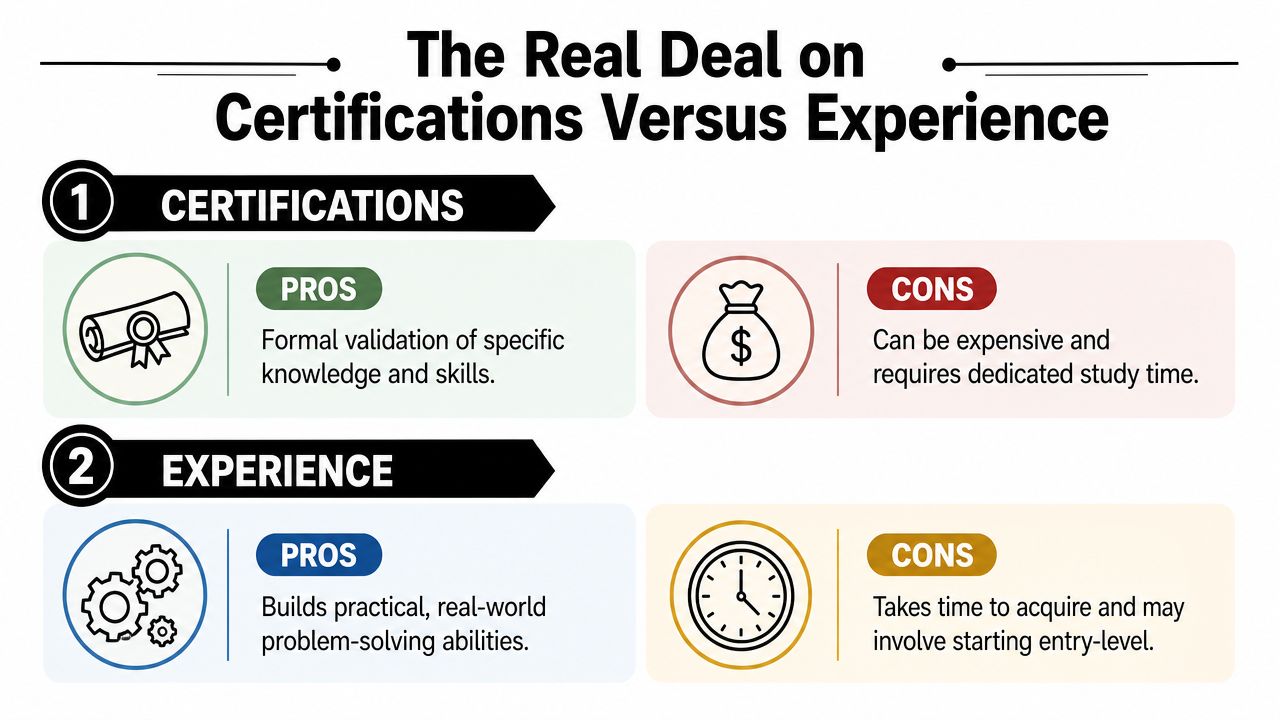
Certs get attention. Experience closes the deal.
A common refrain in hiring forums and IT career threads is simple: certifications help you get noticed, but experience is what gets you hired. That sounds harsh. It's also how the market works.
Hiring managers look at certs and ask, “Does this person know the basics?”
Then they look for evidence and ask, “Can this person troubleshoot, explain their choices, and avoid turning a small outage into a big one?”
That second question decides interviews.
For non-degree candidates, this is good news. You do not need to wait for someone to hand you a job title before you start building experience. You can create proof right now, and good employers will count it if you present it well.
Useful proof looks like this:
- A home lab where you configured VLANs, DHCP, subnets, and inter-VLAN routing
- Packet Tracer or GNS3 projects with saved configs and short notes on what broke and how you fixed it
- A network diagram for a small office or lab that shows segmentation, IP ranges, and device roles
- A troubleshooting writeup that reads like a change note, with the issue, tests, root cause, and fix
How to build experience before your first networking job
Start acting like a junior network admin now.
A cert proves you studied. A lab, a project, and clean documentation prove you can think through problems.
Use a simple system:
- Build a small lab: Used gear is fine. Simulators are fine too. The point is repetition.
- Keep records: Save screenshots, configs, diagrams, and short summaries for every project.
- Practice explanation: If you cannot explain why you chose a subnet, ACL, or VLAN design, you are not ready for interviews.
- Help in low-risk environments: Community groups, clubs, and small nonprofits sometimes need basic network help. Start with simple work and document it carefully.
This approach fits STAR candidates better than generic advice built around degrees and internships. You are replacing pedigree with evidence. If you want a stronger way to present that evidence to employers, read about competency-based assessments and how hiring teams evaluate real skills.
Your Step-by-Step Game Plan to Get Certified and Hired
Most beginners make one of two mistakes. They either overplan for six months and never take an exam, or they rush into the hardest cert they can find and get wrecked.
Use a cleaner plan.
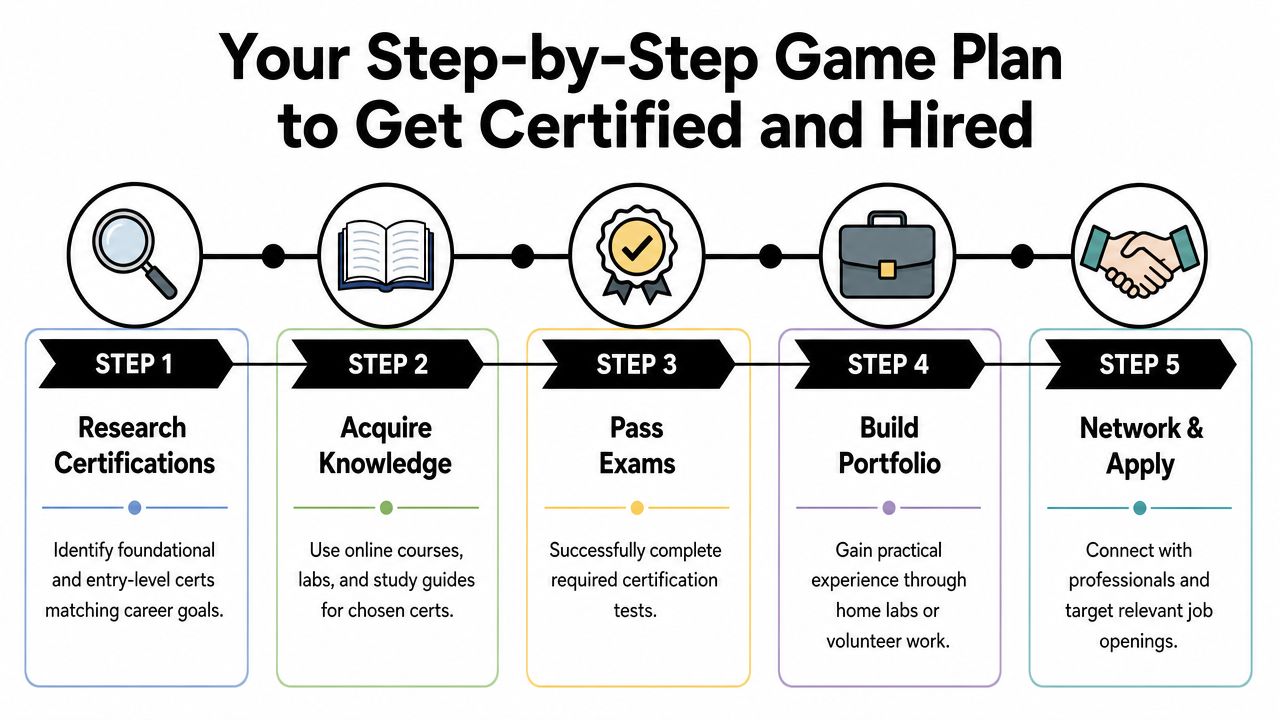
A roadmap that actually makes sense
Start with A+ only if you need basic computer grounding
If hardware, operating systems, and troubleshooting basics still feel shaky, A+ can help. If you already know your way around systems, skip it and save the time.Earn Network+ if you need broad fundamentals
This is your foundation cert when you're building from scratch. It gives structure to topics that otherwise feel scattered.Build a home lab immediately
Don't wait until after the exam. Lab work should run alongside your studying. Packet Tracer and GNS3 are common starting points, and even a simple setup teaches you more than passive video watching.Go after CCNA once the basics click
Achieving CCNA makes your profile start to look serious for networking jobs. It forces you to move from “I kind of get it” to “I can explain and troubleshoot it.”Add Security+ to strengthen your marketability
This stack works because employers like candidates who understand both connectivity and protection. According to this salary analysis, stacking Security+ on top of Network+ can lift potential earnings from the $45,000 to $85,000 range to the $60,000 to $100,000 range.
Why this order works
This sequence builds confidence and employability at the same time. You start with broad understanding, add practical proof, then finish with a stronger specialist signal.
It also keeps you from becoming the classic “cert collector with no stories” candidate.
A few essentials:
- Apply before you feel ready: Entry-level employers rarely expect perfection.
- Keep a simple project log: Date, problem, tool, fix, lesson.
- Use job titles strategically: Search for network technician, junior network administrator, NOC technician, IT support with networking responsibilities, and infrastructure support roles.
- Target degree-optional employers first: Your energy should go where skills matter most.
For a wider job-search strategy, this guide on how to get a job without a degree is worth a read.
How to Pass Your Certification Exam
You do not need a degree to beat this exam. You need a routine that sticks after a full workday, a cheap lab, and enough reps that subnetting, VLANs, and troubleshooting stop feeling theoretical.
That matters a lot for STAR candidates. If you are building your credibility through certs and hands-on work instead of a college transcript, your study method needs to produce two things at once. A passing score and real stories you can talk through in interviews.

Build a study system that forces recall
A lot of junior techs study in a way that feels productive and produces nothing. They watch videos, highlight pages, and tell themselves they will lab later. Then the exam asks them to troubleshoot a routing issue and their brain goes blank.
Use three tracks every week:
- Learn the topic: Use the exam objectives, one main video course, and one study guide.
- Test your memory: Use flashcards, short quizzes, and blank-page recall where you write out concepts from memory.
- Practice the skill: Build labs where you configure, break, and fix the topic yourself.
Here's the weekly rhythm I recommend.
| Study block | What to do |
|---|---|
| Early week | Learn one topic in depth from video or reading |
| Midweek | Lab it until you can explain each step out loud |
| End of week | Take practice questions and review only what you missed |
Keep your stack simple. One course. One book. One lab setup. Three different resources for the same topic usually wastes time.
And yes, talk through your labs out loud. If you can explain why OSPF formed a neighbor relationship, why a trunk is failing, or why a host lost connectivity after an ACL change, you are learning the material the way employers care about.
If you want a cleaner way to turn your lab work and cert progress into resume bullets later, save your project notes in a format you can reuse with a networking resume builder.
Here's a useful walkthrough to reinforce your prep process:
The exam week checklist
Exam week should feel boring. Calm wins.
- Review the objective list: Every domain should look familiar.
- Focus on weak spots: Stop rereading chapters you already own.
- Use one or two practice exams well: Review every wrong answer and write down why you missed it.
- Do one final lab pass: Configure the topics that tend to slip under pressure.
- Protect your sleep: Fatigue turns easy questions into stupid mistakes.
One more rule. Do not chase a perfect score. Chase a pass with solid understanding.
That mindset helps non-degree candidates more than anyone, because your cert is not the finish line. It is proof that you can learn fast, document your work, and show up prepared. Those habits also help you negotiate your next job offer once the interviews start.
If your study plan does not include labs, it is incomplete.
Turning Your New Certification into a Job Offer
You passed the exam on Saturday. By Monday, you should be turning that win into resume bullets, LinkedIn proof, and interview stories that make a hiring manager think, "This person can do the job."
That is the part many new cert holders miss.
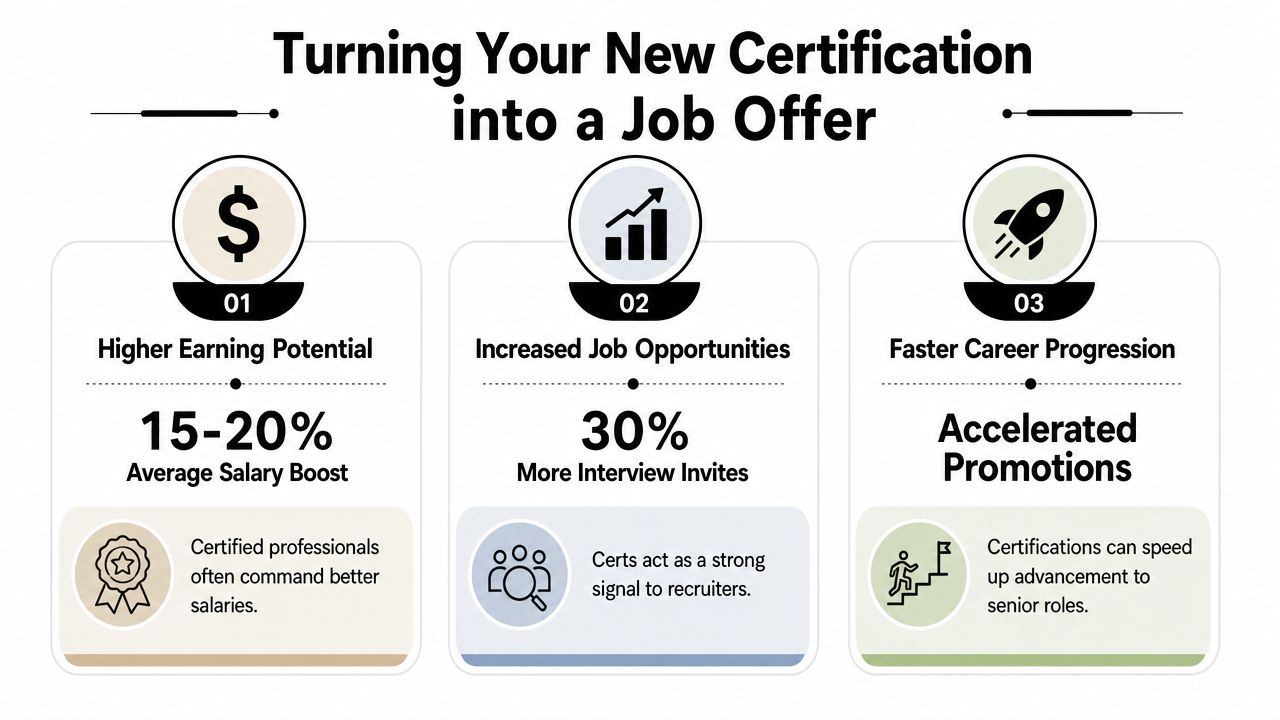
Translate certs into resume language recruiters understand
A certification line gets you into a search result. Proof gets you the interview.
Recruiters and hiring managers do not want to guess what your cert means in practice. Spell it out. Show the tools you used, the problems you worked through, and the tasks you can handle right now. That matters even more for STAR candidates and non-degree applicants, because your resume needs to make your skills obvious fast.
Bad version:
- Passed CCNA certification
Better version:
- Earned CCNA and built hands-on lab projects focused on switch configuration, VLAN setup, connectivity troubleshooting, and network documentation
Bad version:
- Studied network security
Better version:
- Added Security+ knowledge to a networking foundation and practiced secure access, segmentation, and basic incident response in lab scenarios
The salary upside is one reason this effort pays off. The U.S. Bureau of Labor Statistics shows network and computer systems administrators earn a solid median wage, and certs help you compete for the better-paying roles inside that category. The cert alone is not the magic. The cert plus evidence is what gets attention.
Use your lab work like real project experience
If you do not have paid IT experience yet, your lab is your experience. Treat it that way.
Write about it like work you completed for a real environment. Use action verbs. Name the tools. Mention the result. A hiring manager will respect a candidate who built, tested, documented, and fixed things far more than one who just says they are motivated.
Use bullets like these:
- Built and documented a home networking lab to practice routing, switching, IP addressing, and network segmentation
- Configured and tested VLANs, inter-VLAN routing, DHCP, and access control rules in repeatable lab scenarios
- Troubleshot simulated outages and recorded root causes, fixes, and follow-up steps
- Created network diagrams, device notes, and change logs to mirror real support documentation
That sounds like an entry-level network admin. "Passionate IT learner" does not.
If you want a faster way to turn those projects into clean resume bullets, use a resume builder for skills-first networking candidates.
Show proof in interviews, not just enthusiasm
Your interview should sound like a technician talking about work, not a student talking about a test.
Bring two or three short stories that prove you can solve problems. One story can cover a lab you built from scratch. One can cover a troubleshooting issue you caused and fixed. One can cover how you documented the setup so someone else could follow it. That combination works especially well for non-degree candidates because it replaces pedigree with evidence.
Keep your answers simple:
- What was the problem?
- What did you do?
- What was the result?
- What did you learn?
That structure keeps you focused and makes you sound experienced, even if your experience came from home labs, volunteer work, or contract gigs.
Negotiate like someone with proof, not hope
Once interviews start landing, do not get shy about pay.
Use your certification, lab portfolio, project documentation, and interview examples as evidence that you can contribute on day one. If an offer comes in low, this guide on how to negotiate your next job offer gives a solid, practical framework for pushing back without sounding combative.
Recruiters hire the candidate who looks prepared, trainable, and low-risk. Your job is to make that decision easy.
Your Future in Networking Starts Now
A networking career doesn't belong only to people with computer science degrees. It belongs to people who learn the fundamentals, practice the work, and prove they can solve problems when systems break.
That's good news if you're a STAR candidate. You can build this career through certifications, labs, project documentation, and smart job targeting. You do not need permission from a university to start acting like a professional.
The path is simple, even if it isn't effortless. Start with a foundation cert if you need it. Build a lab. Move into CCNA when you're ready. Add security knowledge if it fits your goals. Then market your work like it counts, because it does.
If you're also thinking long term, keep an eye on where infrastructure work is heading. This overview of Atlanta's cloud and data skills is a useful reminder that networking blends more and more with cloud, security, and data-heavy environments.
Start now. Not when you feel perfectly ready. Ready is overrated. Skilled and moving beats hesitant every time.
If you want a faster path to degree-optional roles, HiredBySkill is built for exactly that. You can find skills-first openings, explore career paths, and use practical tools that help STAR candidates turn certifications and real experience into better job options.
Latest jobs
- Intelligence Systems Technician — Booz Allen Hamilton
- Registered ECE Teacher | Busy Bees Pioneer Highway — Busy Bees Aotearoa
- Clinical Nurse Educator — St Vincent's Health Australia
- Pharmacist - Grade 1 — Mercy Health
- MECCA Doncaster - Zone Manager — Mecca Brands
- Senior Manager, SHD Medical Science Liaison — Edwards Lifesciences
- Contract Manager - MagnumOne ANZ — Magnum RFM Ice Cream, Inc. (Selecta Philippines)
- Senior Auditor — BDO in Australia