What Are Competency Based Interview Questions and STAR Tips
Wondering what are competency based interview questions? Get clear answers, sample questions by skill and STAR answer tips.
Competency based interview questions ask candidates to describe a real past situation that shows a specific job skill in action. They don't ask how talented you think you are; they ask what you did last time the work got messy.
So here's a question worth sitting with. If two people can both say they're great problem solvers, how does an interviewer find out who has really solved a problem? Most interviews reward the smoother talker. A competency interview tries, at least, to reward the person with receipts. That matters a lot if your receipts come from a barracks, a bootcamp, a shop floor, or your kitchen table instead of a university seminar room.
Table of Contents
- What Competency Based Interview Questions Are and Why Employers Use Them
- Sample Questions Sorted by Competency
- How to Answer With the STAR Method
- Turning Non-Traditional Experience Into STAR Stories
- How Interviewers Score Answers Fairly
- Fairness Traps and Accessibility Barriers to Watch
- Build Your Story Bank Before Your Next Interview
What Competency Based Interview Questions Are and Why Employers Use Them
Cooking makes the difference easy to feel. Ask "Are you a good cook?" and you get a confident nod. Ask "Walk me through the last dinner you cooked for twenty people, step by step" and suddenly you learn whether they can plan portions, time a roast, and stay calm when the gravy splits. When people ask what are competency based interview questions, the honest answer is that they are the second kind of question, pointed at work.
A typical opener sounds like this. "Tell me about a time you resolved a conflict with a coworker." Or, "Describe a time you diagnosed a problem under pressure. What did you do, and what changed afterward?" The interviewer is listening for specifics: what the situation was, what you personally did, and what happened because of it.
Storytelling polish helps. Evidence is what gets scored.
That sets these questions apart from two familiar interview staples. "Tell me about yourself" is wide open, so candidates wander. Hypotheticals like "What would you do if a customer got angry?" let anyone describe their best, imaginary self. A competency question pins you to a real Tuesday when the customer was angry, you were tired, and the till jammed.
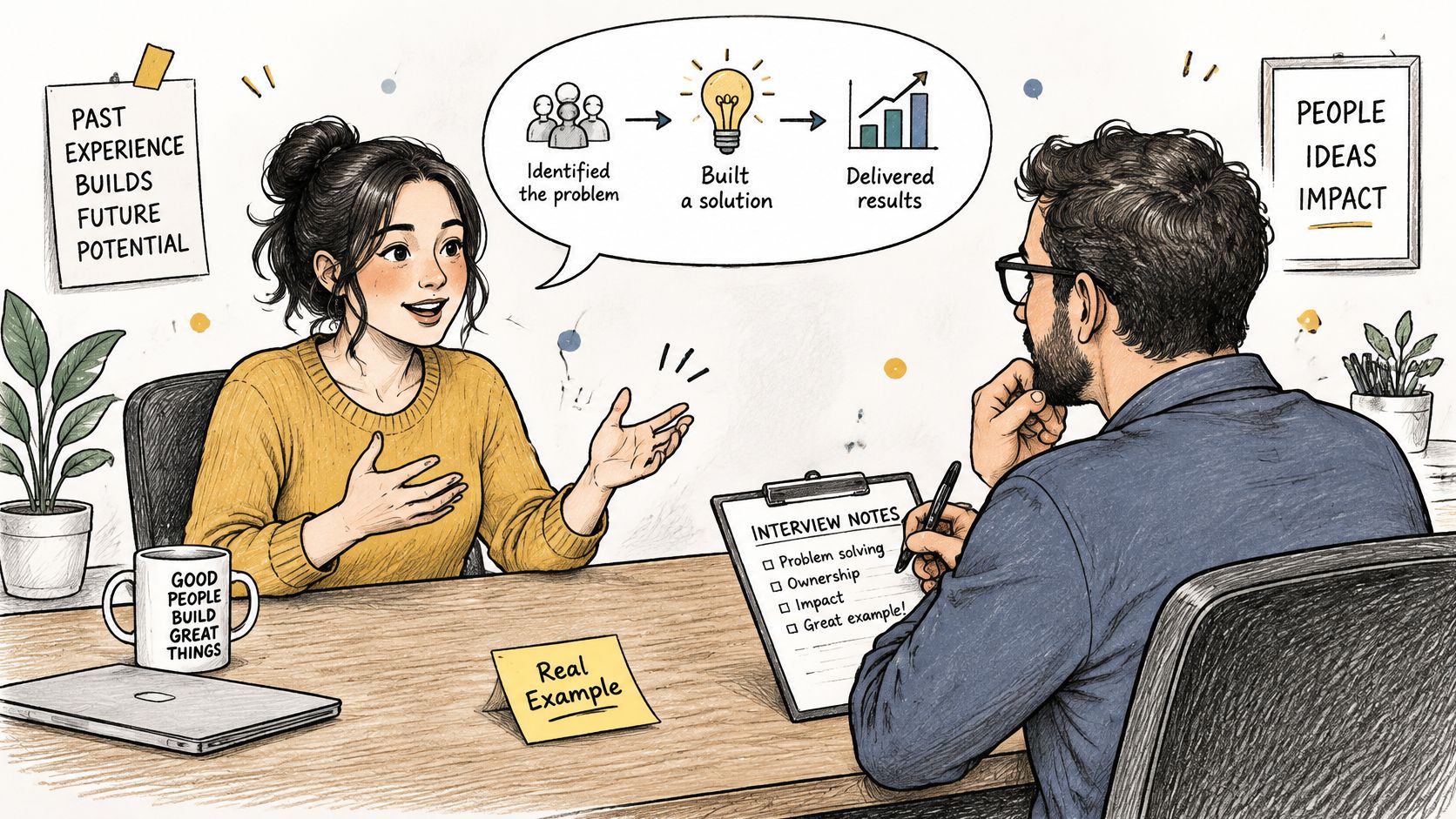
Why employers bother with all this
The thinking underneath is simple. Past behaviour helps predict future behaviour, especially when each question maps to one competency the job needs, identified through proper job analysis. A warehouse role might need inventory accuracy. A developer role might need secure coding. A degree alone shows neither one directly.
This isn't a new fad either. The UK Civil Service Competency Framework rolled out across the Civil Service from April 2013, after some departments started adopting it in April 2012, aiming for one consistent way to spot the skills and behaviours linked to good performance at each grade, as explained in the Global Government Forum guide to Success Profiles. The UK later broadened to Success Profiles because a solely competency based process could feel too rigid and miss parts of a person.
The research case gets really interesting here. A 1993 meta-analysis covering 31 studies found an average interview validity coefficient of 0.27 and an estimated true validity of 0.38, with interview structure the only one of six examined characteristics that moderated validity, summarised in the overview of personnel selection research. Structured interviews have been found to predict job performance better than unstructured ones. In human terms, asking everyone the same questions and scoring against the same guide works far better than a friendly chat and a gut feeling.
That's also why this format suits degree-optional, skills-based hiring so well. A panel can compare a career changer, a veteran, and a four year graduate on the same evidence, because the evidence comes from what each person did, not where they studied. One honest limit though. Structure alone doesn't make an interview fair or accurate. Ask structured questions about the wrong skill and you'll still hire the wrong person, just very consistently.
Sample Questions Sorted by Competency
Read across each row. The left column names the competency being tested, the middle gives you a question in the classic "Describe a time" shape, and the right column shows the evidence that separates a strong answer from a vague one. If you're preparing, that right column is gold. It's basically the interviewer's shopping list.
| Competency | Sample question | Strong evidence to listen for |
|---|---|---|
| Problem-solving | Describe a time you diagnosed a problem under pressure. What did you do, and what changed afterward? | Clear diagnosis steps, a decision they owned, and a measurable change |
| Teamwork | Tell me about a time you finished a task with someone you disagreed with. | Named behaviors on both sides, a compromise, and the final outcome |
| Customer handling | Describe a time an unhappy customer left still frustrated. What happened next? | Listening steps, a fix within their authority, and whether the customer came back |
| Prioritization | Tell me about a time three urgent jobs landed on you at once. How did you choose the order? | A stated rule for ranking, what they delayed or delegated, and the impact |
| Communication | Give an example of explaining something complicated to someone with no background in it. | Adjusted language or visuals, a check for understanding, and proof it worked |
| Attention to detail | Tell me about a time you caught an error before it reached someone else. | How they checked, what the error was, and the process change they added |
| Learning and adaptability | Describe a time you had to learn a new tool or skill quickly to finish work. | Learning method, time frame, and the result on the job |
| Ownership and leadership | Tell me about a time you took charge when nobody asked you to. | The gap they spotted, the action they took, and how others responded |
Notice how every question is past tense. That's deliberate. "Tell me about a time" is hard to answer with theory, so candidates reach for memory instead. And notice the strong evidence never says "sounded confident" or "seemed like a nice person." It names observable things, a specific decision, a number, a check they ran, a person they followed up with.
If you want a deeper bank of examples organised the same way, CliniRoo's competency interview guide is worth a browse alongside this table, particularly for healthcare flavoured roles where customer handling becomes patient handling and the stakes change.
Two wrinkles worth knowing about
Sometimes a candidate has not yet lived the exact scenario. That's where a situational variant comes in, a realistic dilemma phrased as "What would you do if a delivery arrives short an hour before closing?" It tests judgement and reasoning rather than memory, and it gives newer workers, bootcamp graduates, and career changers a fairer shot at showing how they think. Interviewers often mix a couple of these in with the past tense questions.
The second wrinkle is a rule interviewers should treat as sacred. Map each question to exactly one competency. The moment a question tries to test teamwork, leadership, and communication all at once, scoring turns to soup. Nobody knows which score the answer earned. One question, one competency, one clean score.
Try this tonight: pick any row, say the question out loud, and notice whether your answer contains a decision, a number, and an outcome. If one is missing, that's your homework.
Questions like these should grow out of job analysis, meaning someone studied the actual role before writing them. A logistics employer asking about tidy spreadsheets when the job is really about calming furious drivers has skipped that homework, and the difficult conversations in that role will expose the gap fast, which is why preparing for charged workplace conversations often doubles as interview prep. Before any interview, rehearsal beats reading. Pick at least two questions per competency, answer them out loud, and time yourself. Your second attempt will be half the length and twice as clear.
How to Answer With the STAR Method
You've got a good story buried in your memory and ninety seconds to tell it. STAR is the shovel. It stands for Situation, Task, Action, Result, and it keeps your answer in the order an interviewer's scoring sheet expects. Here's the shape at a glance.
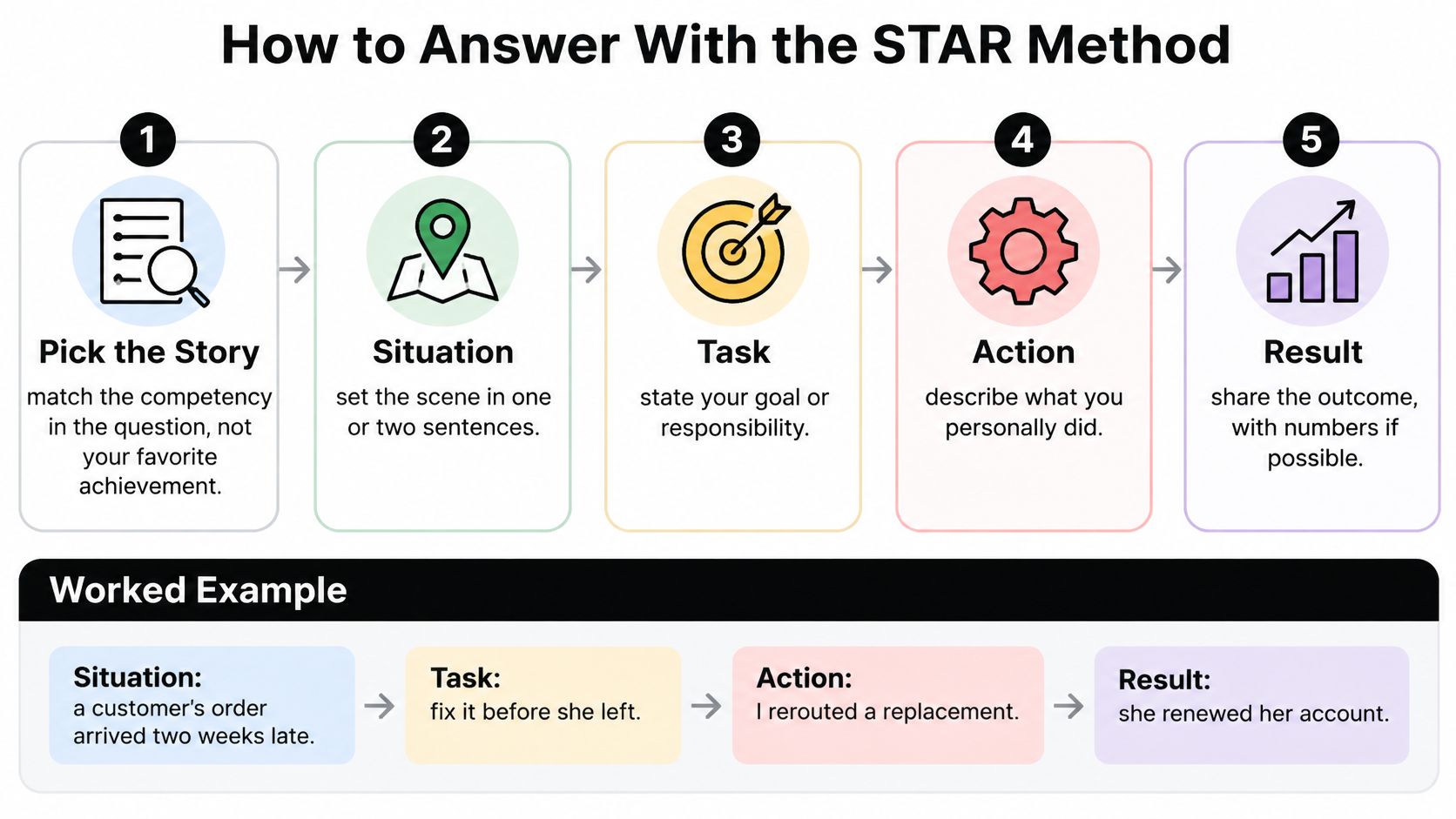
- Pick a story that matches the competency in the question. Not your favourite achievement, not the biggest thing you've ever done. If they asked about handling an unhappy customer, your marathon personal best stays in the drawer.
- Situation sets the scene in one or two sentences. Where were you, what was happening, and why did it matter. Keep it tight, because this part earns you almost no points.
- Task states what you were responsible for. This tells the interviewer your role, so they can tell your work apart from everyone else's.
- Action is where the marks live. Say exactly what you did, use "I" for your decisions, and name the steps, tools, or people involved. "I called the supplier, then I reprinted the labels" beats "we sorted it out" every time.
- Result closes with an outcome and a number if you have one. An observable change works too. Add what you learned or what you'd repeat, and stop talking.
- Keep the whole thing to about 90 seconds. Longer isn't stronger. Longer usually means the setup ate the answer.
The Australian Department of Employment and Workplace Relations describes these same evidence blocks in its guidance on behavioural interviewing, and it makes the point that this structure surfaces personal contribution instead of letting candidates hide behind "we improved it." That guidance also fits candidates whose evidence comes from volunteering, apprenticeships, or learning on the job.
A worked example from a tire shop
Say you're a shift lead at a regional tire shop with a three day backlog of brake jobs. Situation and Task: customers are waiting three days, no-shows are climbing, and you own the bay schedule. Action: you rebuilt the appointment order around parts availability instead of booking order, and you sat with your fastest technician to watch his quick-check process, then taught it to the others. Result: wait time fell from three days to one, and no-shows dropped because people stopped giving up and going elsewhere.
See how the story does the persuading? No claim like "I'm very organised" appears anywhere. The interviewer concludes it themselves, and conclusions people reach on their own stick far better than ones you hand them.
If you'd rather watch the rhythm of a STAR answer than read about it, this short walkthrough is a handy rehearsal companion.
Three fixes rescue most wobbly answers. First, swap out "we" unless you immediately name your own part. Second, replace vague endings like "it went well" with something checkable. Third, cut the setup in half, because most candidates spend forty seconds on background and ten on their actual actions. And if you get a hypothetical question with no matching past example, walk through the steps you'd take in order, explain the reasoning behind each, then point to a past moment where you used that same judgement. That's honest, and it scores.
Turning Non-Traditional Experience Into STAR Stories
Good news first. Your experience counts even if it never happened in an office with a lanyard. Interviewers scoring against competencies care about the behaviour, not the building it happened in. A food bank rota involves the same organising muscles as a warehouse schedule. A capstone project with a panicking team at 2 a.m. is still teamwork under deadline pressure.
| Experience source | Example story | Competency it shows |
|---|---|---|
| Military service | Led a four-person team through a vehicle maintenance backlog | Leadership and prioritization |
| Bootcamp | Debugged a failing app deploy under a demo deadline | Problem-solving and persistence |
| Apprenticeship | Redid a joint after an inspector flagged a safety issue | Attention to detail and safety |
| Freelance work | Handled a client who changed the project scope twice | Customer handling and communication |
| Volunteering | Ran the Saturday intake rota for a food bank | Organization and teamwork |
| Self-taught project | Shipped a small open-source tool and fixed bugs reported by users | Ownership and learning |
The trick is translation, not exaggeration. Three moves do most of the work.
- Swap jargon for plain language. "Ran a convoy" becomes "coordinated six vehicles on a timed route with two fuel stops." Civilian interviewers can't score what they can't picture, so give them the picture.
- Add a workplace frame. Treat your capstone like a client project, because functionally it was one. The scope changed twice, the deadline didn't move, and somebody had to renegotiate what got cut.
- Name the evidence. Mention the code repository, the maintenance logbook, the supervisor sign-off, the before and after photos. Concrete artefacts make a story feel verifiable, and these same bullets slot neatly into a skills-based resume built around evidence.
Now the warning, and it matters. Don't invent office style stories you never lived. Competency interviews include follow up probes precisely because panels expect detail. "What did you say next?" and "How did you know it worked?" will collapse a borrowed story in about ten seconds, and you'll feel it happen. Your real story, told plainly, survives every probe because you were there.
There's a contrarian point tucked in here too. Even a well run competency interview can accidentally reward polished storytelling over quiet competence. The defence isn't to become a performer. It's to practise telling one plain, specific story until the facts come out in order without you hunting for them. Boring and true beats dazzling and thin, every single time.
How Interviewers Score Answers Fairly
Interviewers, this part's yours. Fair scoring starts before anyone sits down, with a five point rubric and behavioral anchors that describe what each score sounds like.
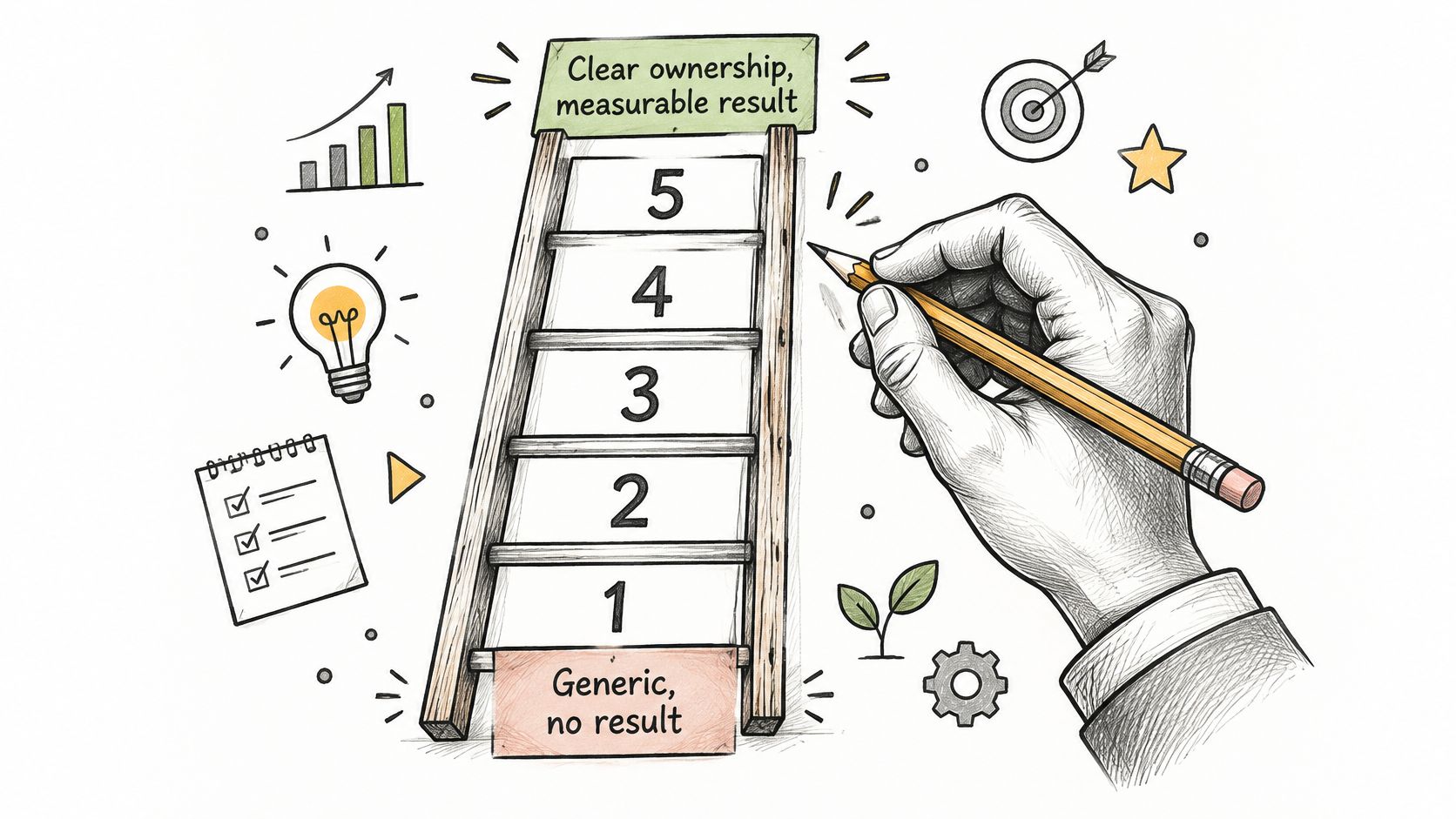
| Score | What the answer shows | Example phrase |
|---|---|---|
| 1 | Generic, no ownership or result | We usually just pull together and get it done |
| 2 | Some detail, unclear personal role | I helped out with the schedule |
| 3 | Sound process, outcome only partly verified | I reorganized the pick routes and the backlog eased |
| 4 | Clear actions, result described but not checked | I rebuilt the order and waits dropped to about a day |
| 5 | Independent, sound approach, trade-offs explained, result verified | I chose parts-first sequencing, tracked waits daily and cut them from three days to one |
That ladder mirrors the approach in the U.S. Office of Personnel Management guidance on leveraging assessments, which recommends proficiency scales such as five levels from awareness to expert and generally equal weighting across competencies unless there's a documented job related reason to weight them differently. Same lead questions, same probes, same sequence, same rubric for every candidate. That's the whole control system.
In the room, five habits keep it honest. Rate independently before discussing, so the loudest panel member doesn't anchor everyone. Compare scores competency by competency, not by overall vibe. Ask the same follow up probes for every candidate. Write down the evidence you heard, not your impression of the person. And weight each competency equally unless your job analysis says otherwise, the way you'd define competencies for engineering interviews before writing a single question. Panels assessing interpersonal evidence can sharpen this further with a structured approach to evaluating soft skills instead of relying on charm.
One trap deserves naming. "Culture fit" as a scoring reason is where bias goes to hide. If you can't point to the sentence in the answer that earned the score, you don't have a score yet.
Score the evidence, not the speaker.
Fairness Traps and Accessibility Barriers to Watch
Sometimes the barrier isn't the candidate. It's the process itself, silently testing things nobody put on the score sheet. A recorded video interview might claim to measure problem solving while in reality measuring camera comfort, broadband reliability, speech patterns, and whether you happen to make the kind of eye contact a piece of software expects.
The numbers behind that worry are sobering. A 2025 Center for Democracy & Technology report found that most participants in its research did not see accommodation options in digital assessments, and people who searched for them often could not find information about how to request support, detailed in the Center for Democracy & Technology research on automated employment decision tools. Participants also raised concerns about video systems using facial expression analysis and automated evaluation that could discriminate against disabled applicants.
Questions candidates can ask upfront
- What's being assessed in this round, and against which competencies?
- Is an alternative format available, such as a live conversation instead of a recording?
- How are recordings evaluated, and is AI involved in scoring them?
- How do I request reasonable accommodations, and who do I contact?
What employers should sort out first
Validate that every question and every tool measures a job relevant competency directly. Publish accommodation instructions before the interview, not buried after it. Offer practical supports like real-time captioning for hearing loss so deaf and hard of hearing candidates can follow questions accurately in live or remote rounds. And drop facial or emotional inference as a proxy for capability, because a person's expression is not their competence.
The nuance to hold onto is this. Same questions for everyone is not always equal access. Consistency protects reliability, but accessible formats are sometimes the only way the interview measures skill instead of a disability related barrier.
Build Your Story Bank Before Your Next Interview
Don't improvise your evidence. Build a story bank of five to six STAR stories covering problem solving, teamwork, customer handling, leadership, learning, and one honest setback. Trim each to roughly 90 seconds, and tag it with the competencies it proves and the job types it fits. When a question lands, you're choosing from a shelf instead of digging through a junk drawer.
Read job postings like a detective while you build it. The competency words in the requirements section are basically a leaked copy of the interview, so "must prioritise competing deadlines" tells you exactly which story to polish. Keep the whole bank in one note file you can scan in two minutes before the call, and rotate stories between interviews rather than reciting the same one until it sounds memorised. If your next round is in person, rehearsing the logistics alongside the stories helps too, and a quick refresher on what to expect at an on-site interview settles the practical nerves.
One concrete step for this week. Write a single story using the STAR steps, then say it out loud twice. Nothing more is needed. One story, told well, teaches your brain the shape for all the others.
Ready to put those stories in front of employers who score evidence over credentials? HiredBySkill lists degree-optional openings across tech, trades, logistics, healthcare support, and more, with tools like a resume builder to turn your story bullets into sharp resume lines. Browse roles that fit your competencies, apply with your story bank at your side, and let your receipts do the talking.
Latest jobs
- Restaurant Supervisor — Dreamscape Hospitality
- Manager, Airport Operations — Avelo Airlines, Inc.
- Website Coordinator - NAVSAFECOM (On-Site) — Vistra Communications
- Donor Greeter — Goodwill of the Finger Lakes
- Wares Processor — Goodwill of the Finger Lakes
- Lead Pricer - Apparel — Goodwill of the Finger Lakes
- Kitchen Assistant — The Harpenden Arms, Harpenden
- Part Time Waiting Staff — Miller & Carter - Worcester Park