How to Become an Employer Branding Specialist Without A
Learn how to become an employer branding specialist without a degree. Discover skills, tools, and strategies to build your career in this growing field.
You've been asked to “make the careers page more engaging,” but nobody can tell you whether the real problem is weak messaging, a slow application form, poor mobile experience, or a hiring manager who won't provide usable employee stories. That awkward gap is where an employer branding specialist earns their seat at the table. The job isn't posting cheerful photos on LinkedIn. It's turning the employee experience into credible messaging, then connecting that messaging to the recruiting funnel.
For STARs, or workers skilled through alternative routes, the role offers a useful advantage. You may not have a traditional HR background, but you may already know how to write for real people, manage pressure, explain complex work, or spot friction in a process. I built teams without degree filters, and the strongest candidates often arrived with portfolios that proved those abilities more clearly than a diploma would have.
Table of Contents
- What an Employer Branding Specialist Actually Does
- The Skills That Actually Matter on the Job
- Building a Portfolio Without a Job Title
- Learning Resources and Certifications Worth Your Time
- Networking and Getting the First Interview
- Winning the Interview With Measurable Answers
- A 90-Day Plan and Sample Resume Bullets You Can Steal
What an Employer Branding Specialist Actually Does
A candidate from a military logistics background once walked into an employer branding interview with no degree and no conventional HR title. Instead of apologizing, they opened a simple portfolio: a rewritten careers-page hero section, a short employee-story interview guide, and a funnel map showing where applicants might abandon the process. The conversation changed immediately. We weren't discussing missing credentials anymore. We were discussing judgment.
An employer branding specialist owns the company's reputation as a workplace across the candidate journey. That can include careers-site copy, employee stories, recruitment campaigns, social content, job-description standards, candidate feedback, and internal storytelling. The specialist usually works across HR, talent acquisition, marketing, communications, design, and analytics, but ownership boundaries still matter. Marketing may own the corporate brand, recruiters may own the hiring pipeline, and HR may own the employee experience. Employer brand connects those pieces and asks whether the promise matches reality.
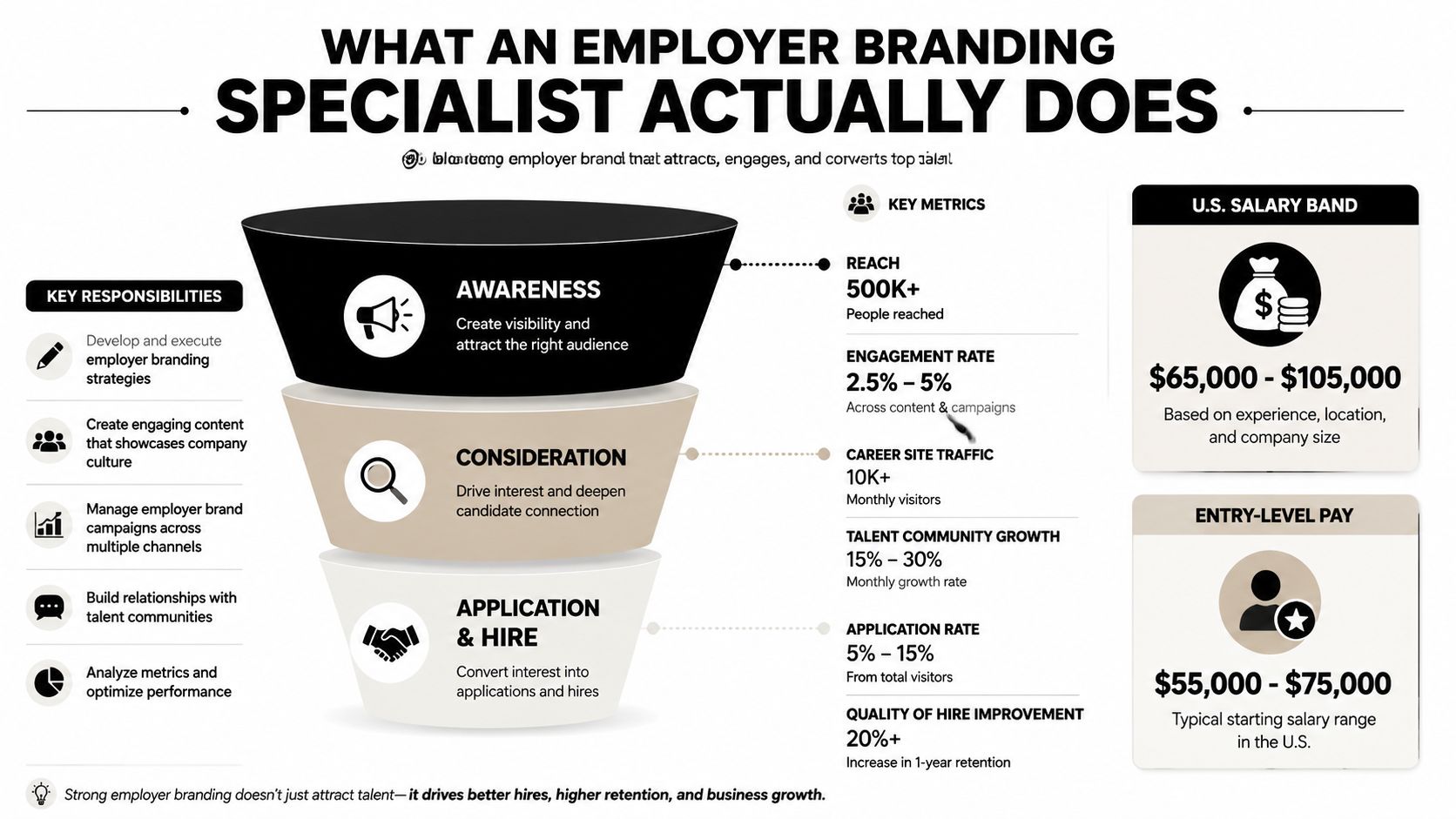
The daily work follows the funnel
A normal day might start with an analytics review, followed by a meeting with talent acquisition about a hard-to-fill role. Then comes an interview with an employee, a rewrite of a job page, feedback on a campaign asset, and a check-in with a hiring manager who thinks “fast-paced culture” is a complete value proposition.
The careers site should be treated as a conversion funnel, not a brochure. Benchmark reporting puts average click-to-apply conversion at about 6%, while top performers reach 10% or more. Application abandonment averages 40% or more, compared with 15% to 20% for high performers, and the strongest teams reduce time to apply from 8 to 10 minutes to 3 to 5 minutes. Those benchmarks are reported in industry employer branding conversion data, which also indicates that 89% of applicants apply on mobile.
That means your work might involve separating careers-page visits from click-to-apply activity, form completion, and mobile completion. A beautiful campaign that sends candidates to a broken form hasn't solved the hiring problem.
The role has real labor-market value
Employer branding has become a specialized compensation niche in major markets. In the United States, the reported average salary for an Employer Branding Specialist is $111,147 per year as of August 1, 2026, with the middle 50% earning $102,889 to $116,620 and the 90th percentile reaching $121,603, according to Glassdoor's Employer Branding Specialist salary data. The same listing reports $95,371 for entry-level work and an hourly rate of $53.
Those figures don't mean every employer will offer the same package. They do show that the function has moved beyond a side task inside recruiting or marketing. Employers are differentiating by scope, experience, geography, and strategic responsibility.
For a first-year project list, expect work such as:
- Careers-site audit: Review messaging, navigation, job pages, accessibility, and application friction.
- EVP translation: Turn internal culture, growth, pay, inclusion, and leadership behavior into evidence-based candidate messaging.
- Content system: Build repeatable employee-story formats instead of chasing random social posts.
- Campaign measurement: Connect channels and content to applications, offers, hiring speed, and retention.
- Stakeholder enablement: Coach recruiters and leaders so the brand doesn't disappear during outreach and interviews.
A practical primer on building a strong employer brand can help you understand the strategy layer. For your own portfolio, pair that thinking with a clear record of marketing skills for your CV, especially writing, audience research, campaign planning, and measurement.
The Skills That Actually Matter on the Job
The job rewards range more than polish. A strong employer branding specialist can write a clean headline, question a weak brief, read a basic dashboard, and tell a senior leader that the proposed message sounds nothing like the workplace employees describe.
A useful way to assess yourself is to ask, “Could I show evidence of this skill?” If the answer is no, create a small work sample rather than adding another vague phrase to your resume.

Seven abilities employers can see
Careers-page writing. You need to turn “we value collaboration” into a specific, believable explanation of how teams work. A retail supervisor already does this when explaining expectations, progression, and daily realities to new hires.
EVP and social storytelling. Employee stories work when they reveal a choice, challenge, or change, not when they read like a brochure. A bootcamp graduate can demonstrate this by interviewing a peer about the first project they shipped and editing the story for a defined candidate audience.
Basic analytics. You don't need to become a data scientist. You do need to distinguish reach from action, build a simple tracking sheet, and ask where candidates stop moving. A self-taught developer may already have this habit from monitoring product usage or debugging a user journey.
Project management. Campaigns involve approvals, interviews, legal review, design, publishing, and reporting. A veteran who coordinated people, equipment, and deadlines has highly relevant evidence, even if the old job title didn't include “project manager.”
Design sense. You should recognize hierarchy, readability, accessibility, and consistency. You don't have to be a full-time designer, but you should be able to improve a cluttered job graphic in Canva or give useful feedback to one.
Stakeholder coaching. The best message often sits inside someone else's head. Your job is to draw it out, challenge corporate filler, and help leaders communicate like people. Strong communication habits matter, so use this practical guide to improve communication skills.
Candidate-experience design. Read the process as a candidate would. Check whether the job page answers basic questions, whether the form feels reasonable, and whether the interview promise matches the actual experience. Employee engagement context also matters, and the Firacard employee engagement guide offers a useful lens for connecting internal experience with external reputation.
A quick self-audit
Give yourself a simple score for each ability:
- Proof: Can you show a real artifact?
- Process: Can you explain how you produced it?
- Outcome: Can you connect it to a recruiting or employee experience goal?
- Transfer: Can you explain how your previous work prepared you for it?
If you can answer all four for writing, project management, and candidate experience, you've got a credible starting point. Fill the gaps with portfolio work, not inflated language.
Building a Portfolio Without a Job Title
A portfolio beats a paragraph that says you're “passionate about people and culture.” It gives the hiring manager something to inspect, question, and remember. You don't need confidential company data or permission from an employer. You need a clear problem, a thoughtful intervention, and an honest explanation of what you could and couldn't measure.
| Project | Time Needed | What to Show |
|---|---|---|
| Careers-page audit | 30 days | Before-and-after copy, friction map, mobile observations, and recommended funnel events |
| Mock EVP | 60 days | Audience research, EVP pillars, proof points, sample careers-page copy, and risks |
| Mini-campaign | 90 days | Creative brief, channel plan, tracking method, results or simulated reporting, and post-mortem |
Start with the careers page
Choose a company with a public careers site. Capture the landing page, one job description, and the application path. Don't merely say the site feels confusing. Identify the missing information, unclear calls to action, repeated claims, and points where a candidate might hesitate.
Rewrite the hero section, one job page introduction, and one employee-story prompt. Then create a funnel map that separates careers-page traffic, click-to-apply activity, form completion, and mobile completion. If you lack access to analytics, label your numbers as unavailable and present the measurement plan you'd use instead. Fabricated results will hurt you more than missing results.
Use a one-page PDF for the summary. Include:
- Business problem: What hiring or candidate-experience issue are you addressing?
- Audience: Which role or talent group matters?
- Evidence: What did you observe?
- Recommendation: What would you change first?
- Measurement: Which event would confirm progress?
- Trade-off: What might the recommendation cost in time, consistency, or stakeholder effort?
Build an EVP with proof, not slogans
Pick an employer you admire and research public material from its careers site, job descriptions, leadership content, and employee-facing language. Draft an EVP for one talent audience, such as veterans entering operations, bootcamp graduates entering support engineering, or tradespeople moving into field leadership.
Every promise needs evidence. If you write “career growth,” name the behavior or program that would make the claim credible. If you write “flexibility,” explain where flexibility applies and where it doesn't. Skills-first messaging becomes persuasive when it tells candidates what they'll be trusted to do, how they'll learn, and what proof of performance matters.
Attach a campaign to a recruiting outcome
Create a small LinkedIn campaign or public Google Doc series around one role family. Write the audience definition, message, creative concept, publishing schedule, and measurement plan. Track impressions, clicks, click-to-apply activity, application completion, and candidate feedback where access allows. If you can't access downstream data, don't pretend the campaign produced hires. Show the handoff you'd request from the ATS.
The most common mistake is designing attractive assets without attaching them to a funnel. A polished employee quote is only useful when you know which audience it serves and what action follows.
For presentation polish, use the HiredBySkill resume builder to keep your experience concise, then link to the fuller portfolio.
Learning Resources and Certifications Worth Your Time
Learning employer branding requires a mix of recruitment knowledge, copywriting, candidate experience, and measurement. The mistake is collecting certificates before producing anything. Hiring teams usually trust a clear audit or campaign post-mortem more than a crowded credential list.
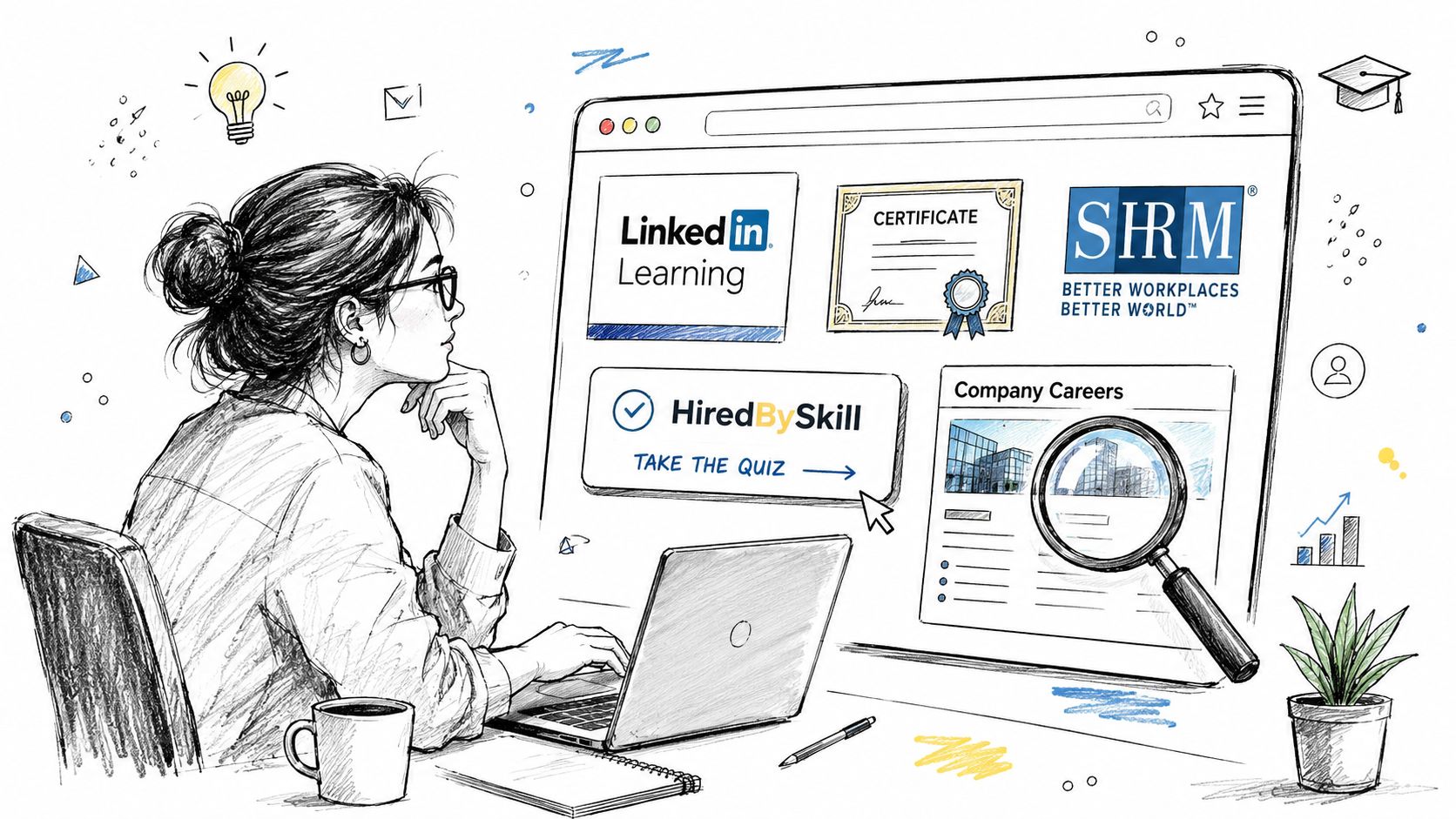
Use free material to build judgment
Start with LinkedIn Learning employer brand tracks, SHRM webinars, The Talent Board's candidate-experience sessions, and public company career-site teardowns on YouTube. Don't watch passively. After every lesson, apply one idea to a real careers page and save the result.
A career quiz can help you test whether employer branding fits your strengths, but it shouldn't replace work samples. You're looking for evidence that you can move from observation to recommendation.
Practical rule: If a course doesn't leave you with a usable artifact, treat it as background reading, not portfolio progress.
This video can help you compare the creative and strategic sides of the field:
Pay for depth, not decoration
A paid Employer Branding Masterclass may be worthwhile if it includes feedback on your work, realistic briefs, and measurement practice. The Universum global employer brand course can add useful perspective for regional and multinational messaging. A Google Data Analytics certificate is relevant when you need more confidence with spreadsheets, dashboards, and structured analysis.
Credentials that move the needle usually do one of three things:
- Add missing context: You understand recruitment, EVP, or candidate experience better.
- Improve execution: You can produce stronger copy, research, or analysis.
- Create proof: You finish with reviewed work that belongs in your portfolio.
Everything else is mostly decoration. A practical professional development resource can help you choose learning based on the gap you need to close.
A realistic 12-week rhythm
- Weeks 1 to 2: Study employer brand fundamentals and audit two careers sites.
- Weeks 3 to 4: Practice EVP writing and employee-story interviewing.
- Weeks 5 to 6: Learn funnel events, spreadsheet tracking, and basic reporting.
- Weeks 7 to 8: Complete the careers-page portfolio project.
- Weeks 9 to 10: Build the mock EVP and supporting proof points.
- Weeks 11 to 12: Launch or simulate the mini-campaign and write the post-mortem.
That sequence keeps learning tied to output. You'll finish with a body of work, not just a list of tabs and certificates.
Networking and Getting the First Interview
You don't need an HR alumni network to meet people in employer brand. You need a useful reason to start a conversation and enough restraint not to turn every interaction into a job request.
Begin on LinkedIn. Follow employer brand leads, recruitment marketers, talent acquisition managers, and candidate-experience practitioners. Leave comments that add an observation from your own background. “Great post” disappears. “The careers-page example works because it answers the candidate's concern before asking for an application” gives the writer something to respond to.
Use a low-pressure outreach sequence
After you've engaged with someone's work, send a short message. Keep the request specific and easy to decline.
To a recruiter
Hi [Name]. I'm moving from [background] into employer branding and built a short audit of [company's] careers page. I noticed [specific observation]. I'm not asking for a referral, but I'd value your view on whether this is a real candidate-experience issue. Would you be open to one quick question?
To a hiring manager
Hi [Name]. Your team's work on [specific campaign or career page] caught my attention. I've managed [relevant transferable responsibility] and recently created a skills-first employer brand portfolio. What separates a useful portfolio from a merely attractive one for your team?
To a current specialist
Hi [Name]. I'm researching the day-to-day work of employer branding specialists. Your move from [background] into [current role] stood out because I'm taking a similar route. If you have room for a short conversation, I'd love to ask how you made your experience legible to hiring teams.
Don't send a portfolio before someone asks unless it directly answers the question you raised. Respectful follow-up matters more than repeated nudges.
Find communities with practitioners inside them
Look for focused groups such as Talent Brand Alliance, RecOps Collective, and People Ops Society. Slack and Discord communities can be more useful than broad networking spaces because members discuss actual briefs, tools, hiring needs, and mistakes.
Bring something before you ask for something. Share a careers-page teardown, offer feedback on a job description, or answer a question about employee storytelling. You'll build familiarity faster by being helpful than by announcing that you're looking for opportunities.
Skills-first platforms and niche job boards are also worth checking, especially where employers explicitly remove degree filters. The employer branding profession itself is increasingly formalized. In a 2025 industry survey, HR owned employer branding in 58% of companies, while 24% shared ownership between HR and marketing or communications, according to Salary.com's employer branding specialist overview. That structure gives you several entry points, including recruitment marketing, internal communications, candidate experience, and talent operations.
Winning the Interview With Measurable Answers
Employer branding interviews often sound creative, but the strongest answers connect creativity to hiring economics. A hiring manager wants to know whether you can improve the message, protect authenticity, work with stakeholders, and measure what happens after someone clicks.
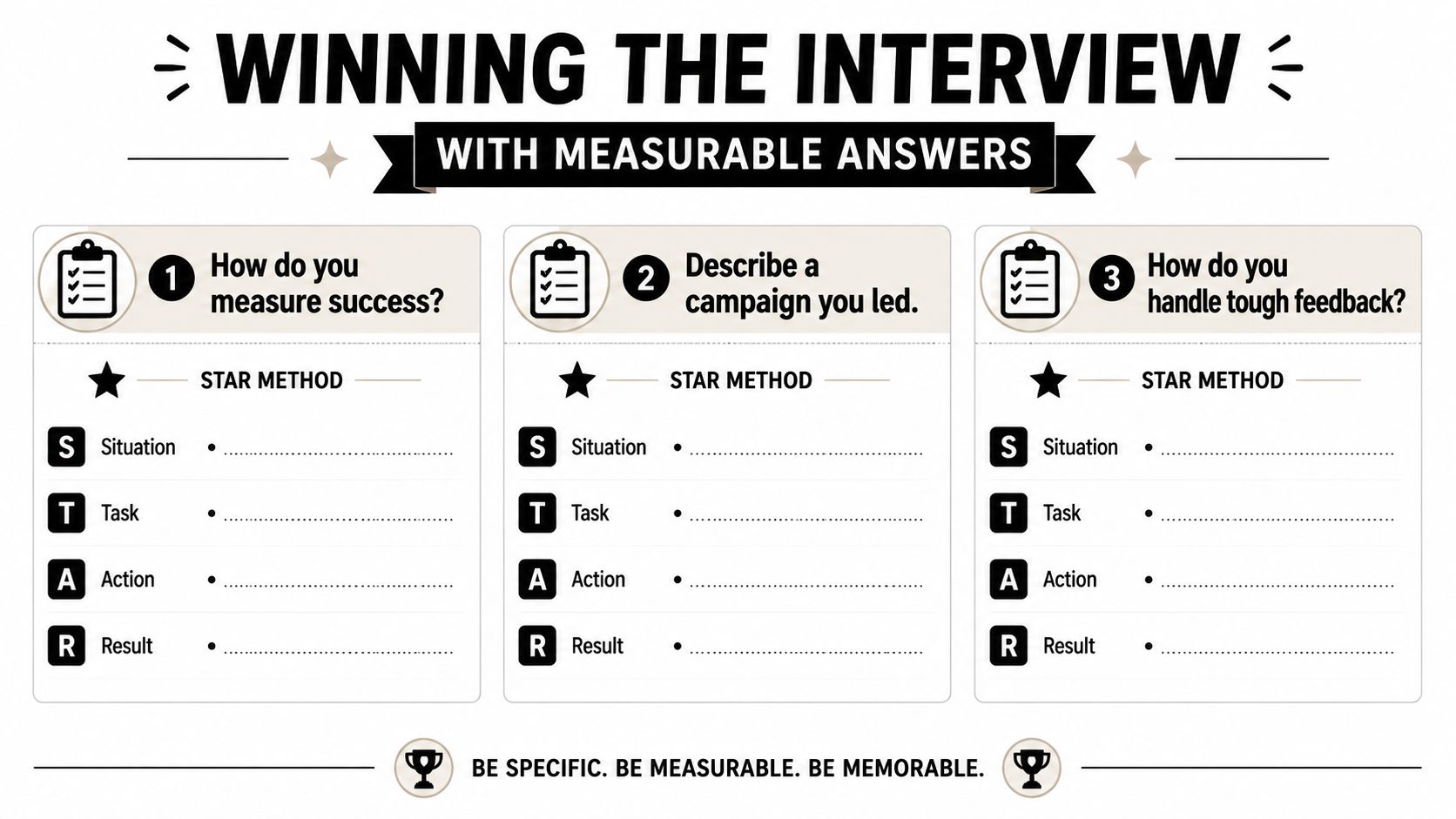
Keep a small KPI stack ready
Use offer acceptance, cost per hire, time to hire, and 12-month retention as your core business measures. Then connect them to leading indicators such as careers-page engagement, click-to-apply activity, application completion, candidate feedback, and channel source.
Only 44% of companies measure ROI from employer branding efforts, while reported challenges include lack of staff at 45%, limited budget at 39%, and low leadership engagement at 35%, according to JobScore's employer branding statistics. The same benchmark summary associates strong employer brands with 40% to 50% lower cost per hire, 15% to 20% faster time to hire, and 85% or higher offer acceptance, compared with 70% to 75% average offer acceptance.
Use those figures as benchmark context, not as promises. In an interview, say you'd establish a baseline, compare branded and non-branded channels, and review each stage monthly.
Five questions you should rehearse
- How do you measure success?
- Describe a campaign you led.
- How do you handle tough feedback?
- How would you make a skills-first message credible?
- What would you improve on our careers site?
Three answer patterns work especially well:
- Measurement: “I'd start by defining the candidate action we need. Then I'd instrument traffic, click-to-apply, form completion, and mobile completion, connect the source to the ATS, and report downstream outcomes rather than stopping at engagement.”
- Campaign: “I'd identify the role, audience, and barrier first. Then I'd use employee evidence to build the message, test the call to action, and document what happened at each funnel stage.”
- No degree: “I don't have a degree, but I've managed complex work, communicated with different audiences, and built a portfolio that shows how I think. I'd rather be evaluated on the quality of those artifacts and the results I can produce.”
For a printable structure, use these STAR method resume examples to turn military, retail, trades, or bootcamp experience into clear evidence.
Interview-day cheat sheet
Bring three portfolio artifacts, one measurement plan, one stakeholder-conflict story, and one example of feedback changing your work. Ask which hiring problems the team expects this role to solve, which data is available, and how HR, marketing, and talent acquisition divide ownership.
A 90-Day Plan and Sample Resume Bullets You Can Steal
A good new hire doesn't arrive promising a viral campaign. They arrive ready to learn the business, understand the candidate journey, and earn the right to make changes.
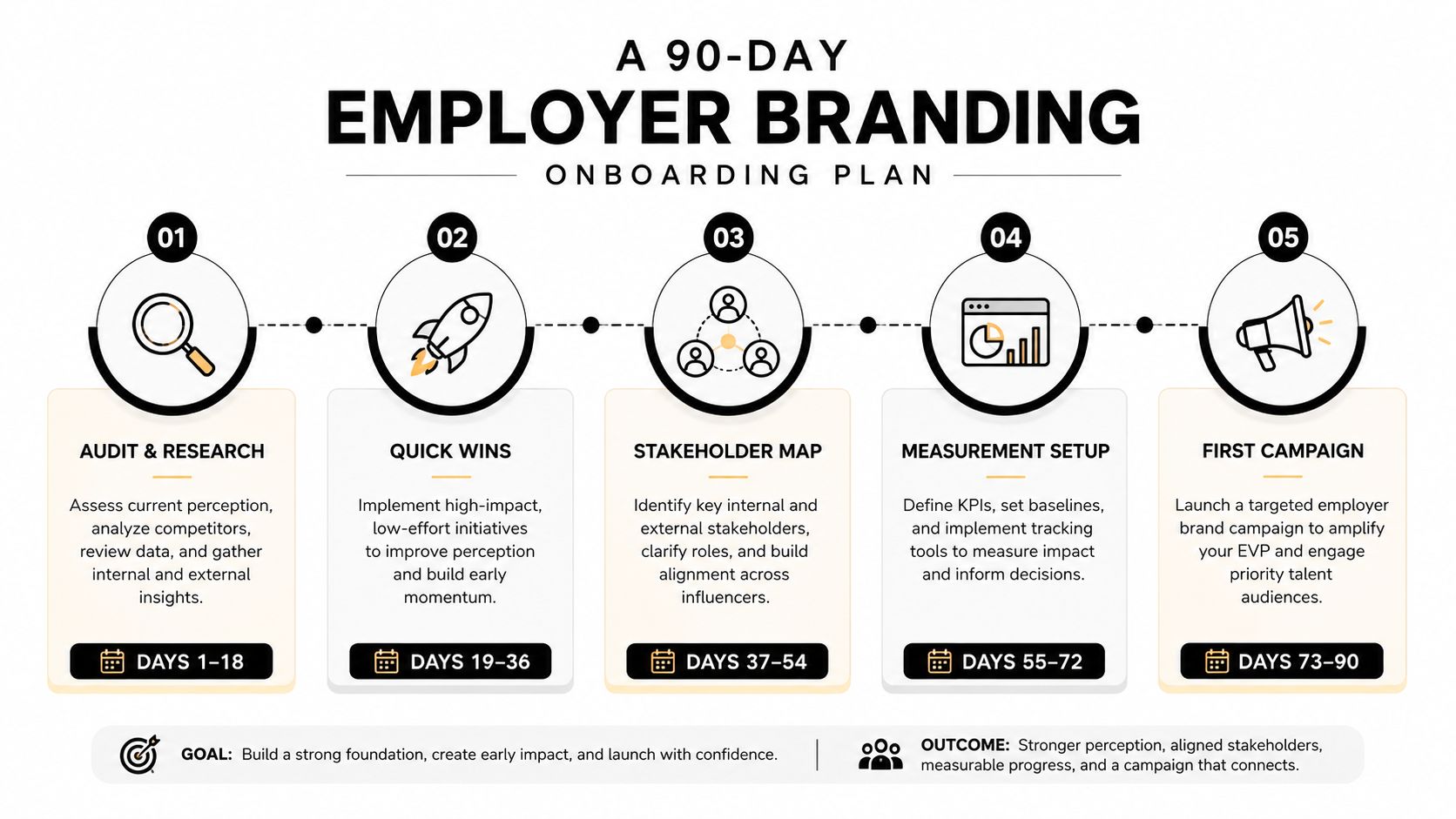
Your first 90 days
- Days 1 to 30, audit and research: Review careers pages, job descriptions, employee feedback, candidate feedback, channel activity, and the ATS handoff. Interview recruiters and employees before recommending a new slogan.
- Days 31 to 45, quick wins: Fix unclear calls to action, remove repeated claims, improve one priority job page, and create a usable employee-story brief.
- Days 46 to 60, stakeholder map: Identify decision-makers, subject-matter experts, approvers, blockers, and leaders whose behavior must support the EVP.
- Days 61 to 75, measurement setup: Define funnel events and the KPI stack. Establish a reporting rhythm that shows what content contributes to hiring activity.
- Days 76 to 90, first campaign: Launch one focused campaign for one talent audience, then publish a post-mortem with results, limitations, and the next test.
Resume bullets for STARs
Adapt these to your real evidence:
- Rewrote candidate-facing content to explain role expectations in plain language.
- Coordinated cross-functional projects involving deadlines, approvals, and multiple stakeholders.
- Interviewed employees or customers and turned recurring themes into audience-specific messaging.
- Audited a digital journey and identified points of confusion before conversion.
- Created content for a defined audience across written and visual channels.
- Built a simple tracker for campaign activity and candidate actions.
- Coached team members or leaders on clearer communication.
- Improved process documentation so users could complete tasks with less support.
- Presented recommendations using evidence, trade-offs, and next steps.
- Translated technical, operational, or frontline experience into accessible stories.
Skills-first hiring improves employer brand from both sides of the table. Candidates see that the company values capability, while employers gain stories from people who took different routes into meaningful work. More than half of employers in a 2025 skills-based hiring report had removed degree requirements from at least some job postings, rising from 30% the year before, and 53% had ditched degree requirements altogether, according to the Glassdoor employer branding specialist salary page. A Harvard Kennedy School post also reports that non-degreed workers hired into roles that previously required degrees receive an average 25% salary increase, as cited in this employer branding salary resource.
HiredBySkill helps STARs find skills-first roles where capabilities, certifications, and experience matter more than a college diploma. Visit HiredBySkill to explore degree-optional opportunities, build a stronger resume, and identify employer branding paths that match the work you already know how to do.
Latest jobs
- Driver - Mini Bulk/Coolift/Rapid/Utility - Macon — Ozarks Coca-Cola-Dr Pepper Bottling Company
- Business Services Manager - Macon — Ozarks Coca-Cola-Dr Pepper Bottling Company
- Merchandiser - Macon — Ozarks Coca-Cola-Dr Pepper Bottling Company
- Field Sales Manager - Macon — Ozarks Coca-Cola-Dr Pepper Bottling Company
- Order Builder Loader - Macon — Ozarks Coca-Cola-Dr Pepper Bottling Company
- Automotive Yard Hand - Prestige Used Cars — Dutton Automotive
- Cashier — Gas N Wash
- Bakery Technician — Polly Country Market