Average Pay for Receptionist
Discover the real average pay for receptionist roles in 2026. We break down salary data by industry & location, plus tips for earning a higher wage.
The national median pay for a receptionist is $17.90 per hour, or $37,230 per year. That's the clean answer, but it's also where a lot of people get misled, because that number is only the starting point for figuring out what you should earn.
If you've searched average pay for receptionist jobs, you've probably seen a mess of numbers. One site says one thing, another says something higher, another tosses out an hourly rate that doesn't seem to match the annual salary at all. That isn't because you're bad at research. It's because salary data gets lumped together across different job definitions, cities, and experience levels.
And if you don't have a degree, that confusion can cost you real money. Plenty of candidates undersell themselves because they grab the first number they see and assume that's the ceiling. It usually isn't. A receptionist job can pay like a basic front-desk role, or it can pay more because you're handling scheduling, customer flow, software, executives, or industry-specific tasks that make the office run.
The smart move isn't memorizing one salary figure. It's learning how to read the number, spot what affects it, and use that to ask for more.
Table of Contents
- Why Is It So Hard to Find the Real Receptionist Pay?
- Decoding the Numbers What Average Really Means
- The Four Levers That Control Your Paycheck
- Your No-Degree-Needed Plan to a Bigger Salary
- From Front Desk to Corner Office A Receptionist Career Path
- Frequently Asked Receptionist Pay Questions
Why Is It So Hard to Find the Real Receptionist Pay?
The phrase average pay for receptionist sounds simple. It isn't. You're trying to get one neat number for a job that exists in medical offices, law firms, apartment buildings, salons, dealerships, schools, and corporate headquarters. Those are not the same job, even when the title looks identical.
One employer wants someone to greet guests and answer phones. Another wants someone to manage calendars, route urgent calls, juggle software, handle intake, calm angry customers, and keep the day from falling apart. If the work changes, the pay changes.
That's why salary websites clash. Some track people who self-report. Some use payroll data. Some use a narrow title like Receptionist I. Others bundle receptionists with information clerks. Then job seekers compare all of it as if it came from one master spreadsheet. It doesn't.
The title is too broad
“Receptionist” is one of those titles that hides the actual job. Employers use it for basic front-desk coverage, but they also use it for work that overlaps with coordinator, office assistant, patient scheduler, client services, or executive support.
A better question is this: What kind of receptionist job is it?
Look at these variables before you trust any pay number:
- Location matters: Big metro markets usually pay differently than smaller towns.
- Industry matters: Medical, legal, hospitality, and corporate admin roles often have different workload and pay patterns.
- Skill load matters: If the job expects scheduling systems, Microsoft Office, Salesforce, billing, or bilingual communication, that should affect your target pay.
- Shift matters: Less convenient hours can change what employers are willing to offer.
Don't ask, “What do receptionists make?” Ask, “What do receptionists with this workload, in this city, in this industry make?”
A national number is useful, but only as a baseline
You still need a benchmark, because walking into an interview with no number in your head is a great way to get lowballed. But treat the national figure like a starting line, not the finish line.
If you're aiming for your first role, that benchmark helps you judge whether a posting looks thin. If you already have customer service, scheduling, or office support experience, you should be thinking about how to position yourself above the most basic tier.
And if you're coming from retail, hospitality, or healthcare support, don't overlook adjacent roles. A lot of people who'd be strong at front-desk work also fit entry-level administrative jobs that may offer better long-term growth.
Decoding the Numbers What Average Really Means
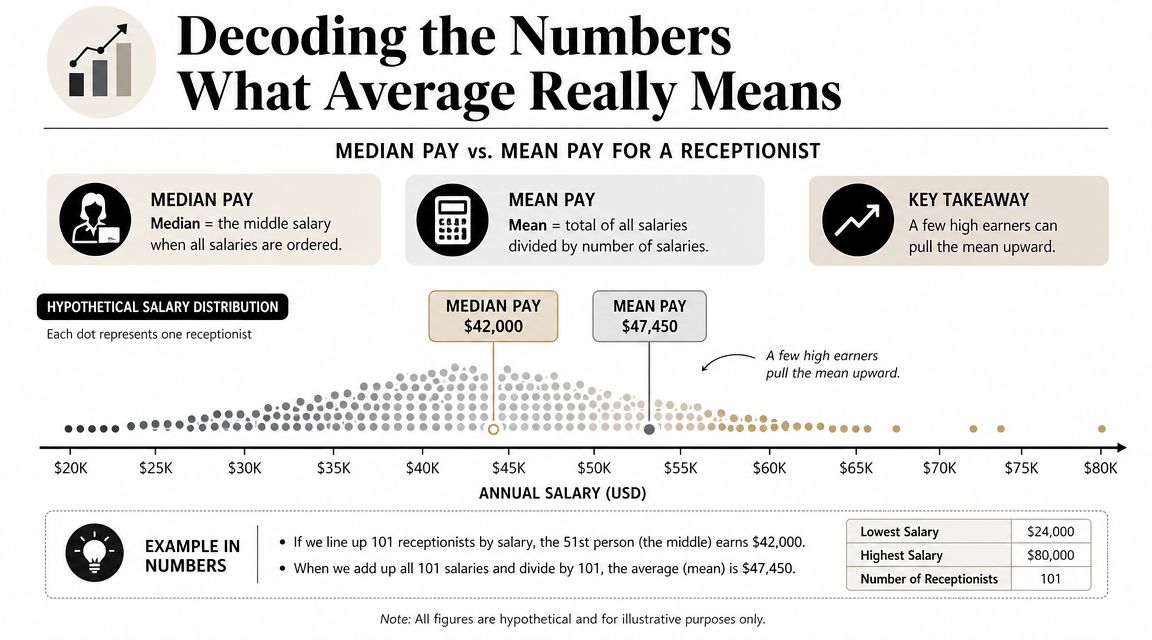
Want to know why one receptionist salary page says $16-something an hour and another makes the same job look like a $40,000 role? They are not measuring the same thing. If you do not spot that fast, you will anchor too low in interviews and accept a weak offer.
Some numbers are median. Some are plain-language average. Some cover the full receptionist occupation. Others track a narrower level such as Receptionist I. That difference matters a lot, especially if you do not have a degree and need to argue from skills, workload, and market value instead of credentials.
Median beats average for job seekers
Use median as your starting point.
It shows the midpoint. Half of receptionists earn more, and half earn less. That makes it more useful than a loose average, which can get pulled up by a smaller group of better-paid jobs.
For negotiation, this is the key move. Treat median as the baseline for a standard receptionist role, then build your case above it if the job asks for more than basic front-desk coverage. If you handle scheduling, phones, visitors, calendar support, software systems, intake, or bilingual communication, you should not argue from the bottom of the range.
Practical rule: Use median to set your floor. Use your duties and market to set your target.
Why salary sites disagree
Different sites count different groups of workers and package pay data in different ways.
PayScale reports a 2026 U.S. average hourly rate of $16.50 on its PayScale receptionist hourly rate page. Salary.com puts Receptionist I at about $20 per hour, or $41,622 per year, with a central 25th to 75th percentile band of $38,064 to $45,439 and a 90th percentile of $48,924 in the Salary.com Receptionist I benchmark.
Both can be useful. You just need to read them correctly.
| Source type | What it often reflects | Why it can differ |
|---|---|---|
| Self-reported pay data | What workers say they earn | Reporting is voluntary, so the sample can skew |
| Structured compensation data | Employer-defined job levels | Titles are narrower and duties are more standardized |
| Job-posting or market explainers | Hiring trends and pay context | The numbers can reflect local demand, title variation, or posting language |
If you want a broader explanation of how salary data gets gathered and sorted, these global job market insights give useful context.
How to read pay numbers without getting lowballed
Candidates make expensive mistakes. They compare an hourly figure from one source to a salary figure from another, ignore title level, and assume both refer to the same job. They usually do not.
Use this filter every time you look at receptionist pay:
- Check the unit. Hourly, annual, and "up to" numbers are not interchangeable.
- Check the title. Receptionist, Receptionist I, front desk coordinator, and medical receptionist can sit in different pay bands.
- Check what pay includes. Some sources show base pay only. Others mix in bonuses or other forms of compensation. If you need a better handle on that difference, read this guide to base pay vs total compensation expectations.
- Check the workload. A role that includes software, scheduling, billing support, or customer issue handling should pay more than a greet-and-answer-phones job.
Here is the lesson. Do not grab the first number you see and repeat it in an interview.
Use two or three sources. Figure out whether each one reflects a broad occupation, a narrow job level, or self-reported pay. Then match that data to the actual job in front of you. If you do that, you stop sounding like a guesser and start sounding like someone who knows what their work is worth.
The Four Levers That Control Your Paycheck
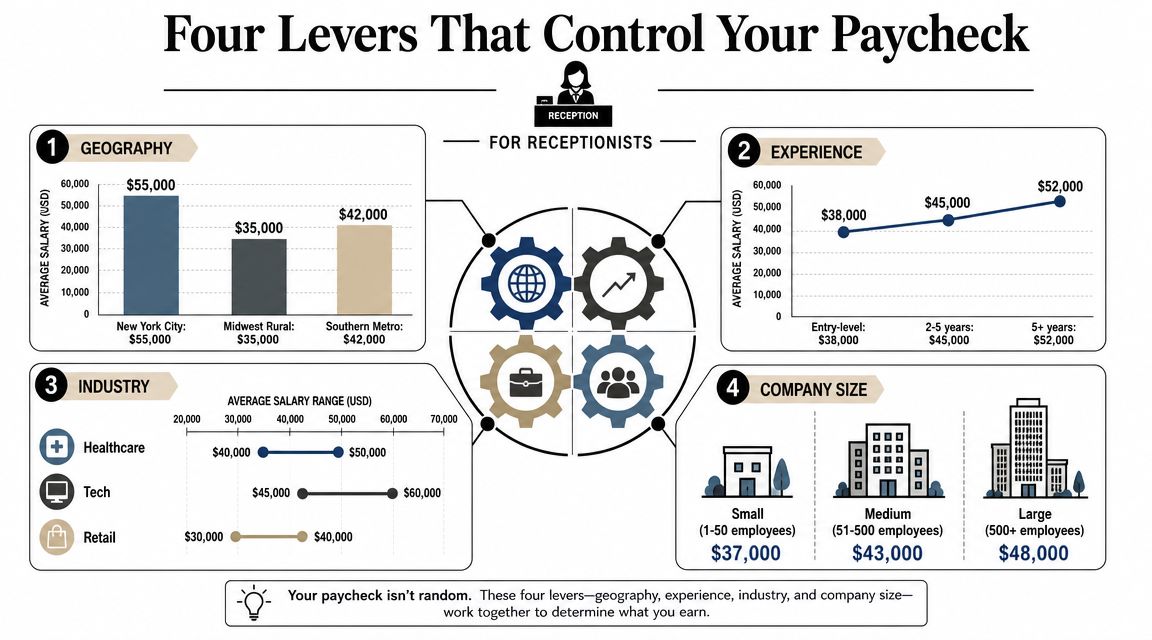
Want to earn more as a receptionist without a degree? Stop staring at one average salary number. Your pay comes from four levers, and once you know which one matters most for a specific job, you can negotiate with a lot more confidence.
The title matters less than people think. Employers pay for context. A receptionist in a quiet office with basic phone duty sits in a different pay band from a receptionist handling scheduling, intake, billing support, and upset customers all day.
Geography changes the floor and the ceiling
Location sets the range before your resume even enters the conversation.
National pay data gives you a starting point. Local market data tells you what employers near you have to pay to fill the role. If you live in a major metro like Los Angeles, quoting only a plain national number can cost you money. Employers already know their hiring market is tighter and more expensive.
Use local wage data when it favors you. Use national data when an employer is trying to anchor you too low. That is how you use salary numbers strategically instead of repeating them blindly.
Industry changes the job more than the title does
Industry often explains pay better than the word “receptionist” does.
The Data USA profile for receptionists and information clerks reports a 2024 national average of $31,838 per year, and it also shows that these workers are commonly employed in physicians' offices. That matters because a healthcare front desk usually includes more moving parts than a basic lobby job. You may be handling packed calendars, patient intake, insurance details, and constant interruptions.
A law office, medical practice, property management firm, and startup can all post a receptionist role. The daily job can be completely different. So can the pay.
Ask better questions before you compare offers:
- Who are you serving? Patients, executives, tenants, clients, or walk-in visitors?
- How much coordination is involved? One calendar is different from juggling several providers or managers.
- What software do they expect you to use? Specialized systems usually mean higher-value work.
- What is the cost of mistakes? Errors in healthcare or legal settings carry more risk than errors at a basic front desk.
Pay attention to the full offer, not just the hourly number. A lower base rate with stronger benefits, steadier hours, or better promotion odds can still be the smarter move. This breakdown of base pay vs. total compensation expectations helps you compare offers the right way.
Experience is really about scope
Years alone do not raise pay. Scope does.
Employers pay more when they trust you with work that keeps the office running without constant supervision. That includes training new hires, managing calendars, solving scheduling conflicts, handling intake, supporting leadership, coordinating vendors, or keeping records accurate.
Here's the pattern:
- Entry-level scope: greet visitors, answer calls, route messages, cover the desk
- Mid-level scope: own scheduling, manage office flow, use office software well, keep records straight
- Higher-value scope: prevent problems, handle pressure calmly, support multiple people, and fix issues before they reach a manager
If you do higher-scope work, say that clearly in interviews. Candidates without degrees win pay bumps by proving responsibility, not by apologizing for their education.
Extra skills create pay separation fast
This is the lever you can change fastest.
Bilingual communication, Excel, Outlook, scheduling platforms, CRM systems, payment handling, and basic bookkeeping all make you more useful. Employers pay more for receptionists who reduce chaos, protect time, and keep customers or patients from getting frustrated.
Be specific. “Strong communication” says nothing. “Managed a multi-line phone system, scheduled 40 plus appointments per day, and handled intake errors without supervisor support” gives an employer a reason to pay more.
If you do not have a degree, this is your playbook. Build practical skills, tie them to real tasks, and use that proof to argue for a higher range.
Your No-Degree-Needed Plan to a Bigger Salary
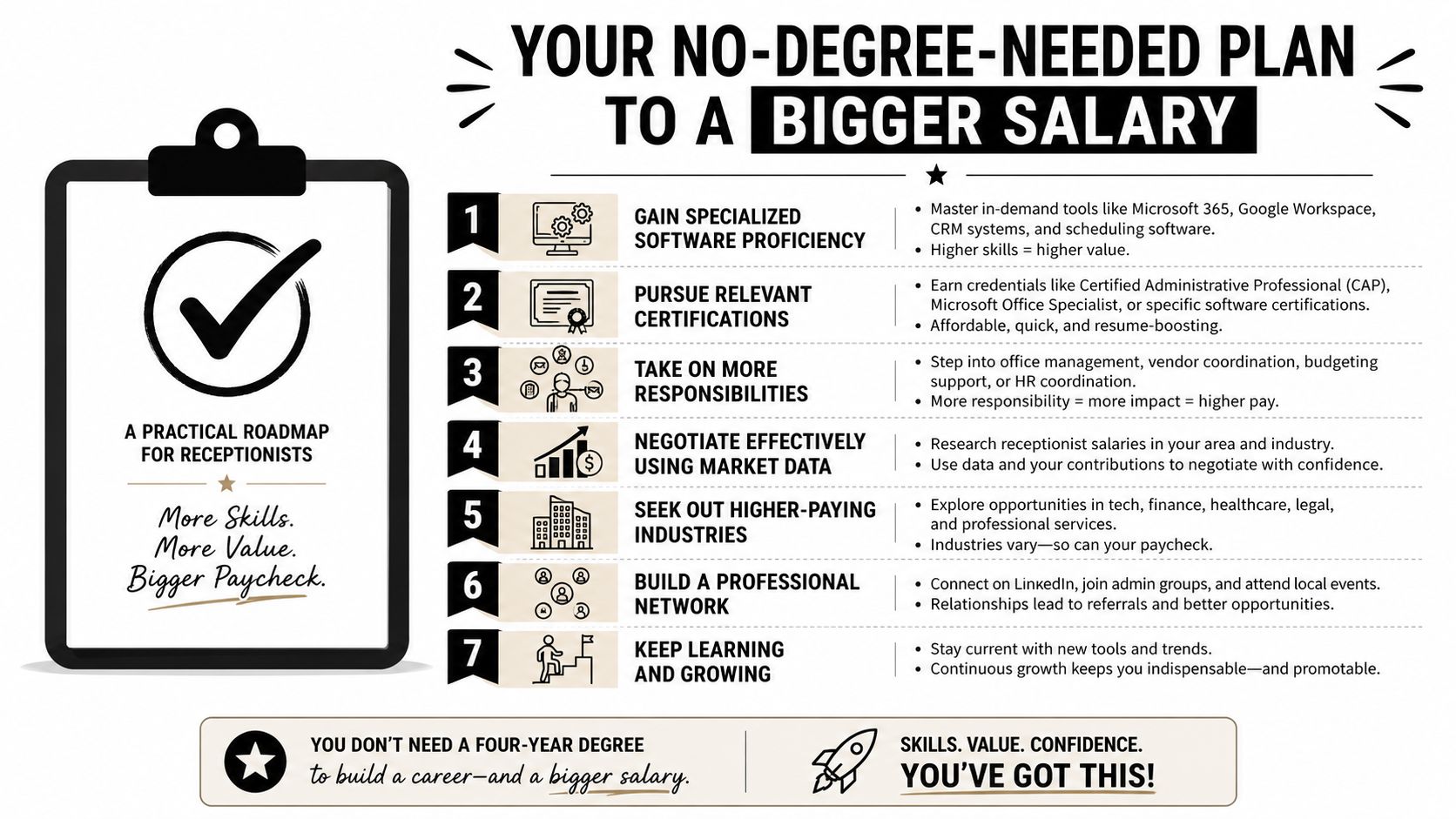
You do not need a four-year degree to move up from low-paid front-desk work. You need proof that you can handle more than basic front-desk work.
That proof can come from short courses, software fluency, sharper resume language, and a better negotiation script. Employers hire for usefulness. Start there.
A simple roadmap helps:
Build proof not just confidence
Confidence is nice. Hiring managers don't pay extra for vibes.
They pay when they see that you can walk in and handle the tools and responsibilities they care about. If you don't have a degree, stack practical signals instead.
Good options include:
- Microsoft Office skills: Excel, Outlook, Word, and calendar management still matter a lot in admin work.
- Scheduling systems: If you've used appointment software in healthcare, beauty, auto service, or hospitality, that counts.
- Basic bookkeeping exposure: Even light invoicing or payment handling can strengthen your profile.
- Bilingual communication: If you can serve customers in more than one language, say it clearly.
And put those skills into accomplishment language. “Answered phones” is weak. “Managed front desk, routed calls, coordinated schedules, and handled visitor intake” is stronger because it sounds like real office work.
This video breaks down mindset and communication habits that help when you're trying to level up professionally:
Use a tighter negotiation script
A lot of receptionists negotiate badly because they make it personal. Don't lead with bills, stress, or how hard you work.
Lead with fit.
Try this:
“Based on the scope of the role, the scheduling and customer-facing responsibilities, and the local market, I'm looking for a rate at the higher end of the posted range.”
If the job includes software, intake, billing support, executive scheduling, or bilingual service, say that directly. Tie your ask to the work.
You can also use this cleaner version:
- Start with alignment: “I'm excited about the role and I think my background fits the front-desk and coordination needs well.”
- Name the value: “I can contribute with scheduling, customer communication, and office systems right away.”
- Make the ask: “Given that scope, I'd like to discuss compensation toward the stronger end of the range.”
That works better than apologizing for asking.
Target roles that reward added value
Some receptionist roles are dead-flat. Others function as a bridge into admin careers with better pay and better titles later.
You want postings that mention things like:
- Calendar management
- Client intake
- CRM updates
- Office coordination
- Executive support
- Billing or records
- Multi-location scheduling
Those jobs usually ask more of you, but they also give you better resume material. And resume material is what gets you out of the lowest-paid tier.
If you're trying to map no-degree paths that can lead to stronger earnings over time, this no-degree salary guide is a smart place to compare adjacent options.
From Front Desk to Corner Office A Receptionist Career Path
Want a receptionist job to pay off long-term instead of trapping you in the lowest salary tier? Then stop treating the title as the story. The scope is the story.
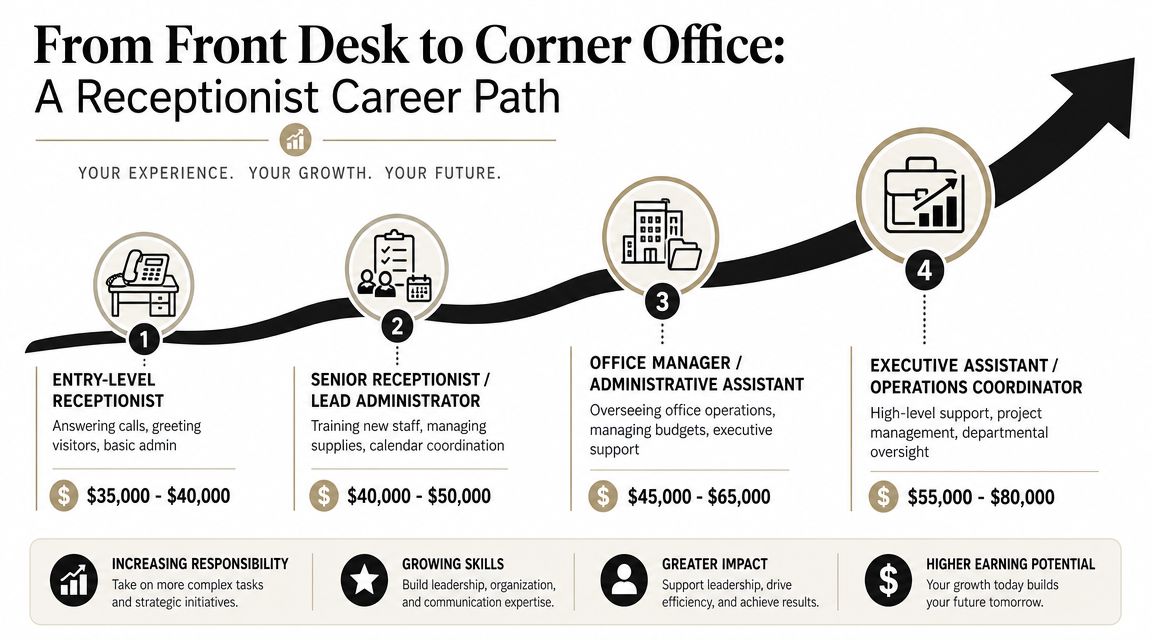
Two people can both be called receptionists and build completely different careers.
One stays in a narrow front-desk role. They greet visitors, answer calls, sort mail, and keep the lobby presentable. Honest work, but limited bargaining power.
The other uses the same starting title to pick up higher-value tasks. Calendar control. Meeting support. Vendor coordination. Records handling. Client intake. Executive support. That person is already doing the kind of work that leads to stronger titles and better pay, degree or no degree.
That distinction matters because salary numbers confuse people. Averages lump basic front-desk jobs together with receptionist roles that carry real admin weight. If you do not separate those jobs in your head, you will undersell yourself in interviews and accept flat offers that have no path attached.
The smart move is to judge a receptionist role by what it trains you to do next.
Strong next-step options include:
- Administrative assistant
- Office coordinator
- Executive assistant
- Office manager
- Patient coordinator or client services coordinator
Those moves usually happen when your resume shows more than courtesy and phone etiquette. Employers pay more for receptionists who keep schedules straight, protect details, solve small problems without supervision, and keep an office running without drama.
If you want a clearer sense of how these responsibilities overlap across titles, read Understanding office admin roles today.
Here is the practical rule. Chase receptionist jobs that add business skills to your resume, not just desk coverage to your day.
That means you should track your work in concrete terms:
- Scheduled multi-person calendars
- Coordinated meetings and room logistics
- Managed intake or client records
- Supported billing, CRM updates, or office systems
- Handled confidential information
- Helped executives, managers, or multi-location teams
Those details make it easier to negotiate your next offer because they explain why you sit above entry-level front-desk pay.
If your goal is upward mobility, start scanning administrative jobs with stronger growth potential alongside receptionist postings. That is how you stop chasing titles and start building a pay ladder.
Frequently Asked Receptionist Pay Questions
Can you get a receptionist job with no experience?
Yes, but don't market yourself as having “no experience” if you've worked retail, hospitality, food service, customer support, or healthcare support. Those jobs often build the exact skills employers want at a front desk.
Translate your background. Cash handling becomes accuracy. Customer service becomes visitor management. Handling a busy checkout line becomes staying calm under pressure.
Is being a receptionist a dead-end job?
Only if you let it be.
If you stay in the smallest version of the role forever, pay may stay limited. If you use it to build scheduling, software, communication, and coordination experience, it can lead to stronger admin roles.
What's the best way to ask for more money?
Be specific and calm. Tie your ask to the work, not your personal situation.
Use market data, local conditions, and your actual scope. If the employer wants software skills, intake handling, scheduling, records, or bilingual support, mention those when you negotiate.
Should you focus on hourly pay or annual salary?
Focus on what helps you compare offers accurately. An hourly number is useful, but you also need to know schedule consistency, overtime expectations, and what the role includes.
A job that looks slightly lower on paper can still be stronger if it builds better experience and leads to the next step.
What should you do before applying?
Run this checklist:
- Study the posting: Highlight software, scheduling, and communication tasks.
- Match your resume: Use the same language where it fits truthfully.
- Prepare examples: Have short stories ready about handling people, solving problems, and staying organized.
- Research the employer: Look for clues about industry pace and professionalism.
- Know your target: Walk in with a pay range you can defend.
If you want a smarter way to frame your experience, especially without a degree, learning what skills-based hiring means in practice will help you position yourself better.
The short version is this. Don't obsess over one salary number. Learn how employers price the role, then make yourself look like the stronger version of the candidate.
If you're job hunting without a degree and want better options than the usual lowball postings, HiredBySkill is worth a look. It's built for skills-first candidates, pulls in degree-optional jobs across industries, and gives you tools to compare paths, tighten your resume, and find roles where what you can do matters more than what's on a diploma.
Latest jobs
- Advisory Engineer — Lenovo
- Chef de Groupe Sites et Sols Pollués H/F — SOCOTEC
- Responsable d'agence H/F — Kinougarde-Complétude
- Saisonarbeiter:Innen (m/w/d) Mitte Dezember 2026 bis Ende März 2027 — Salesianer Miettex Gmbh
- Chargé d'accueil et de services hôteliers - H/F — Louvre Hotels Group
- Könyvelő (angol nyelvtudással) — Kronospan
- Pädagogische Fachkraft (gn) - intensivpädagogische Wohngruppe — Lotsenwerk GmbH
- (Junior) FP&A Controller (all genders) — Sunnic