How to become a software developer without degree
How to become a software developer without degree - Learn how to become a software developer without degree. Get a step-by-step roadmap for self-taught devs,
You're probably reading this between shifts, on a lunch break, or late at night after watching one more “day in the life of a software engineer” video and thinking, “I could do this. I think. Maybe. If I didn't miss the college-degree train.”
I know that feeling. It's half excitement, half annoyance. Excitement because coding looks like a powerful tool. Annoyance because every job post seems designed to make you doubt yourself before you even start.
Here's the straight answer. You can absolutely learn how to become a software developer without degree credentials. Not in a fake motivational-poster way. In a practical, hireable, build-real-things way. The degree question matters far less once you can show clean code, solid projects, decent communication, and a believable story about why you made the switch.
That last part matters more than is commonly understood. Plenty of beginners obsess over courses and forget the bigger game. You are not just learning syntax. You are building a career narrative that makes an employer think, “This person can do the work, learns fast, and already acts like a developer.”
Table of Contents
- Your Degree Doesn't Define Your Tech Career
- Choose Your Adventure The Three Paths to Code
- Building Your Developer Toolkit What to Actually Learn
- Your Six-Month Launch Plan From Zero to Job-Ready
- Show Your Work The No-Degree Portfolio and Resume
- Landing the Job and Launching Your Career
Your Degree Doesn't Define Your Tech Career
A lot of people who end up in software didn't start there. They started in retail, hospitality, the military, warehouses, call centers, construction, admin work, and jobs that taught them how to solve problems under pressure. Then one day they touched code and realized they liked building things more than repeating the same work forever.
That's not some fringe story anymore. A significant and growing share of software engineers, estimated at 27% to over 30%, work without a traditional college degree, and over 100,000 students graduated from coding bootcamps in 2020 alone, many moving into software roles according to DesignGurus on non-degree software engineers. That should change how you frame this whole idea. You're not trying to sneak into tech through a side door. You're walking a route plenty of people already use.
The trap is thinking your problem is “I don't have a degree.” Usually your real problem is one of these:
- You don't have a plan: You're bouncing between Python videos, React tutorials, and Reddit threads.
- You don't have proof: You've learned things, but nothing visible shows what you can build.
- You don't have a story: Employers can't tell why you're making the pivot or why they should bet on you.
A degree can help with signaling. It doesn't replace proof.
Practical rule: Employers forgive a missing diploma faster than they forgive a weak portfolio.
If you need help mapping the transition itself, this software engineer career change roadmap is worth reading because it treats the switch like a sequence of decisions, not a magical leap. And if you want the clearest explanation of why employers are changing their filters, read this breakdown of skills-based hiring.
The real shift happening in hiring
Companies still list degree requirements sometimes. Fine. Ignore the mythology around that. Hiring teams care most about risk. They ask themselves whether you can ship code, learn fast, communicate clearly, and fit into a team without creating chaos.
That's why your mission is not “convince them I'm academically equivalent.” Your mission is “remove doubt.”
You remove doubt by doing work in public. A GitHub profile. Deployed projects. Thoughtful README files. A resume that translates old experience into relevant signals. Good answers in interviews. A clear niche. Those things stack.
I wish I understood that sooner. The fastest way to make a degree irrelevant is not to argue about credentials. It's to become easy to believe.
Choose Your Adventure The Three Paths to Code
There isn't one correct road into software. There are three common ones, and each works if it matches your life. Pick the path that you can finish, not the one that sounds coolest online.
One hard fact matters here. It's possible to become job-ready in a compressed timeline. Coursera's guide to becoming a software engineer without a degree notes that some intensive programs can get people there in 3 to 6 months, with some certificates covering building, testing, and deploying applications in six months, while other beginner-friendly specializations teach job-ready skills in as little as four weeks. That doesn't mean everyone should sprint. It means speed is available if structure is strong.
Here's the blunt comparison.
| Path | Average Cost | Typical Timeline | Structure | Best For |
|---|---|---|---|---|
| Self-study | Low to flexible | Flexible, often longer | Loose, self-directed | Disciplined learners with tight budgets |
| Bootcamp | Higher than self-study | Fast, often intensive | High structure | Career changers who want accountability |
| Apprenticeship | Usually paid or low-cost to start | Varies by employer | Real job structure | People who learn best by doing on a team |
If you want more examples of roles that can open the door without a diploma, this list of tech jobs that don't require a degree is useful because it broadens the target beyond the exact title “software developer.”
Self-study for stubborn independent people
Self-study is the cheapest path and the easiest to start badly.
The upside is obvious. You can begin tonight with a browser, free resources, and time. You control the pace. You can study before work, after dinner, on weekends, whenever life allows.
The downside is less obvious. When you self-study, you're not just learning code. You're designing curriculum, tracking progress, deciding what matters, and pushing through boredom without external deadlines. A lot of smart people stall here, not because they can't code, but because they never narrow the scope.
Self-study works best if you:
- Like figuring things out alone: You don't panic when instructions are incomplete.
- Can keep a routine: Even a modest daily habit beats sporadic weekend marathons.
- Can ignore shiny objects: New frameworks will try to seduce you every week.
Bootcamps for speed and structure
Bootcamps are the accelerator. If you need deadlines, mentors, peer pressure, and a curriculum that says “do this next,” a good bootcamp can save you months of wandering.
A bootcamp doesn't magically make you employable. It does something more useful. It compresses decisions. Instead of spending weeks wondering what backend framework to learn, you start building. That's valuable when you're switching careers and your mental bandwidth is limited.
Still, don't buy vibes. Buy outcomes you can inspect. Look for project-heavy training, code reviews, interview prep, and portfolio support. If a program mostly sells community and inspiration, keep your wallet in your pocket.
A bootcamp is useful when it gives you feedback loops, not when it gives you a hoodie.
Apprenticeships and internships for real-world reps
This is the most underrated route.
If you can land an apprenticeship or internship, you skip a lot of guesswork because you start learning inside an actual software workflow. Tickets. Pull requests. Standups. Code review. Debugging someone else's mess. That stuff matures you fast.
The catch is competition. These roles are fewer, and you usually need enough fundamentals to pass screening anyway. So even if this is your ideal route, you still have to do enough self-study to be credible.
A good fit here is someone who already has professional habits from another field. Show up on time, ask smart questions, document your work, and take feedback without getting weird about it. Those habits transfer beautifully.
So which one should you choose
Use this simple filter:
- Choose self-study if money is tight and you're consistent without supervision.
- Choose bootcamp if you need a fast runway and external structure.
- Choose apprenticeship or internship if you can get close to employers early and learn best in a real environment.
You can also combine them. Plenty of people do a few months of self-study, then add a bootcamp, or self-study while applying for apprenticeships. The mistake is waiting for the perfect path. Pick one and commit long enough to generate proof.
Building Your Developer Toolkit What to Actually Learn
Most beginners waste time by learning sideways. They collect languages like souvenirs. A little Python, a little Java, a little React, some random AI prompt engineering, then six months later they still can't build a complete app.
Don't do that. Employers hire juniors who can contribute to a stack, not tourists who can recognize twenty logos.
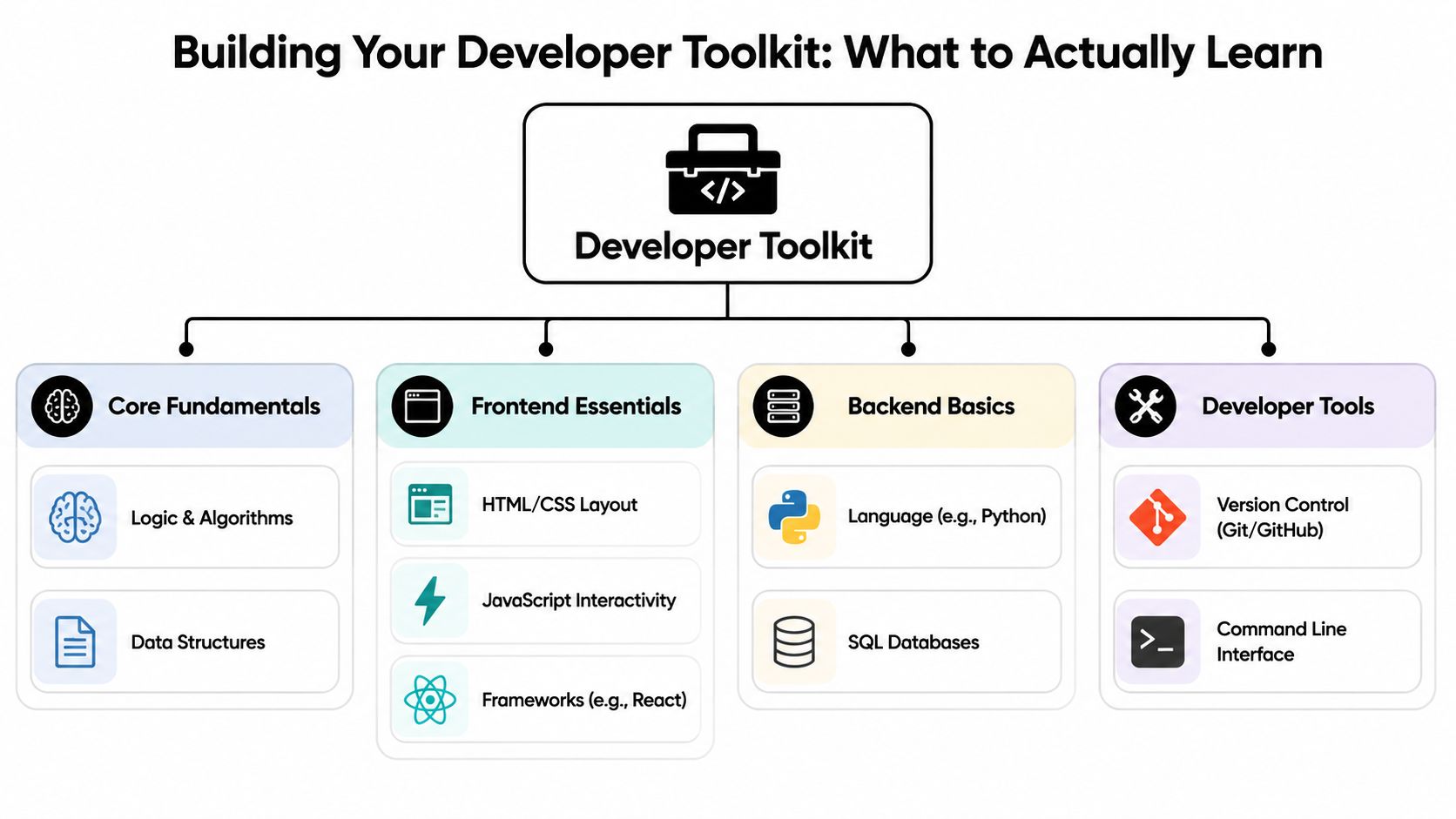
Pick one starter stack and stick with it
Often, web development is the cleanest entry point. You can see results fast, deploy projects publicly, and build things employers understand.
A practical starter stack looks like this:
- Frontend: HTML, CSS, JavaScript, then React
- Backend: Node.js with Express or Python with a lightweight web framework
- Database: SQL first
- Deployment: Vercel, Netlify, or another simple hosting option
- Version control: Git and GitHub from day one
That's enough to become dangerous. You don't need Kubernetes, three cloud certifications, and opinions about microservices before your first job.
If you want one principle to organize your study, it's this. Learn just enough of each layer to build one complete product. That teaches you how software fits together, which is much more valuable than endlessly polishing isolated tutorial exercises.
Learn the tools hiring managers quietly care about
Beginners obsess over languages because languages are visible. Hiring managers often care just as much about habits.
They notice whether you can use Git without panic. They notice whether your README explains setup clearly. They notice if your commit messages look thoughtful or chaotic. They notice if you can debug, ask good questions, and explain tradeoffs like a normal adult.
Here's the toolkit I'd push you toward early:
- Git and GitHub: Learn branches, pull requests, commit hygiene, and how to undo mistakes.
- Command line basics: You don't need wizard-level terminal skills. You do need comfort.
- Debugging: Browser dev tools, logs, reading error messages, reproducing bugs.
- Testing basics: Enough unit or integration testing to show you respect quality.
- Communication: Writing issues, READMEs, project notes, and concise status updates.
There's a reason employers care about willingness to learn. Junior developers get hired for trajectory as much as current skill. If you show disciplined growth, people can work with that.
Use AI like a junior with taste
AI tools changed the learning curve. That part is real. According to Tallo's discussion of becoming a software engineer without a degree, tools like GitHub Copilot can cut learning curves by up to 55%. But the same source warns about over-reliance, noting that self-taught developers who balance AI-assisted prototyping with human-reviewed open-source contributions have hire rates 3 times higher.
That lines up with what I've seen. AI is fantastic for scaffolding, explaining syntax, generating starter tests, and helping you get unstuck. It's terrible as a substitute for understanding.
Use AI for:
- Boilerplate: Routing setup, test skeletons, config files
- Explanations: “Why is this async function failing?”
- Refactoring ideas: Cleaner component structure, naming suggestions
- Learning support: Alternate explanations when docs feel dense
Don't use AI to fake competence. If the tool writes every line and you can't explain the result, you're building a trap for future-you.
Use AI to move faster through the boring parts. Slow down on the parts that teach judgment.
A good junior today knows how to pair with AI without outsourcing their brain.
Your Six-Month Launch Plan From Zero to Job-Ready
You do not need another vague “just keep coding” speech. You need a calendar and outputs. The best six-month plans are boring in the right way. They focus on a small set of skills, a few visible projects, and relentless repetition.
One expert roadmap described in BayOne's guide to becoming a software engineer without a degree lays out a structured six-month path: choose a specialization in Month 1, build 3 portfolio projects in Months 2 and 3, learn advanced deployment in Month 4, focus on certifications and networking in Month 5, then handle interview prep in Month 6. It also warns that project scope creep derails over 60% of self-learners. That warning is gold. Most beginners don't fail from laziness. They fail from trying to build the next Airbnb before they can reliably ship a to-do app.
Here's the visual version first.
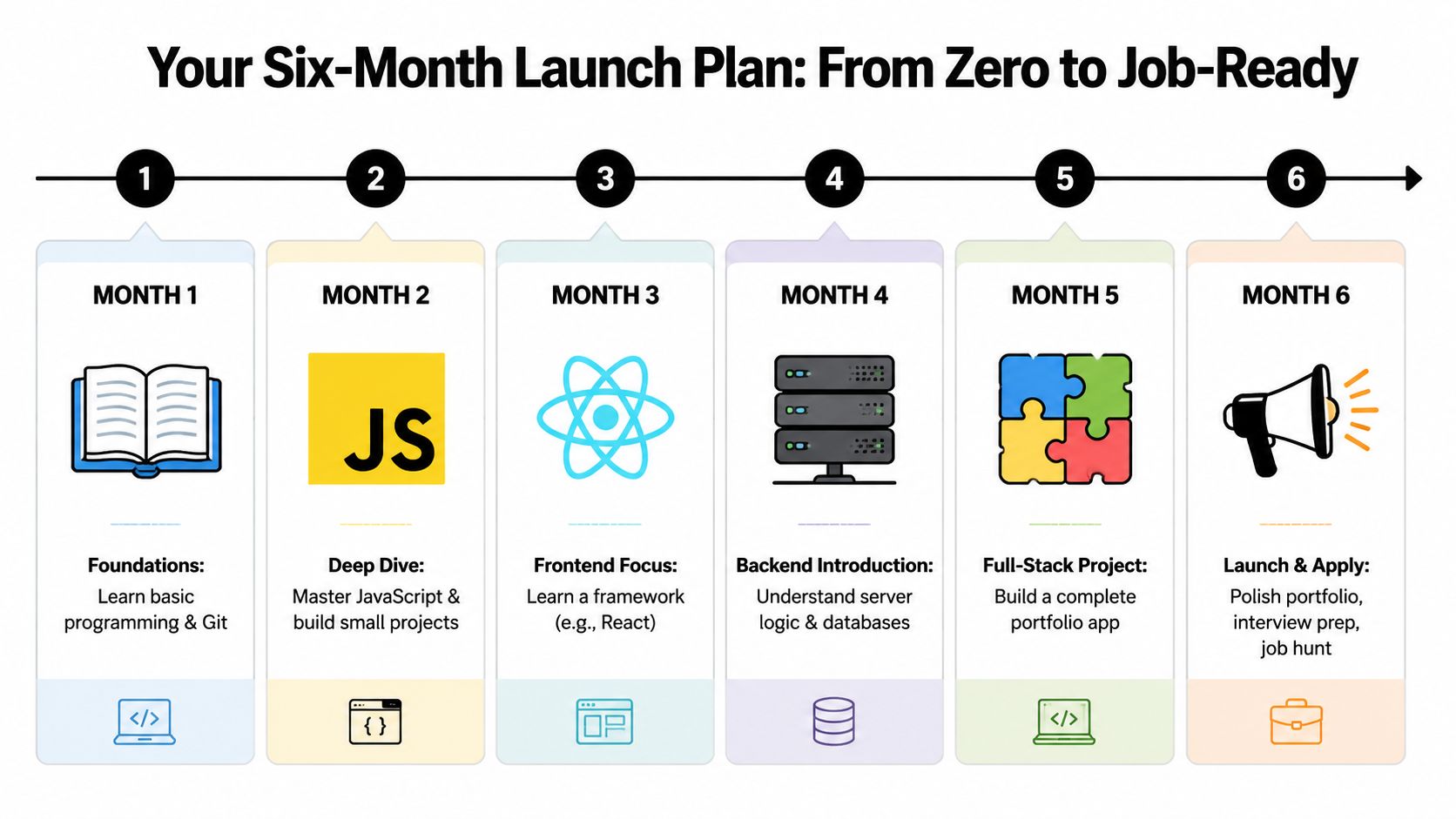
Month 1 and 2 get dangerous with the basics
Month 1 is where you pick a lane. Frontend is fine. Backend is fine. Full-stack is fine if you stay disciplined. Waffling is not fine.
Spend this month learning:
- Programming basics: Variables, functions, loops, conditionals, arrays, objects
- HTML and CSS: Enough to build responsive layouts
- JavaScript fundamentals: DOM, events, async basics
- Git: Daily use, not “I'll learn later”
Month 2 is for repetition with small projects. You should build several ugly, functional things. A calculator. A habit tracker. A note app. A weather app using an API. These are not resume centerpieces. They are reps.
Your standard should be simple:
- Finish the project.
- Push it to GitHub.
- Write a short README.
- Deploy it if possible.
- Move on.
If you spend three weeks color-tuning a calculator, you're hiding from harder learning.
Later in the timeline, this video gives a helpful perspective on the practical path from beginner to employable developer.
Month 3 and 4 build projects people can actually remember
By Month 3, you need portfolio anchors. Not ten tiny demos. Three solid projects is a strong target because it forces range without creating chaos.
I'd recommend this mix:
- Project one: A polished personal portfolio site
- Project two: A CRUD app with authentication
- Project three: A more opinionated app that solves a real problem from your life or former job
That third one matters most. If you worked in hospitality, build a shift swap or prep checklist tool. If you came from logistics, build a route planner or inventory dashboard. If you were in the military, build something around operations tracking or structured workflows. Specificity beats generic “task manager” clones every time.
Month 4 is where your projects grow up. Add deployment, environment variables, basic tests, and better documentation. Learn enough Docker or CI tooling to show you understand modern workflow, even if lightly. Your code doesn't need to be fancy. It does need to look cared for.
The portfolio project that gets attention is usually the one that solves a familiar problem well, not the one with the most buzzwords.
Month 5 and 6 polish deploy and get in the arena
Month 5 is polish. Many people get impatient at this point and start shotgun-applying too early. Resist that urge for a couple of weeks and tighten everything.
Do these before heavy applications:
- Clean your GitHub profile: Pin your best repositories.
- Rewrite your READMEs: Problem, stack, setup, screenshots, decisions, future improvements.
- Fix rough UI edges: Spacing, labels, empty states, error handling.
- Deploy everything: Make it easy to click and test.
- Practice explaining choices: Why React, why SQL, why this auth approach.
Month 6 is the job hunt plus interview prep. Start solving straightforward coding problems. Practice talking through your projects out loud. Record yourself if needed. Explanations often ramble because speakers haven't heard themselves explain technical work.
A strong weekly rhythm in this phase looks like this:
| Day | Focus |
|---|---|
| Monday | Apply to targeted roles |
| Tuesday | Coding practice and debugging |
| Wednesday | Resume tailoring and LinkedIn cleanup |
| Thursday | Project improvements and documentation |
| Friday | Mock interview answers |
| Weekend | One deeper build session plus one rest block |
That rest block matters. Burnout makes people sloppy, cynical, and weird in interviews.
Also, protect yourself from the classic beginner mistake. Don't turn your flagship app into an endless monster. Add only the features that strengthen your story. Shipping a complete moderate project beats eternally “building” a masterpiece no recruiter will ever see finished.
Show Your Work The No-Degree Portfolio and Resume
If you don't have a degree, your portfolio is not decorative. It is the evidence. It's the answer to the unasked question every employer has: “Can this person already function like a developer?”
A lot of people from non-tech backgrounds underestimate how valuable their prior experience is. That's a mistake. According to edX on becoming a software engineer without a degree, many aspiring developers come from trades, hospitality, and the military, and targeted skill mapping can help them succeed twice as fast in a tech pivot. A military operations background can map directly to cybersecurity principles. The broader lesson is bigger than that example. Your past job likely trained useful instincts already.
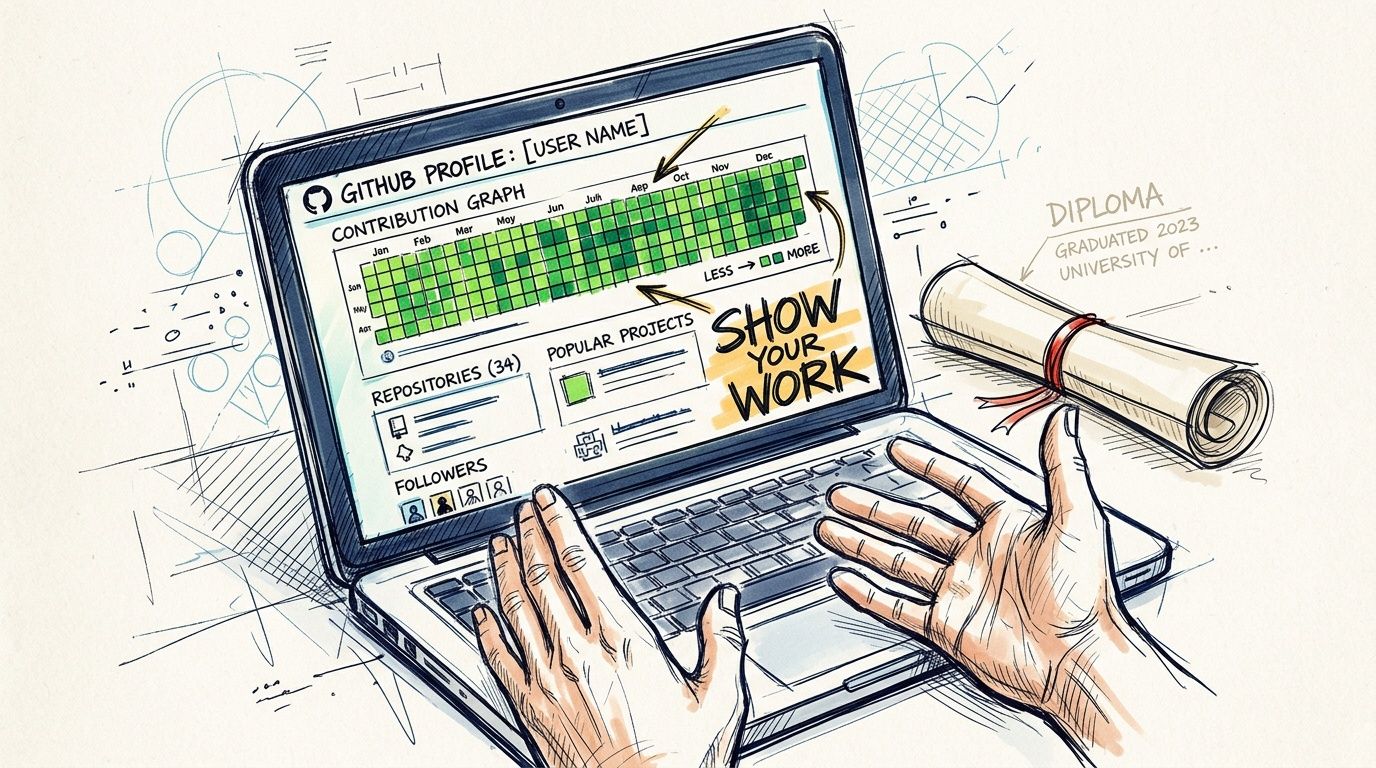
Your portfolio is your proof
A good portfolio says three things fast:
- I can build
- I can explain
- I can finish
That means each project needs more than a repo link. It needs a story. Every serious project should include:
- A clear problem statement: What pain point does this app solve?
- Tech stack choices: Why these tools?
- Setup instructions: Can another developer run it?
- Screenshots or demo link: Reduce friction.
- Challenges and tradeoffs: Show thinking, not just output.
- Next steps: Signal judgment about scope.
Here's a strong README skeleton:
- Project summary
- Live demo
- Features
- Tech stack
- Installation steps
- Architecture or app flow
- Problems you solved
- Future improvements
That structure conveys professionalism. Most juniors skip it. Don't.
Turn old jobs into relevant evidence
This part changes everything for career changers. Stop treating your previous work as dead weight. Translate it.
If you worked in hospitality, you probably handled constant prioritization, customer communication, and fast error recovery. That maps well to triaging bugs, clarifying requirements, and staying calm during incidents.
If you worked in trades, you likely developed process discipline, troubleshooting habits, and respect for systems that break when one detail is off. That sounds a lot like debugging and shipping software without careless mistakes.
If you served in the military, you already understand structured workflows, documentation, operating under pressure, and mission-focused execution. Teams trust those habits.
A few resume reframes:
| Old experience | Better software framing |
|---|---|
| Managed inventory | Worked with tracking systems, accuracy, and process optimization |
| Trained new staff | Onboarded teammates and documented repeatable workflows |
| Led shift operations | Coordinated execution across multiple priorities and stakeholders |
| Resolved customer issues | Diagnosed problems quickly and communicated solutions clearly |
You can also reinforce professionalism with the right supporting sections. This guide on affiliations on a resume is useful if you've joined developer communities, alumni groups from bootcamps, veteran networks, or local coding meetups.
Your old job title doesn't matter nearly as much as the behaviors it proved.
What a no-degree resume should emphasize
A no-degree resume should not apologize. It should redirect attention.
Lead with a compact summary that says what you build, what stack you use, and what kind of roles you want. Then place Projects high on the page. Not buried below years of unrelated work.
A strong order looks like this:
- Summary
- Technical skills
- Projects
- Relevant experience
- Education or training
- Community or affiliations
Under projects, write bullets that sound like work, not homework. Bad bullet: “Created a website using React.” Better bullet: “Built and deployed a React-based inventory dashboard with authentication, searchable records, and responsive layouts.”
Under previous roles, pull forward transferable behaviors:
- ownership
- problem-solving
- process improvement
- team communication
- documentation
- consistency under pressure
You are not pretending your old life was software engineering. You are showing that the traits that made you good there now support your move here.
Landing the Job and Launching Your Career
The first job search is where a lot of capable beginners lose momentum. Not because they lack skill, but because they apply randomly, chase every listing, and let rejection rewrite the truth. Early hiring is messy. Don't take that personally.
Apply like a strategist not a gambler
Target roles where your story makes sense. Junior frontend. Entry-level full-stack. QA with coding exposure. Support engineer roles with scripting. Apprenticeships. Internal tools teams. Smaller companies that care about shipping.
Apply with a system:
- Tailor the summary: Match the role without lying.
- Feature the relevant project first: Put your closest proof near the top.
- Keep a tracker: Role, company, date, response, follow-up, notes.
- Prefer skills-first employers: They're more likely to read your work before filtering your education.
If you want a realistic view of remote work expectations, this guide for aspiring remote engineers is worth a look because it gets into the habits remote teams value. And before interviews, review these practical questions for job interview scenarios so you don't freeze when the conversation turns behavioral.
Talk about your projects with the STAR method
You do not need corporate robot energy in interviews. You do need structure.
Use the STAR method:
- Situation: What problem existed?
- Task: What did you need to build or fix?
- Action: What did you do?
- Result: What changed?
Example:
- Situation: “I used to work with messy shift coordination, so I built a scheduling app around that pain point.”
- Task: “I wanted managers to create shifts and staff to view updates in one place.”
- Action: “I built the frontend in React, added authentication, created CRUD operations, and deployed the app so people could test it.”
- Result: “I learned how to design around real user flow, handle state changes, and improve documentation after feedback.”
That answer works because it sounds like ownership. It doesn't sound like you copied a tutorial and hoped nobody would ask questions.
Your first job is not the finish line
Once you land the role, your degree matters even less. Experience becomes your new credential.
Your first year should be about three things:
- Be coachable: Ask precise questions. Write things down. Don't repeat avoidable mistakes.
- Ship small wins: Fix bugs, improve tests, clean docs, make yourself useful early.
- Keep learning: Read code from stronger developers. Study the stack your team uses. Learn why decisions get made.
You don't need to become a genius overnight. You need to become reliable. Reliable juniors turn into strong mid-level developers faster than flashy juniors who resist feedback.
The big secret is that software careers are built on compounding. One project becomes a portfolio. One portfolio becomes an interview. One interview becomes a job. One job becomes proof. After that, the degree question starts fading into the background where it belongs.
If you're ready to stop guessing and start applying to degree-optional roles, HiredBySkill is a solid place to start. It's built for skills-first hiring, which makes it far easier to find employers who care about what you can do, not just what's printed on a diploma.
Latest jobs
- New Home Consultant — Fletcher Building
- Accountant - Supervisor Level — Bowman & Company LLP
- Service Technician — DAIOHS U S A INC
- Full Charge Bookkeeper — Bowman & Company LLP
- Substitute Administrative Assistant- St. Peter the Apostle Catholic School — St Peter the Apostle Catholic School
- Media Specialist- St Peter the Apostle Catholic School — St Peter the Apostle Catholic School
- Depot Supervisor — DAIOHS U S A INC
- Court Maintenance Worker — Royal Oaks Country Club Houston