How to Make a List of References That Gets You Hired
Learn how to make a list of references that impresses recruiters. Our guide covers choosing referees, formatting, and asking permission, with tips for STARs.
You've done the hard part. You applied, got interviews, answered the tough questions, and then the email lands in your inbox: “Can you send over a list of references?”
A lot of candidates freeze right there, especially if they didn't come up through a neat corporate ladder. If your background includes bootcamps, military service, apprenticeships, freelance work, open-source projects, community leadership, or jobs where your title didn't capture what you did, reference advice can feel weirdly unhelpful.
Good news. Your reference list doesn't need to look traditional to be strong. It needs to be credible, relevant, and easy for a hiring manager to use. That's it. If you're trying to figure out how to make a list of references without a pile of old bosses on standby, you're in the right place.
Table of Contents
- Your Last Big Play to Win the Job Offer
- Choosing Your Champions It's Not Just Old Bosses
- The Art of Asking for a Favorable Reference
- Formatting Your Reference List Like a Pro
- When to Share and How to Protect Your Contacts
- Putting It All Together
Your Last Big Play to Win the Job Offer
Getting asked for references can feel like one more test. It's not. It's the employer asking for final proof that the version of you they liked in the interview is the same version other people have worked with.
That matters even more now because the hiring market has shifted. In 2024, about 45% of organizations stopped requiring a bachelor's degree for some jobs, complementing the 55% that already dropped this bar in 2023. This means virtually all surveyed employers now waive degree requirements for at least some roles, making skills and verified experience more important than ever according to iMocha's skills-based hiring trends.
So when a recruiter asks for references, they're not asking for fluff. They're asking for validation.
If you're a STAR, skilled through alternative routes, this is your moment. Your references can confirm the things a degree used to signal on paper: reliability, problem-solving, communication, follow-through, leadership, technical ability, and whether people trust you when the work gets messy.
Practical rule: Your reference list should not be an afterthought. It should support the same story your resume and interviews already told.
Think of it this way. Your resume starts the argument. Your interview deepens it. Your references close it.
That's why I tell people to treat references as part of the same package as their resume strategy. If you're still tightening the story your application tells, this breakdown of the purpose of a resume helps connect the dots.
A weak list says, “I found three people.” A strong list says, “I chose people who can verify exactly why I should get hired.”
Choosing Your Champions It's Not Just Old Bosses
The worst reference advice on the internet is also the most common: only list former managers.
That's outdated. It punishes anyone whose career path didn't come with tidy org charts and annual reviews. If you learned on the job, in the field, in the military, in a bootcamp, through contract gigs, or by building your own portfolio, you still have professional references. You just need to choose them with intention.
A critical gap in most career advice is who to list as a reference if you lack traditional supervisors. With 35% of skills-based hires coming from non-traditional routes like apprenticeships or bootcamps, it's important to know how to frame instructors, mentors, or team leads as valid professional references to meet the standard 3-5 person requirement, as noted by Insight Global's guidance on professional reference lists.
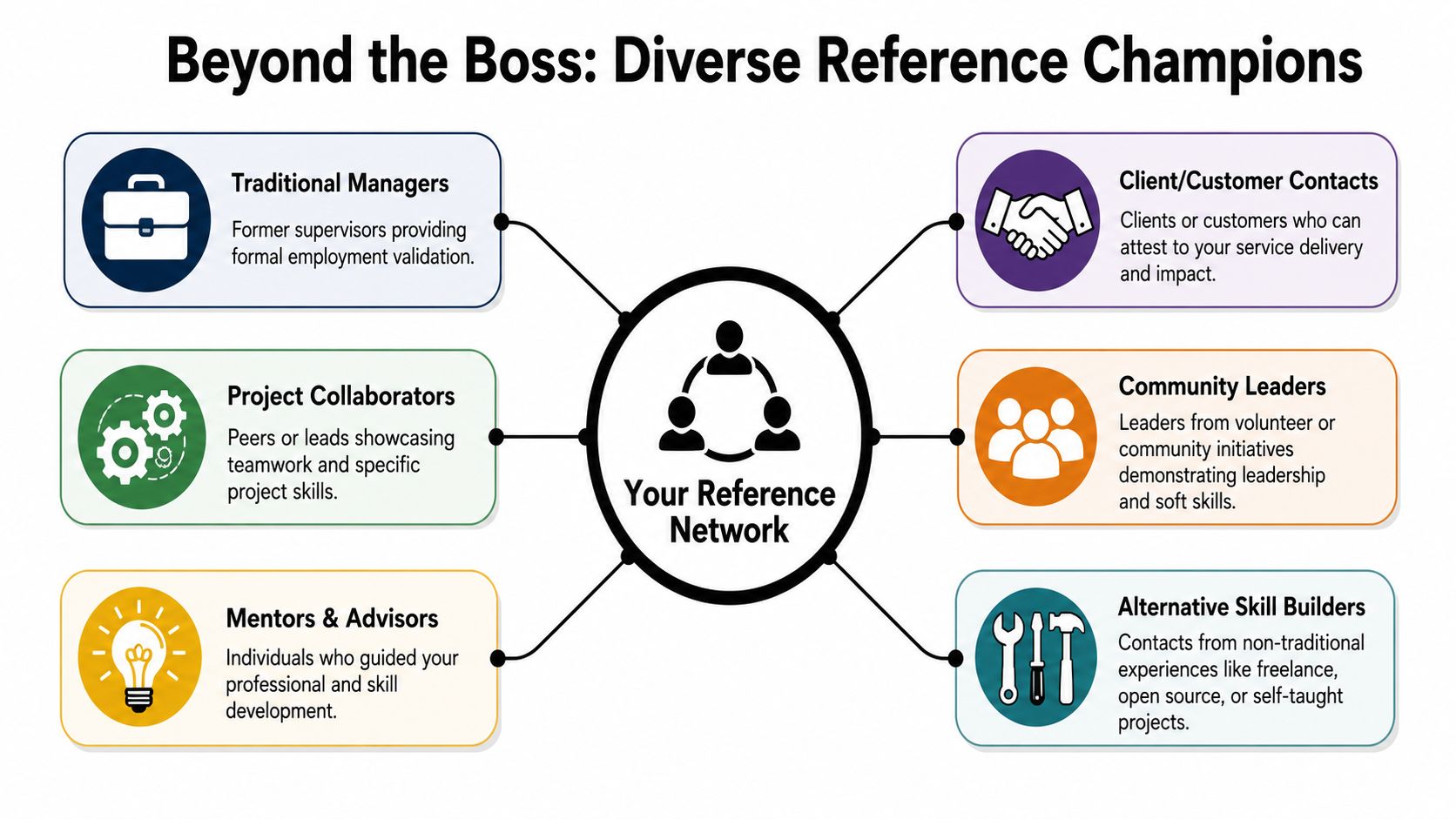
Who counts as a strong reference
Here's my ranking. Not by prestige, but by usefulness.
- Supportive managers first: If you have a former manager who will clearly and enthusiastically back you, use them. They can usually speak to reliability, performance, and how you handled responsibility.
- Project leads and collaborators next: These people are gold for skills-first roles. They saw how you work in real situations, which tools you used, and whether others could count on you.
- Instructors and mentors for skill-building paths: A bootcamp instructor, apprenticeship mentor, or military trainer can be excellent if they directly observed your growth and standards.
- Clients for freelance or service work: A client who can speak to your communication, delivery, and professionalism often says more than a generic boss ever could.
- Community leaders when the work was real: Volunteer organizers, nonprofit leads, and committee heads are valid if they supervised your contribution in a serious setting.
- Professors only when they know your work well: This is especially useful early in your career, but only if they can talk about your performance, not just your attendance.
Who to avoid
Not every familiar name belongs on a reference sheet.
If the person likes you but can't speak to your work, don't use them.
Skip these:
- Personal friends: Even if they mean well, they usually weaken your list.
- Family members: Never. Hiring teams don't consider this credible.
- Big-name contacts who barely know you: A recognizable title won't save a vague recommendation.
- Anyone who sounds lukewarm: Neutral references hurt. Silence would be better.
How STARs should match references to the job
Don't build one generic list and send it everywhere. Match references to the role.
If you're applying for IT support, a bootcamp instructor who watched you troubleshoot systems is stronger than a restaurant manager who only knows you're punctual. If you're moving from retail into operations, a shift lead who saw you train coworkers and handle inventory could be perfect.
This is also why details like memberships and industry ties can support your larger story. If your background includes trade groups, community orgs, or technical associations, this guide on affiliations on a resume can help you position those connections more strategically.
Your references don't need fancy titles. They need relevant stories.
The Art of Asking for a Favorable Reference
Never surprise a reference. Ever.
If a recruiter reaches out before you've talked to the person, you've already made the process harder. People get busy. They forget details. They may say yes out of politeness and then give a flat, forgettable answer.

Ask early and ask clearly
Reach out before the employer asks, ideally when you start interviewing seriously.
Say what role you're pursuing, why you thought of them, and what part of your work together you hope they can speak to. That last part matters. You're not scripting them. You're helping them remember.
Use something like this:
Hi [Name], I'm interviewing for a [Job Title] role and wanted to ask whether you'd feel comfortable serving as a professional reference. I really valued working with you on [project/team/context], especially around [specific skill or contribution]. If you're open to it, I can send the job description, my resume, and a few reminders about the work we did together.
That message works because it's respectful and specific.
Set your references up to win
Once they say yes, send a short prep package. Keep it clean, not overwhelming.
Include:
- The job description
- Your updated resume
- A short note on what you worked on together
- Two or three skills to emphasize
- One or two examples they might remember easily
Here's what that can look like:
- Project reminder: “We worked together during the warehouse system changeover.”
- Skills to highlight: “Training new staff, solving process issues, and staying calm under pressure.”
- Useful example: “You might remember when I rebuilt the shift handoff checklist and reduced confusion across teams.”
That kind of prep also helps you stay consistent with the rest of your hiring story. If you're practicing the narrative you want employers to remember, these common questions for job interviews are worth reviewing before you brief your references.
Ask one question most people skip
Don't just ask, “Can you be a reference?”
Ask, “Can you be a positive reference for me?”
That one extra word matters. It gives people room to decline if they can't strongly recommend you. Better to learn that now than after a recruiter calls them.
A good reference confirms facts. A great reference adds confidence.
And when someone says yes, thank them like you mean it. Then keep them updated. If they helped you get to the offer stage, let them know what happened.
Formatting Your Reference List Like a Pro
Presentation counts. A messy reference list tells an employer you threw it together in five minutes. A clean one says you're organized and ready.
The format is simple. Don't overcomplicate it.
A properly formatted reference sheet should include for each reference: name, current job/position, company, phone number, email address, and a one-sentence description of your relationship. The candidate's own contact information should be at the top. This simple structure demonstrates professionalism and helps expedite the final hiring stages, based on The Muse's reference sheet template advice.
What to put on the page
At the top, list your own:
- Full name
- Phone number
- Email address
- City and state if you want
Then list your references beneath that in a consistent format. Most companies will ask for two or three references, so have at least three ready. If one person is traveling, misses calls, or responds slowly, you don't want your hiring process stalled.
What you do not need in most cases is your reference's home address. It's unnecessary and a bit peculiar for regular hiring situations.
Sample reference list entry
| Field | Example |
|---|---|
| Name | Jordan Lee |
| Current Job/Position | Operations Supervisor |
| Company | Northline Logistics |
| Phone Number | (555) 123-4567 |
| Email Address | jordan.lee@email.com |
| Relationship Description | Supervised my work on the evening shift at Northline Logistics from 2022 to 2024, including inventory control and team training. |
A simple template you can copy
Use this structure in a Word doc or Google Doc, then save it as a PDF:
- Your name and contact info at the top
- Reference 1
- Reference 2
- Reference 3
- Optional extra references for backup
Keep the relationship line to one sentence. You're trying to help the recruiter understand why this person matters, fast.
Clean formatting signals respect for the reader's time.
Format choices that make you look sharper
A few easy wins:
- Match your resume header: Use the same name, font style, and contact formatting so your materials feel like one package.
- Use professional file names: Something like
FirstName_LastName_References.pdfworks. - Check current titles: Don't assume your contact still works where they did when you knew them.
- Proofread every line: One wrong digit in a phone number can delay the process.
If you're deciding how this should align with the rest of your application materials, this comparison of a chronological vs functional resume can help you keep the whole package consistent.
The best reference sheet is boring in the right way. Easy to read. Easy to forward. Easy to trust.
When to Share and How to Protect Your Contacts
Let's retire one old line for good: “References available upon request.”
You don't need it on your resume. Employers already assume you have references. That line wastes space you could use for skills, results, certifications, or tools.
Share your reference list only when an employer asks, usually after they've interviewed you and have real interest. That keeps your contacts from getting random calls and protects your network from unnecessary exposure.
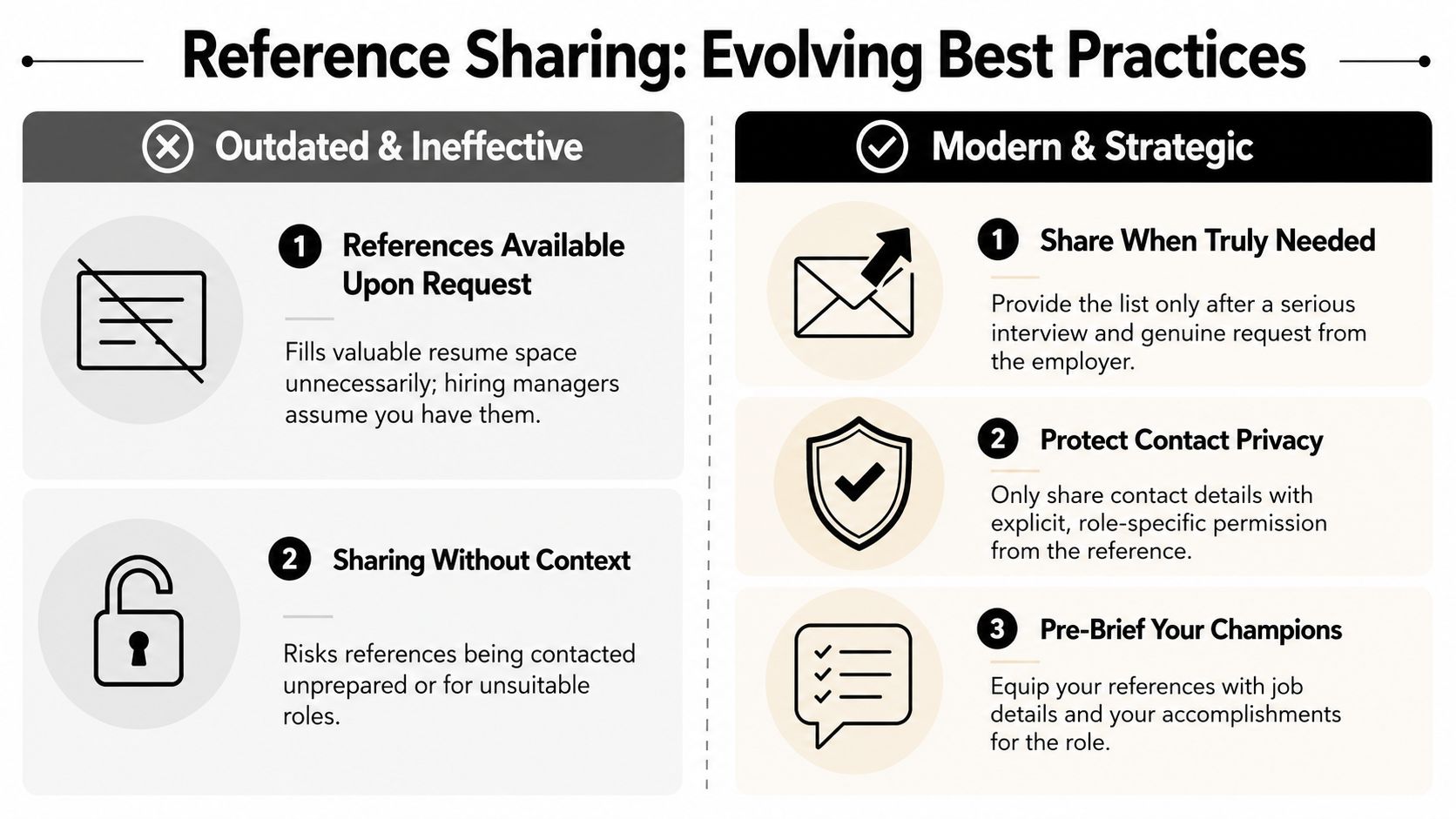
Why privacy matters now
This part gets ignored way too often. In the last year, there has been a 60% rise in AI-scraped harassment targeting job-seeker reference lists. Modern reference guides must address this by advising candidates on privacy protocols, such as adding verification notes or using LinkedIn introductions, to protect their contacts' data from being exposed, as discussed in this video on modern reference privacy risks.
That means your job isn't just making a list. It's sharing it responsibly.
A few smart moves:
- Add context to the document: A short line like “Contact details shared for reference checking related to the [Job Title] role at [Company Name]” sets expectations.
- Use role-specific sharing: Don't blast the same PDF all over the internet.
- Offer a LinkedIn intro first: For some references, that's cleaner than handing out direct contact details broadly.
- Confirm consent each time: If months have passed, ask again before sharing.
Vet who's asking
Recruiters and hiring managers are normal. Scammers are also normal now.
Before you send any reference list, check the company website, the recruiter's email domain, and the person's public professional profile. If you want a practical way to review what's visible online before sharing contact details, PeopleFinder's 2026 social media guide is useful for spotting what personal and professional information is easy to surface.
Here's a quick gut-check. If the hiring process feels rushed, vague, or inconsistent, pause before sending your references into it.
A lot of employers also care about coachability and growth, especially for skills-first roles. If that's part of your pitch, this article on willingness to learn can help you present that trait more clearly before references ever enter the conversation.
A short video can help if you want to see the broader etiquette around timing and sharing:
Protecting your references is part of being a professional. People remember when you handle their information carefully.
Putting It All Together
A reference list isn't paperwork. It's your closing argument.
The strongest version of how to make a list of references is also the simplest one. Choose people who can speak directly to your skills. Ask for permission early. Prep them well. Format the document cleanly. Share it only when it's needed.
If you're a STAR, don't let old-school advice box you out. You do not need a perfect chain of former managers to look credible. You need thoughtful advocates who can confirm how you work, how you learn, and why you're worth hiring.
That's what employers are checking at the finish line. Not whether your path looked conventional. Whether your experience holds up when real people talk about it.
Save the PDF. Keep a backup list. Update titles and contact info every time you job search.
Then send it with confidence.
If you're targeting degree-optional roles and want a better place to search, HiredBySkill is built for candidates who lead with skills, certifications, military experience, apprenticeships, bootcamps, and real-world results instead of a four-year degree.
Latest jobs
- Personal Support Worker — Bayshore
- Case Manager — Bayshore
- Nurse Tech/Unit Secretary - Cardiac/Telemetry - Part Time Days — Williamson Health
- Senior Data Engineer — Sightly Enterprises, Inc.
- Compliance Manager — Lodestar Claims & Risk Services
- Retail Field, Low Voltage &/Or Networking Technicians — Mobile Technologies Inc.
- Senior Claims Specialist - Workers Compensation — Lodestar Claims & Risk Services
- Initiativbewerbung (m/w/d) – Werde Teil unseres HORIZONT-Teams! — HORIZONT e.V.